
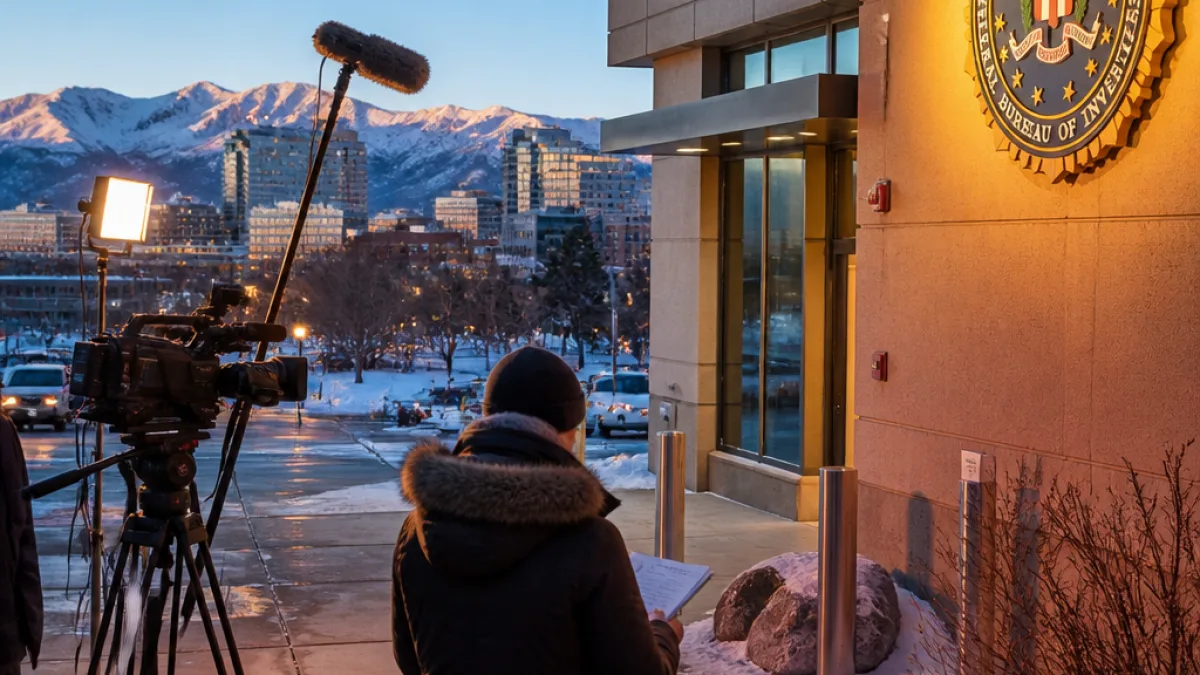
The FBI Anchorage Field Office has begun a monthly interview series aimed at giving Alaskans a clearer view of federal law enforcement work across the state, officials announced this week. The initiative, produced with Alaska’s News Source, will address violent crime trends, drug trafficking — including cartel fentanyl pipelines — and other public safety priorities.
New outreach as crime rates fall
Special Agent in Charge Matthew Schlegel, who took command of the Anchorage Field Office in April, and Public Affairs Officer Chloe Martin described the series as an effort to improve transparency and rebuild trust between the bureau and local communities. Schlegel said the format will allow the FBI to explain how federal investigations fit alongside state and local efforts.
“I’ve now been on the ground for just over six months. And it does take a minute to understand the differences in Alaska to Lower 48 and make sure we’re delivering for the communities here,”
The series arrives as national and Alaska data show reductions in several violent-crime categories. The FBI’s 2025 Uniform Crime Report data cited by the office indicate:
- Violent crime fell by more than 9% nationwide.
- Murders dropped by over 18% nationally.
- Alaska recorded an 11.8% decline in murder and nonnegligent manslaughter.
- Alaska also saw a 4.5% decline in reported rape.
| Measure | Nationwide change (2024–2025) | Alaska change |
|---|---|---|
| Violent crime | Down >9% | — |
| Murder/nonnegligent manslaughter | Down >18% | Down 11.8% |
| Rape | — | Down 4.5% |
What the bureau says it will do
Schlegel emphasized that even with encouraging declines, federal agents will continue to work closely with state and local partners. He framed the drop in violent crime as an outcome that requires continued attention and coordination to sustain.
“What it also does is tell us that we just have to keep working with our partnerships, both state and local ... take some of what the best learned practices from the Lower 48 and things that work to really drive down those numbers,”
Public Affairs Officer Chloe Martin said the series seeks to demystify federal casework and to show residents what the bureau handles from its downtown Anchorage office. She said the conversations will include concrete actions the FBI and partners are taking to protect the public, and will make room for questions about investigations and priorities.
Local implications and continuing challenges
For Anchorage residents, the regular briefings could mean greater clarity on how federal investigations intersect with municipal policing and state law enforcement efforts. They may also provide a forum for community concerns about violent crime and drug supply lines, including organized traffickers who move fentanyl into Alaska.
Officials did not present a comprehensive list of upcoming topics beyond the broad priorities discussed in the initial interview. But the combination of falling homicide and sexual assault reports with the bureau’s renewed public outreach signals a twofold approach: sustain recent progress in reducing violent crime while concentrating resources on persistent threats such as illicit fentanyl distribution.
Schlegel’s remarks reflect an awareness of Alaska’s distinct operational environment and the need to adapt federal strategies accordingly. He acknowledged the value of local partnerships and said the field office will continue to emphasize coordination to protect communities statewide.
The FBI’s monthly series will be broadcast through Alaska’s News Source and is expected to include regular updates on crime statistics, investigative priorities and collaboration with state and local agencies. Residents can monitor the series for details on specific cases and initiatives affecting Anchorage and the rest of the state.
Contact: The FBI Anchorage Field Office public affairs office is the point of contact for scheduling and follow-up questions related to the series.
















