
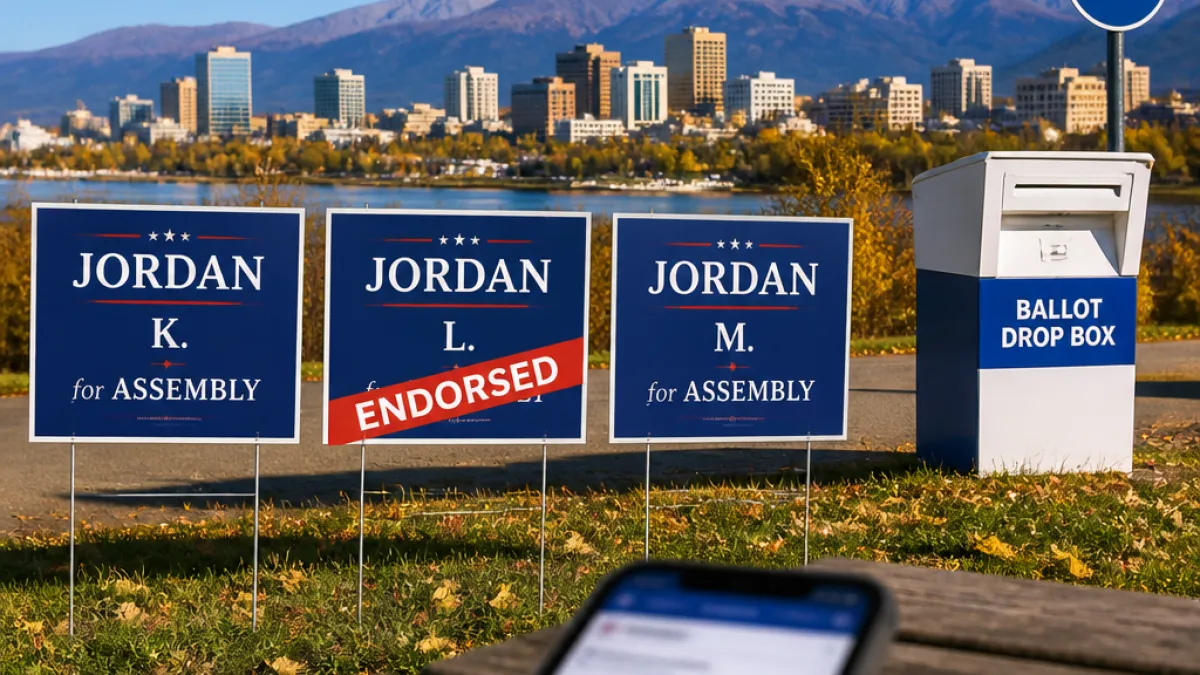
Anchorage — The contest for Alaska’s U.S. Senate seat has taken another strange turn as a former Anchorage mayor who is also named Dan Sullivan publicly endorsed Republican incumbent Dan S. Sullivan over a challenger who bears the same name.
Endorsement from a fellow Dan Sullivan
On Tuesday, former Anchorage Mayor Dan A. Sullivan urged Alaskans to back Sen. Dan S. Sullivan for re-election and to reject retired teacher Dan J. Sullivan, whose presence on the ballot has focused national attention on the race. The former mayor posted on Facebook:
“As the OG Dan Sullivan, I urge Alaskans to vote for Sen. Dan S. Sullivan. He’s been great for Alaska.”
The endorsement from Dan A. Sullivan — who served as Anchorage mayor from 2009 — adds to a flurry of public statements and allegations that have made the campaign one of the more unusual and closely watched Senate races this election cycle.
Primary results and continuing count
Following Alaska’s all-party primary, the top four finishers advance to the general election under the state’s ranked-choice voting system. With some primary votes still being counted, former U.S. Rep. Mary Peltola led the field with about 48% of the reported vote, while Sen. Dan S. Sullivan trailed with about 43%, according to partial returns. The two have already secured advancement to the general election.
| Candidate | Reported share (primary) |
|---|---|
| Mary Peltola | 48% |
| Dan S. Sullivan (incumbent) | 43% |
| Dan J. Sullivan | 2.4% |
Allegations, legal fights and investigations
The presence of Dan J. Sullivan on the ballot prompted immediate accusations from some Republicans that the retired teacher was placed in the race to confuse voters and dilute support for Sen. Dan S. Sullivan, potentially aiding Peltola. Dan J. Sullivan has denied coordinating with Peltola’s campaign, and Peltola has denied any role in placing him on the ballot.
The state Division of Elections initially disqualified Dan J. Sullivan, but the Alaska Supreme Court ruled last month that he could remain on the ballot. NBC News has reported that state and federal prosecutors in Alaska were investigating whether the campaign included elements of a conspiracy intended to confuse voters.
Why this matters
Alaska’s Senate race is among those national strategists are watching closely. Control of the U.S. Senate is at stake this cycle, and the Cook Political Report rates the contest a tossup. The unusual scenario of multiple candidates with the same name has amplified attention on vote counts, ballot positioning and the mechanics of ranked-choice voting.
- Ballot confusion: Voter mistakes or name recognition effects could influence a close contest.
- Legal precedent: The Alaska Supreme Court decision affirmed ballot access for Dan J. Sullivan, affecting the field for November.
- Investigations: Prosecutors have queried whether the candidacy was part of a broader scheme to influence results.
Implications for voters
With the general election set for Nov. 3, Alaskans will face a ranked-choice general election that will require voters to rank candidates rather than select just one. If no candidate receives a majority of first-choice votes, the ranked-choice process will redistribute votes from the lowest-ranked candidates until one achieves a majority.
Campaign watchers say that in a tight race, small percentages can swing outcomes if voters fail to complete rankings or if votes are split among candidates with similar names. The primary showed how even a small vote share — Dan J. Sullivan had about 2.4% in the early returns — can feed speculation about strategic effects in a close contest.
What’s next
All-party primary tallies continue to be finalized, and attorneys and election officials have been monitoring developments following the Supreme Court ruling. Both campaigns and outside groups are expected to heighten outreach efforts as the race moves to the November general election.
National attention and continued scrutiny from investigators mean the race will remain under a microscope in the weeks ahead, as Alaskans prepare to weigh their choices in what has become one of the most scrutinized Senate contests in the country.
Erik Lindgren covers state politics for WE NEWS.

















