
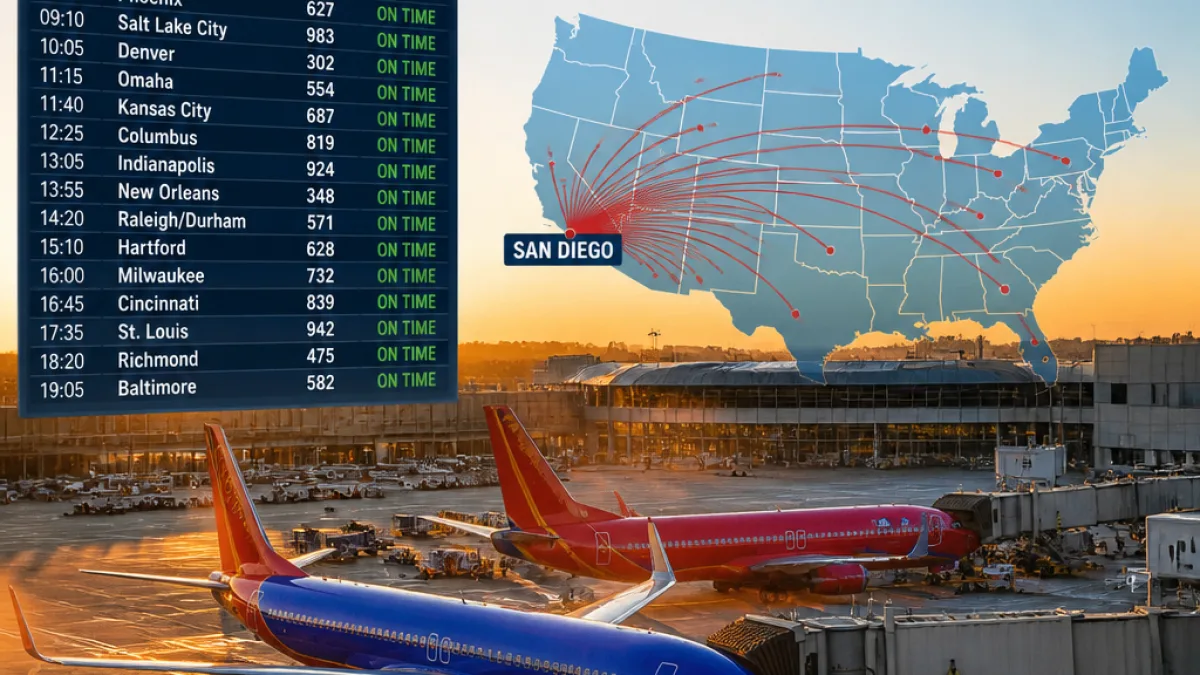
San Diego — Two major U.S. carriers dramatically expanded service at San Diego International Airport in 2026, launching a combined 17 new nonstop routes and boosting total seat capacity by about 4.4 million seats. The moves mark a significant escalation in competition on routes from the California airport and reflect broader shifts in airline network strategy.
Rapid network growth and overlapping service
Alaska Airlines introduced six routes from San Diego in 2026, while Southwest Airlines rolled out 11 new nonstops. The additions include a mix of restored markets and brand new links: for Alaska, cities such as Tulsa, Dallas/Fort Worth and the long-awaited return of Loreto, Mexico after a two-decade absence; for Southwest, destinations like Boston, Fort Lauderdale and Kahului on Maui.
Alaska deployed a mix of Embraer 175 regional jets and Boeing 737 aircraft to serve its new routes, while Southwest relied primarily on its 737 MAX fleet. Year-over-year seat counts rose substantially at both carriers: Alaska recorded roughly a 35% increase in seats, and Southwest about 20%, according to the carriers’ reported network adjustments.
Competitive dynamics at San Diego International
The twin expansions have set up direct head-to-head service on many city pairs. Together the two airlines now meet directly on 29 routes from San Diego. That overlap is intensifying competition on pricing, schedules and flight frequencies as both carriers seek to secure market share.
Southwest has emerged as the dominant operator in terms of seat share at the airport, now accounting for about 37% of total capacity. The airline’s growing presence — combined with Alaska’s aggressive additions — creates pressure on yield and requires careful operational planning to maintain profitability while meeting demand.
Questions about sustainability and network strategy
Industry observers note the expansions reflect a departure from strictly low-cost or legacy models toward a more hybrid approach. For both carriers, long-term success on the added routes will hinge on sustained passenger demand and operational efficiency, including aircraft utilization, crew scheduling and gate availability at the constrained San Diego facility.
Air service restorations such as Loreto’s return after roughly 20 years illustrate how airlines balance seasonal leisure demand with year-round business travel markets. The new transcontinental and leisure-focused flights indicate carriers are betting on continued appetite for point-to-point travel.
Implications for travelers and local stakeholders
Passengers could see more nonstop options and potentially lower fares on overlapping routes as Alaska and Southwest compete. At the same time, airport authorities and regional planners will need to monitor impacts on terminal congestion, ground operations and public transportation links supporting air travelers.
- Service additions: 17 new nonstop routes combined (Alaska 6, Southwest 11).
- Seat capacity boost: roughly 4.4 million additional seats across the two carriers.
- Direct competition: carriers now overlap on 29 San Diego routes; Southwest holds about 37% seat share at SAN.
| Carrier | New routes from San Diego | Reported seat change YoY |
|---|---|---|
| Alaska Airlines | 6 (includes Tulsa, DFW, Loreto) | +35% |
| Southwest Airlines | 11 (includes Boston, Fort Lauderdale, Kahului) | +20% |
For San Diego’s travel market, the expansion should widen nonstop choices to both leisure and business destinations, including transcontinental points and popular vacation islands. Local tourism entities are likely to welcome new service to Maui and Mexican resort gateways, while business travelers may benefit from added frequencies to hub cities.
Outlook
How durable the new routes prove will depend on passenger loads across seasons and each carrier’s ability to match capacity to demand without eroding yields. As airlines continue to refine their networks after pandemic-era disruptions, further adjustments are possible: frequency tweaks, seasonal suspensions or additional markets could follow if results differ from projections.
For travelers in Alaska and the broader West, Alaska Airlines’ ongoing network moves remain notable because the carrier’s strategy affects short- and long-haul connectivity across the region. Observers will watch whether the intensified rivalry at San Diego becomes a template for similar market battles elsewhere.
— Erik Lindgren, State Correspondent
















