Washington: US President Donald Trump signed an executive order on Thursday directing the interior secretary to rename Lake Ontario as "Lake America" as part of a widening dispute with Canada that has seen the United States impose heavy tariffs on Canadian exports.
Action coincides with new tariffs
The directive came as the United States announced a 50 per cent tariff on $28 billion worth of Canadian goods after talks between the two countries broke down, according to reporting. The move marks a striking escalation in rhetoric and measures between two long-standing allies.
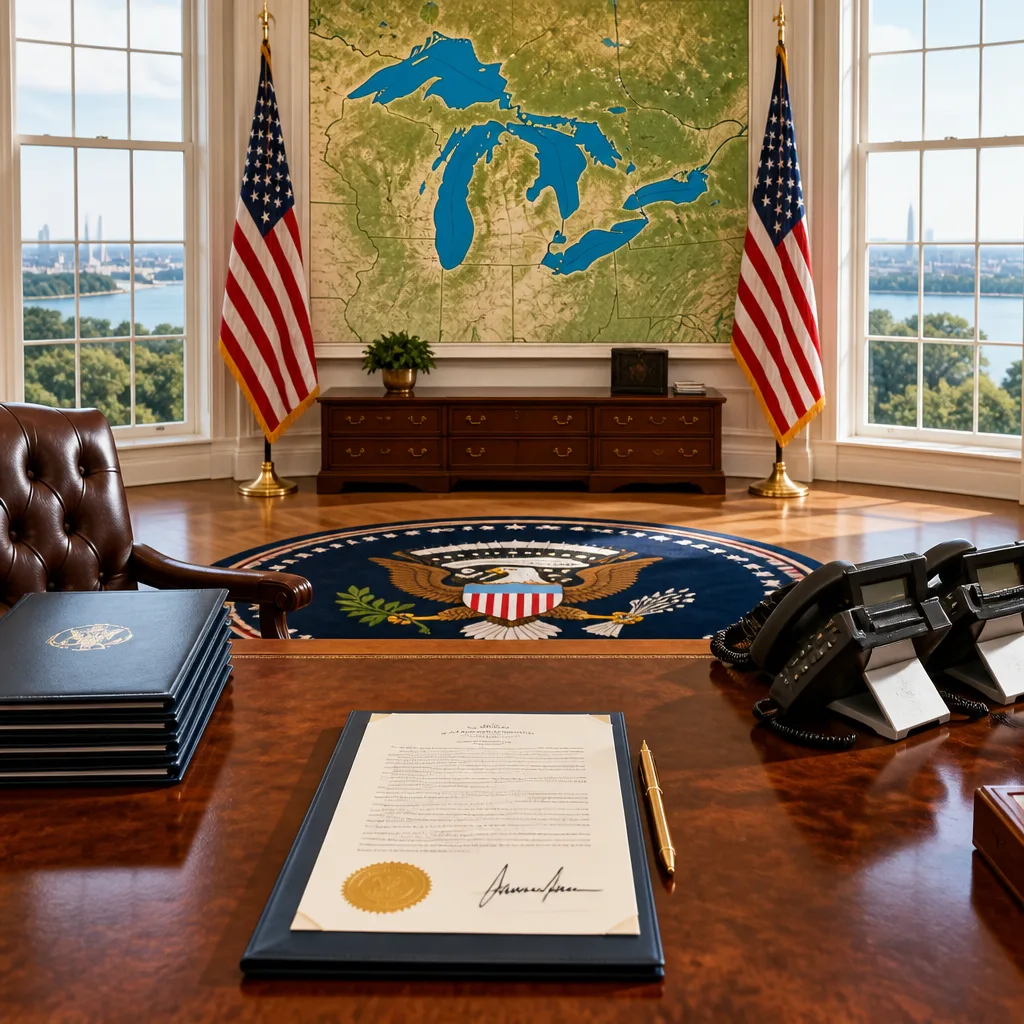
Speaking in the Oval Office with a map behind him labelled "Lake America", the president accused Canadian officials of mistreating the United States and repeated assertions that the neighbour was taking advantage of Washington. He said Canada had been "entitled" and suggested it should not be treated as an equal in negotiations.
"They want to be treated like a state, but they are not a state," the president said.
Rhetoric, map and wider implications
The renaming order follows several public provocations by the president towards Canada since his return to office. In recent days he has publicly suggested the idea that the northern neighbour might be absorbed as a 51st state, comments that have further strained relations.
Observers say the combination of symbolic measures and large-scale tariffs risks deepening diplomatic tensions, complicating cooperation on security and trade between two close partners. The administration framed the actions as responses to what it described as unfair treatment by Canadian officials in bilateral talks.
- Executive order: Directs the interior secretary to rename Lake Ontario to "Lake America".
- Tariff action: 50 per cent tariff on $28 billion of Canadian goods announced after failed talks.
- Rhetoric: President called Canadian officials "entitled" and said they had "treated us very badly".
Responses and disputes
Canadian officials have not been quoted in the initial reporting carried with the story, and the White House presented the action as a response to an unfavourable negotiating posture. The reporting also notes that the president's top trade negotiator has disputed a Canadian assertion that the United States made last-minute demands during the talks, signalling competing versions of what went wrong in negotiations.
Diplomats and trade experts typically view water-body names and cartographic changes as matters requiring bilateral or multilateral agreement; an executive order unilaterally relabelling a shared lake is likely to provoke legal and political pushback, even if primarily symbolic. The practical implications for maps, navigation and international law remain unclear from the initial reports.
International and regional context
The move represents an unusual escalation between two countries with deep historical, security and economic ties. Canada and the United States share the world’s longest undefended border and are major trading partners; abrupt policy shifts and heavy tariffs on tens of billions of dollars in trade could reverberate across supply chains.
| Measure | Detail |
|---|---|
| Tariff rate | 50% |
| Value of goods targeted | $28 billion |
| Geographic target | Canada |
For India, disruptions between two major economies could have indirect effects on global markets, supply chains and multilateral trade rules. Indian exporters and policy-makers watch major bilateral trade disputes closely as they can influence negotiations, tariff precedents and global norms governing cross-border commerce.
At this stage, the United States has formalised the name-change directive internally, while the broader international response and any reciprocal measures from Ottawa remain to be reported. The dispute is likely to attract close diplomatic attention in capitals around the world given the unusual mix of symbolic provocation and substantive trade penalties.
Reporting also noted that media images showed the president speaking with a map behind him that displayed the new name, underscoring the administration's intention to make the matter highly public.