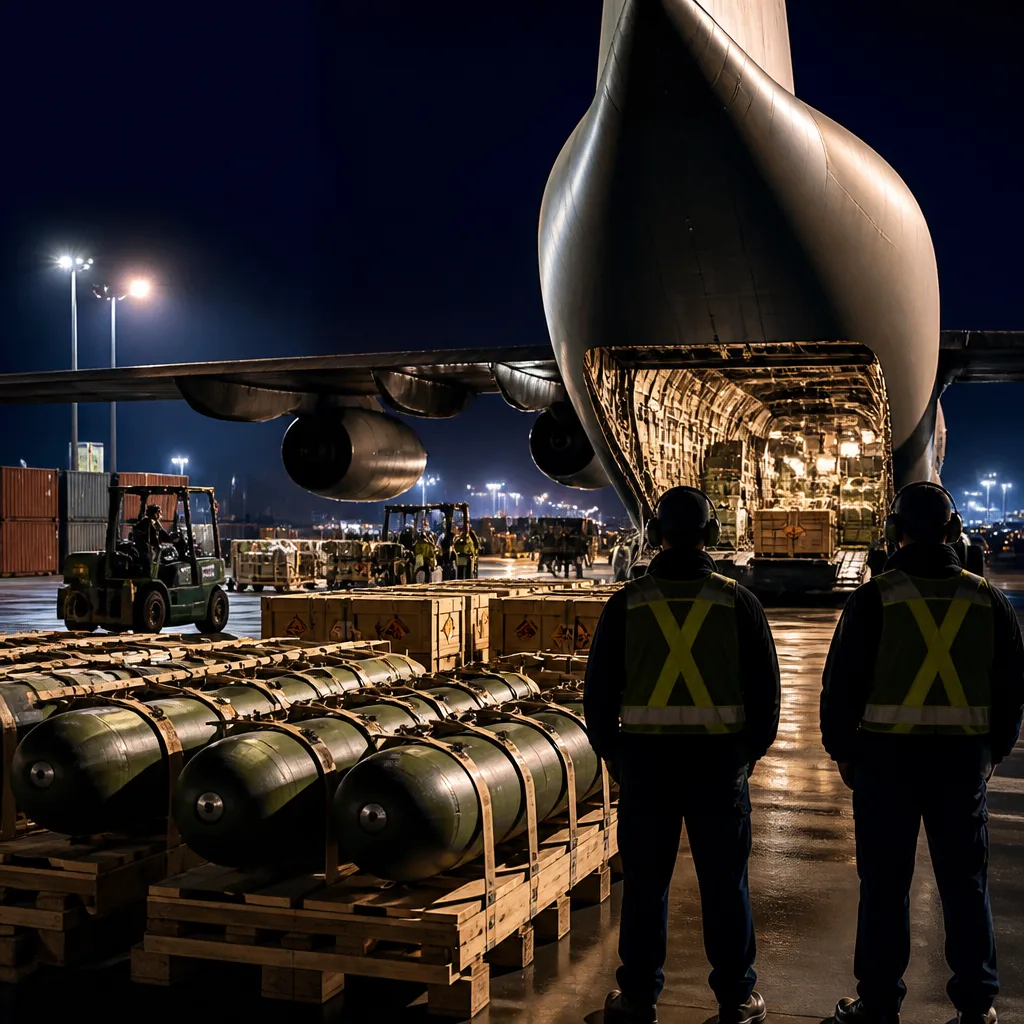
The Trump administration has approved a $2.8 billion arms package for Israel that, according to US media reports, includes a total of 40,000 one‑ton bombs and 20,000 I‑2000 penetrator warheads, in one of the largest munitions clearances for Israel in recent years.
Details of the proposed sale
The package, reported by The New York Times and The Washington Post and corroborated by Reuters citing a US official, would comprise 20,000 MK‑84 bombs and 20,000 BLU‑117 bombs, each weighing 2,000 pounds. The I‑2000 penetrator warheads are designed to penetrate soil, rock and concrete before detonation, according to the reporting.
| Item | Quantity |
|---|---|
| MK‑84 bombs (2,000 lb) | 20,000 |
| BLU‑117 bombs (2,000 lb) | 20,000 |
| I‑2000 penetrator warheads | 20,000 |
Process and timing
The New York Times reported that the State Department recently sent the proposed deal to congressional committees for an informal review. US administrations are able to advance certain large foreign arms sales under emergency authorities, the reports noted, and production and delivery would typically take months or years though processes can be accelerated.
“Foreign arms sales are moving through the appropriate process,” an administration official told AFP, according to reporting.
When approached, a State Department spokesperson said the department “does not comment on proposed sales before formal notification to Congress,” as cited by the media.
Humanitarian and diplomatic concerns
The reported clearance comes as Israel’s use of 2,000‑pound bombs in Gaza and Lebanon has been the subject of scrutiny by human rights groups and some governments. The New York Times and other outlets reported that critics have questioned the humanitarian impact of such powerful conventional munitions in densely populated areas.
- Human rights groups and several governments have criticised the use of heavy ordnance in populated territories, citing civilian harm.
- Officials and analysts warn that deployment of penetrator warheads can increase the risk of damage to underground infrastructure and civilian shelters.
- Production and delivery timelines mean that even an approved sale may be fulfilled over an extended period.
While the reporting cites unnamed US officials familiar with the deal, formal congressional notification would typically follow before a sale is finalised. The balance between strategic partnership, regional stability and humanitarian risk is likely to shape the congressional and international response.
Regional and global implications
Large munitions sales to Israel are closely watched in capitals across the Middle East and beyond. Observers note that a major US shipment — or the approval to procure such weapons — can affect military calculations, diplomatic messaging and humanitarian debates in the region. The reports did not indicate an immediate shipment schedule.
For India, which monitors shifts in US policy and arms transfers for both strategic and diplomatic reasons, the sale is relevant as part of wider trends in US defence exports and Middle East stability. India maintains defence and diplomatic ties with multiple powers in the region and follows developments that could influence security, energy and humanitarian conditions.
At the time of reporting, the State Department had not issued a formal comment on the sale. Media outlets reporting the approval include The New York Times, The Washington Post and Reuters, with AFP also cited on procedural remarks.
Given the size and nature of the munitions involved, the proposed package is expected to prompt scrutiny from human rights groups and debate in congressional and diplomatic circles as formal notifications proceed.