Ahmedabad, Indian scientists have used infrared observations from the Emirates Mars Mission’s Hope spacecraft to map how temperatures and atmospheric waves vary across two of Mars’ largest impact basins, revealing extreme daily and seasonal swings and new clues to the Red Planet’s circulation.
Observations and scope
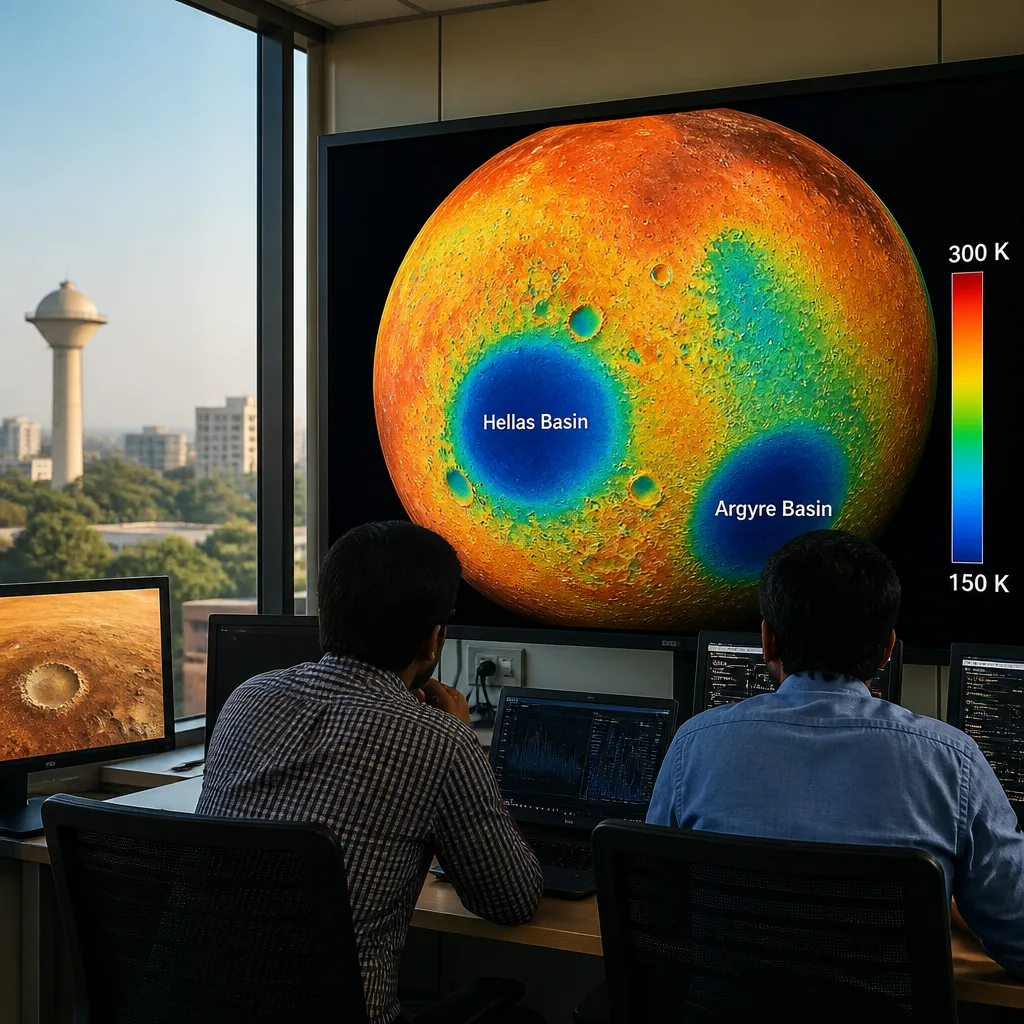
The study, published in Current Science, analyses data from the Emirates Mars Infrared Spectrometer (EMIRS), an instrument that measures infrared radiation from the Martian surface and atmosphere. Scientists at the Physical Research Laboratory (PRL), Ahmedabad, examined EMIRS observations over the Hellas and Argyre basins to characterise temperature variability and large-scale wave patterns that drive atmospheric motion.
Key findings: extremes and drivers
The analysis shows very large surface temperature ranges across the studied regions. Temperatures recorded span roughly 150 Kelvin (-123°C) at the coldest up to almost 295 Kelvin (22°C) at the warmest. Seasonal extremes are sharper on Mars than on Earth, with summer values in some places approaching 300 K (≈27°C) and winter lows near 160 K (-113°C).
Two factors underpin these extremes:
- Very thin atmosphere: Mars’ sparse air cannot store or redistribute heat effectively, so surfaces warm quickly in sunlight and lose heat rapidly after sunset.
- Orbital eccentricity: Mars has a noticeably elliptical orbit and reaches perihelion (closest approach to the Sun) during southern summer, making southern summer markedly warmer—by about 25 K in some regions—than the corresponding northern season.
Wave patterns and atmospheric circulation
Beyond straightforward seasonal warming and cooling, the researchers report that temperatures form large-scale organised patterns that reflect the planet’s atmospheric dynamics. These wave-like variations are important because they help redistribute energy and momentum across the planet and influence local weather over basins and surrounding terrain.
Mapping these waves over prominent basins gives insight into how topography interacts with the thin Martian atmosphere, and how that interaction shapes temperature gradients and circulation cells that can affect dust transport, local winds and the thermal environment encountered by landers and rovers.
| Parameter | Approximate range from study |
|---|---|
| Surface temperature (cold) | ~150 K (-123°C) |
| Surface temperature (warm) | ~295 K (22°C); peaks near 300 K in summer |
| Extreme winter lows noted | ~160 K (-113°C) |
Why this matters
Understanding how Mars “breathes” — the way temperatures rise, fall and ripple across the surface — matters for several reasons. First, it refines models of Martian atmospheric circulation, improving forecasts of wind, dust storms and near-surface conditions. Second, detailed thermal maps help mission planners select landing sites and design thermal protection and power systems for landers and rovers that must cope with rapid temperature changes. Third, the results illustrate how regional topography, such as large impact basins, interacts with global seasonal forcing to produce local climates that can differ substantially from planetary averages.
The study also underscores how international missions and instruments such as EMIRS can produce datasets analysed by teams worldwide, including Indian researchers, to produce new insights into planetary climates.
While the findings advance our empirical picture of Martian temperature variability, the authors note that Mars’ thin atmosphere and complex orbital geometry introduce caveats: local conditions can change rapidly and observations over wider regions and longer time intervals remain necessary to fully constrain seasonal and interannual variability.
The results add a new observational layer to the growing body of knowledge about Mars’ dynamic environment, with direct application to scientific studies and operational planning for future missions to the Red Planet.