GANDHINAGAR: The Institute for Plasma Research (IPR) in Gujarat has commissioned a high-power heating system at the Steady State Superconducting Tokamak-1 (SST-1), an installation officials say will strengthen India’s experimental fusion research.
New heating capability
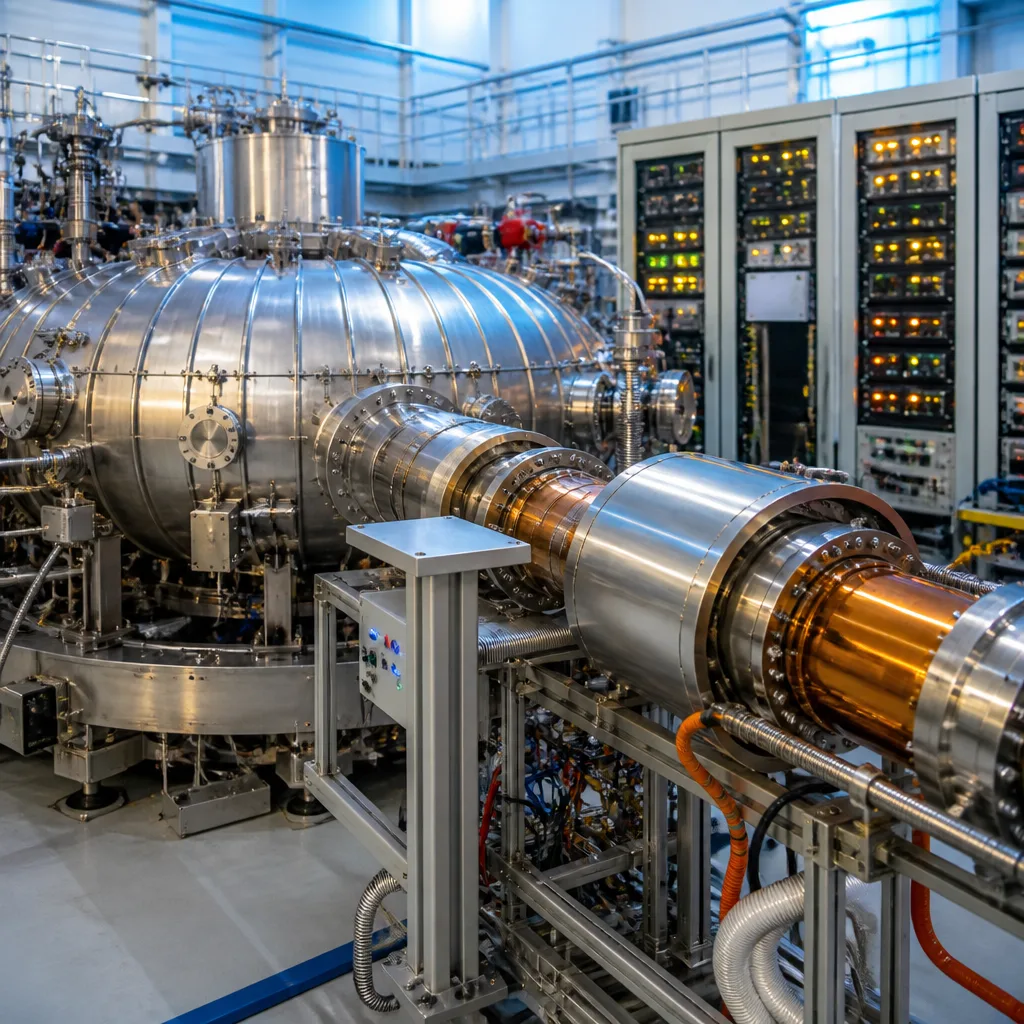
IPR has installed and integrated an 82.6 GHz, 400 kW gyrotron with SST-1. The device can deliver up to 400 kW of radio-frequency power and is being employed for electron cyclotron resonance heating experiments on the tokamak, according to the institute.
Fusion research aims to recreate on Earth the same energy-producing process that powers the Sun by bringing light atomic nuclei together inside extremely hot, electrically charged gas called plasma. Creating temperatures and conditions for fusion is only part of the challenge; heating, controlling and confining the plasma long enough to study its behaviour are equally critical.
Why the gyrotron matters
The newly commissioned gyrotron provides a concentrated source of microwave energy tuned to the electron cyclotron frequency, allowing researchers to heat electrons directly and influence plasma stability and confinement. Such targeted heating helps in:
- raising plasma temperature efficiently,
- driving current and tailoring plasma profiles, and
- studying instabilities that can limit performance in tokamaks.
IPR has previously reported producing plasma temperatures exceeding 200 million degrees Celsius on SST-1 — far higher than the Sun’s core — but sustaining and controlling such plasmas requires complementary systems like high-power gyrotrons.
Technical context and research aims
SST-1 is a doughnut-shaped superconducting tokamak designed to investigate magnetically confined plasmas under steady-state or long-duration conditions. Magnetic fields keep the hot plasma away from the machine walls while auxiliary systems, including neutral beam injectors and radio-frequency sources, heat the plasma and influence current distribution.
The gyrotron at 82.6 GHz has been integrated into the SST-1 experimental setup to perform electron cyclotron resonance heating experiments. These experiments are used not only to raise temperature but also to study how energy and particles move within the plasma and how various modes of instability develop and can be suppressed.
| Parameter | Value |
|---|---|
| Frequency | 82.6 GHz |
| Maximum power | 400 kW |
| Application | Electron cyclotron resonance heating on SST-1 |
Implications for India’s fusion programme
The addition of this high-power gyrotron represents an incremental but important capability upgrade for SST-1. It broadens the experimental parameter space available to researchers and helps bridge experiments on India’s tokamak with international fusion science goals, including understanding heating and control methods that will be vital for larger devices and eventual reactor designs.
While heating systems can raise temperatures, achieving net energy from fusion requires simultaneous success on confinement, stability and fuel handling — long-term challenges that demand sustained experimental campaigns and coordinated engineering advances. The new gyrotron will enable more detailed studies of electron-scale processes and offer a controlled way to test mitigation strategies for plasma instabilities.
Researchers at IPR will now conduct a series of experiments using the gyrotron to characterise heating efficiency, evaluate effects on plasma profiles and test active control techniques. Results from these experiments will inform both SST-1 operations and broader programme planning.
In sum, the commissioning of the 82.6 GHz, 400 kW gyrotron at SST-1 provides India’s fusion programme with a dedicated tool for heating and control experiments — a step forward on the long road toward practical fusion energy, according to the institute.