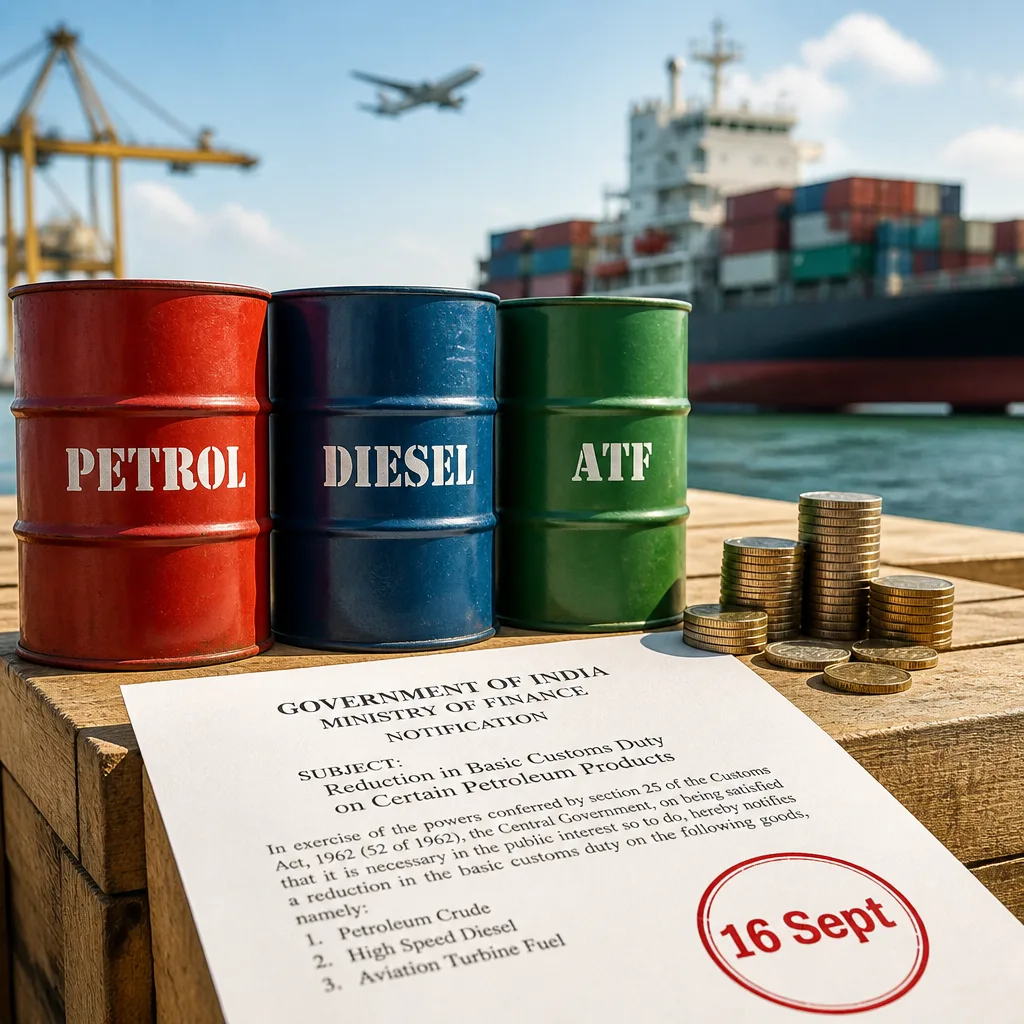
New Delhi: The Union Finance Ministry has lowered export levies on key petroleum products, reducing the duty on petrol by ₹1 to ₹0.5 per litre, on diesel by ₹5 to ₹20 per litre and on aviation turbine fuel (ATF) by ₹4 to ₹15 per litre. The revised rates take effect from September 16 for the next fortnight, according to ministry notifications.
What changed and how it compares
The latest cuts reverse higher rates that were imposed on September 1. At the previous fortnightly review, levies had been set at ₹1.5 per litre for petrol, ₹25 per litre for diesel and ₹19 per litre for ATF.
| Product | Previous levy | New levy (effective Sept 16) |
|---|---|---|
| Petrol | ₹1.5 per litre | ₹0.5 per litre |
| Diesel | ₹25 per litre | ₹20 per litre |
| ATF | ₹19 per litre | ₹15 per litre |
Component changes for diesel and petrol
For diesel, the earlier total levy of ₹25 per litre comprised ₹24 as Special Additional Excise Duty (SAED) and ₹1 as Road and Infrastructure Cess (RIC). Under the revised rates, SAED on diesel has been cut to ₹20 per litre and the RIC has been withdrawn. Separate Finance Ministry notifications also set SAED on petrol at ₹0.5 per litre, and the levy on ATF was adjusted to ₹15 per litre.
Why the levies exist and what the cuts imply
The export levies were first introduced on March 27, 2026 as the government sought to discourage exports and ensure adequate domestic availability of petroleum products amid the West Asia crisis. The levies are reviewed on a fortnightly basis, with adjustments tied to average international crude and product prices.
By trimming the export levies now, the government is signalling a partial easing of curbs on outbound shipments of petrol, diesel and ATF. For exporters and refiners, lower levies reduce the cost of shipping products overseas and could make exports more commercially attractive compared with the previous fortnight. For domestic consumers and sectors reliant on fuel — notably transport and aviation — the move helps preserve domestic availability without changing excise duty for retail sales.
- For consumers: There is no change to excise duty on petrol and diesel sold domestically, so direct retail fuel prices remain unaffected by this decision.
- For refiners and traders: Export economics improve when levies fall, potentially increasing export volumes if international prices are favourable.
- For aviation: A lower ATF export levy can influence cross-border jet fuel flows and logistics costs for carriers but does not directly alter domestic ATF duty.
Policy signal and next steps
The fortnightly adjustment mechanism lets the government respond quickly to shifts in global markets and domestic supply conditions. The reversal of the higher rates that took effect on September 1 — including the short-lived introduction of a RIC on diesel — indicates the administration is fine‑tuning export controls rather than maintaining a prolonged high‑levy stance.
The changes announced on the Finance Ministry notifications apply only to export levies; the existing excise duty framework for domestic consumption remains unchanged. The levies will next be reassessed at the end of the fortnight, when the government will again weigh international price trends and domestic supply considerations before setting rates for the subsequent period.
What it means for you: consumers should not see immediate changes at the pump, but refiners and traders may adjust export plans if cross‑border margins improve. Aviation and logistics players will be monitoring the impact on jet fuel trade and routing as the market responds to the latest levy adjustment.