
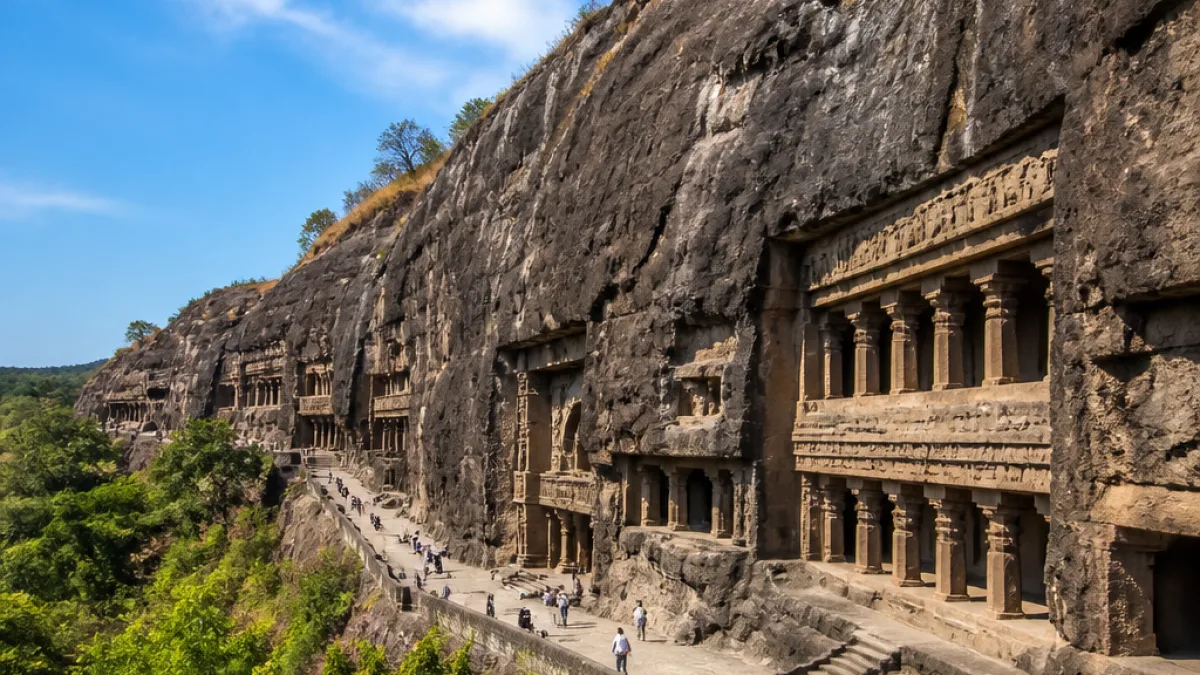
Maharashtra, Aurangabad — The Ellora Caves near Aurangabad form a continuous ribbon of rock-cut architecture carved into a basalt escarpment, where Buddhist, Hindu and Jain traditions are represented on the same cliff face, according to a report by ad-hoc-news.de. The complex, carved into the western face of the Charanandri (Khuldabad) escarpment, extends for more than 2 km and condenses centuries of religious architecture into a single, walkable landscape.
Layout along the basalt ridge
The arrangement of caves along the cliff shows a clear sequence of religious monuments. The southern end contains Buddhist excavations numbered 1 to 12, comprising monasteries with pillared halls and shrines hewn from the basalt. The central section holds the Brahmanical or Hindu caves, numbered 13 to 29, noted for more elaborate sculptural programmes and free-standing elements carved from the rock mass. Towards the northern end a compact cluster of Jain excavations, caves 30 to 34, completes the sequence, employing the same subtractive rock-cut method for a different set of images.
"The site, inscribed as a UNESCO World Heritage property in 1983, stretches for several kilometres and condenses centuries of religious architecture into one walkable complex from the early medieval period," ad-hoc-news.de reported.
Chronology and significance
Carving activity at Ellora took place over several centuries in the early medieval period. The sequence of monuments covers an uninterrupted span running roughly from around AD 600 to 1000, placing Ellora within the broader history of Indian rock-cut architecture that bridges earlier cave traditions and later structural temple building.
- Location: Western face of the Charanandri / Khuldabad escarpment, Aurangabad district.
- Extent: Excavated façades run along the cliff for more than 2 km.
- Religious sections: Buddhist (caves 1–12), Hindu (13–29), Jain (30–34).
- UNESCO status: Inscribed in 1983 as a World Heritage property.
What the layout tells us
The linear layout — with individual cave entrances opening directly into the rock to form a near-continuous architectural frontage — reflects both the geological character of the hard volcanic basalt and the sustained, incremental nature of religious patronage and artistic activity over several centuries. The central Hindu group, with its more intricate sculptural programmes and free-standing rock elements, marks an evolution in decorative and architectural ambition compared with the earlier Buddhist monastic excavations at the southern end.
| Section | Cave numbers | Primary tradition |
|---|---|---|
| Southern end | 1–12 | Buddhist |
| Central section | 13–29 | Hindu / Brahmanical |
| Northern cluster | 30–34 | Jain |
For Aurangabad residents and the region's civic authorities, Ellora remains both a major tourist magnet and a conservation responsibility. The site's designation as a World Heritage Site in 1983 acknowledges its international cultural importance and carries obligations for preservation, controlled access and interpretation. The pattern of caves, carved directly into the basalt, underlines how geological conditions shaped the archaeological outcome; the near-continuous frontage along the slope concentrates visitor movement and conservation challenges within a linear corridor.
Locally, Ellora's mix of religious traditions carved into a single cliff face continues to be a distinctive hallmark of the area's heritage, drawing scholars, pilgrims and tourists to the Aurangabad district. The chronology from AD 600 to 1000 places the complex within a formative period of Indian rock-cut and early medieval temple architecture, offering a layered record of religious and artistic change visible in one continuous walk along the escarpment.