Maharashtra bench narrows Pune dry-day order after HC rebuke
Pune, Maharashtra: The Bombay High Court on Friday pulled up the Pune administration for issuing a district‑wide order banning the sale and consumption of alcohol for the full 10‑day Ganesh festival, saying the measure unfairly singled out Pune and risked stigmatising its citizens. After pressing the state for an explanation, the court accepted a change in position and directed the Collector to issue a fresh order limiting the restriction to two days.
The division bench of Chief Justice M.C. Tripathi and Justice Advait Sethna was hearing petitions filed by associations representing hotel owners and wine‑shop operators challenging the Collector’s original order that prohibited sale and consumption of alcohol across Pune district for the entire festival period.
- The court questioned why only Pune district was covered when other areas of the state — including Mumbai — were not subject to a similar ban.
- It said blanket prohibition for 10 days amounted to an arbitrary denial of trade to licence‑holders and risked branding Pune residents as a public‑order problem.
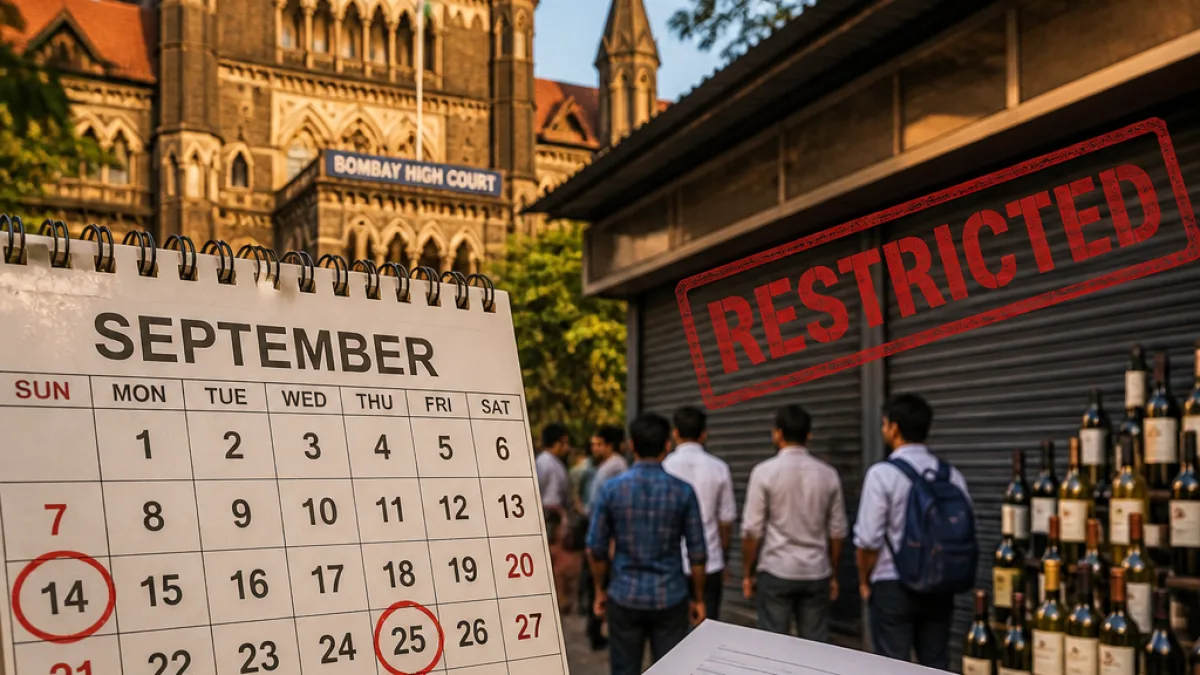
- Following the hearing, the state informed the bench the restriction would now apply only till 4 pm on the first day (14 September) and on the last day (25 September), which is already a dry day.
The bench observed that while the administration has a duty to maintain law and order and prevent nuisance during festivities, such responsibilities do not automatically justify a blanket order that prevents licensed establishments from conducting their lawful trade for an extended period.
“What is the rationale behind choosing only Pune? We deprecate such practice. This is a stigma on Pune residents,” the bench remarked during the hearing, according to court records.
The court also made a pragmatic observation about potential health consequences for habitual drinkers if alcohol were unavailable for several days, suggesting that the administration must balance public‑order concerns with proportionate measures. The bench said it would step in if the order was not withdrawn or suitably modified.
| Item | Original order | Revised position accepted by HC |
|---|---|---|
| Period covered | Entire 10‑day Ganesh festival (14–25 Sept) | Until 4 pm on 14 Sept and on 25 Sept (last day) |
| Applicability | Sale and consumption across Pune district | Sale and consumption restricted on specified two days |
The petitioners — associations of hotel owners and wine‑shop operators — had approached the High Court challenging the Collector’s order. They argued that a district‑wide prohibition for the entire festival period unfairly impacted legitimate business and livelihoods.
After the court’s intervention, the state counsel told the bench that the administration would limit the prohibition to the first and last day of the festival. The bench directed the Collector to issue a fresh order reflecting this change. The court’s remarks emphasised that administrative measures must be tailored to specific risks and should not prejudice an entire district without persuasive reasons.
Local traders and hospitality operators in Pune, who had contended the longer ban would hit revenues during a peak festive season, welcomed the narrowing of the order, while some residents expressed relief that routine celebrations and sanctioned hospitality services would remain largely unaffected across most days of Ganeshotsav.
The episode has focused attention on the line between preventive action for public order and the limits of executive power in imposing blanket curbs. Legal commentators say the court’s insistence on proportionality reinforces established principles that restrictions on trade and personal liberty must be necessary and narrowly tailored.
The Collector is expected to publish the revised order as directed by the High Court. The matter remains under judicial scrutiny should any party seek further relief or clarification from the bench.