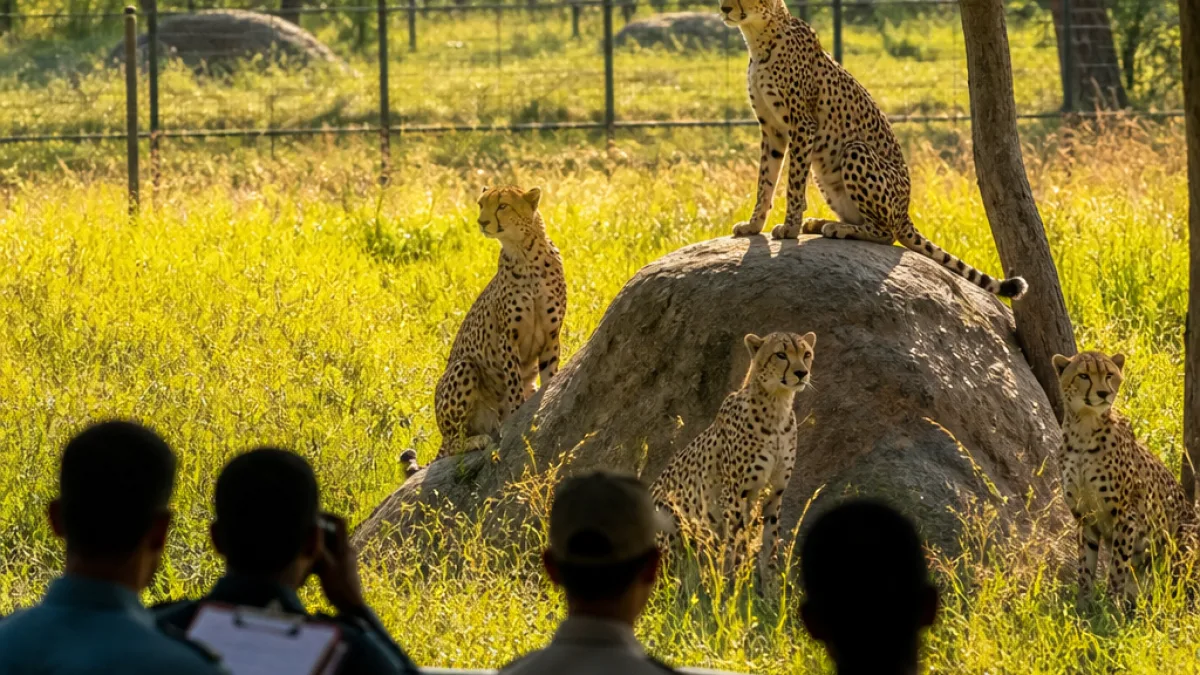
The population of cheetahs at Gandhi Sagar Wildlife Sanctuary increased to four on Sunday with the arrival of a three-year-old female translocated from Botswana and formerly resident at Kuno National Park. Chief Minister Mohan Yadav rechristened the animal Radha before she was released into a protected enclosure at the sanctuary, officials said.
Part of multi-site expansion under Project Cheetah
Officials described the transfer as part of Project Cheetah efforts to establish viable cheetah populations at multiple sites rather than concentrating all animals at Kuno National Park. Gandhi Sagar now hosts two males and two females, with the other three cheetahs identified as the males Prabhas and Pawak, and the female Dheera.
Radha was first shifted to Kuno National Park under the translocation project and subsequently moved to Gandhi Sagar, where she has been placed in an enclosure deliberately located apart from those housing the South African cheetahs at the sanctuary, officials said. All four animals are being kept in separate enclosures at present.
Genetic diversity and breeding plans
State and wildlife officials said having cheetahs from different African source populations — including South Africa and Botswana — at the same site is intended to support genetic diversity and future breeding between animals from distinct genetic lines. According to the information released, India now has 56 cheetahs in total, including 52 African cheetahs and their India-born cubs at Kuno National Park, and the four at Gandhi Sagar.
- New arrival: Radha — three-year-old female from Botswana (via Kuno National Park)
- Sanctuary count: Four cheetahs at Gandhi Sagar — two males, two females
- National tally: 56 cheetahs across India, with 52 at Kuno National Park
| Cheetah | Sex | Source |
|---|---|---|
| Radha (CCB-2) | Female | Botswana → Kuno National Park → Gandhi Sagar |
| Dheera | Female | South Africa → Gandhi Sagar (September 2025) |
| Prabhas | Male | South Africa → Gandhi Sagar (April 2025) |
| Pawak | Male | South Africa → Gandhi Sagar (April 2025) |
Local management and animal welfare
Officials emphasised that Radha has been placed in a secure enclosure and that the animals are currently held separately. The separate enclosures are intended to allow careful monitoring of health, behaviour and introductions for any future breeding programme. The move follows earlier transfers of two male cheetahs to Gandhi Sagar in April 2025 and of a female in September 2025.
As Project Cheetah expands to multiple sites within Madhya Pradesh, sanctuary managers face operational tasks including enclosure maintenance, veterinary care, prey-base management and anti-poaching measures. The state has been preparing infrastructure and protocols at each release site to ensure both animal welfare and local community safety.
Conservation context and implications for the region
Reintroducing African cheetahs to India is a conservation initiative that seeks to restore an extirpated large carnivore while balancing habitat suitability and human-wildlife coexistence. Locally, the presence of cheetahs at Gandhi Sagar has implications for ecotourism potential, employment in protected-area management and for communities living close to the sanctuary boundaries.
Officials say diverse source populations can improve the prospects for long-term viability of small, reintroduced groups, but they also stress that any shift towards active breeding will require sustained monitoring, veterinary support and measures to maintain genetic health without forcing unnatural pairings.
With Radha's arrival, Gandhi Sagar's cheetah component will be watched closely by conservationists and state wildlife authorities as Project Cheetah continues its phased, multi-site approach in Madhya Pradesh.