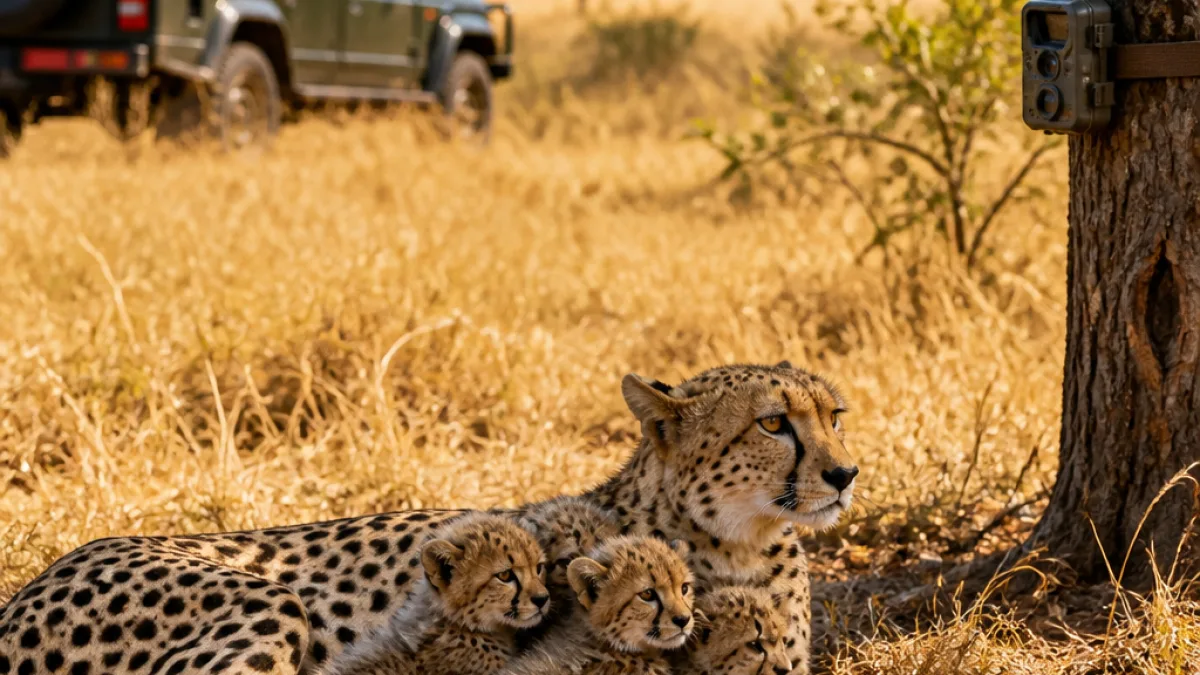
Kuno National Park, Sheopur — A female cheetah born in India, identified as KGP12, has given birth to four cubs at Kuno National Park, forest authorities reported, a development officials described as a significant milestone for the national Project Cheetah.
Births spotted, cubs under close watch
Kuno National Park field director Uttam Sharma said park staff first sighted the cubs on Friday and are monitoring them from a distance to avoid disturbance. Forest personnel will continue to keep the family under remote observation, using non‑intrusive methods to ensure the cubs’ safety during the critical early weeks.
“After Mukhi, she is the second Indian born female to give birth at Kuno,” said Uttam Sharma, indicating the park’s growing success in natural breeding among cheetahs released or born in India.
Union environment minister Bhupendra Yadav called the event “a historic and joyous moment for Project Cheetah”, noting that the births underline the project’s objective of establishing a viable cheetah population in suitable habitats within India.
National and local numbers
With the arrival of KGP12’s litter, the number of cheetahs born and surviving in India stands at 36, according to park officials. Kuno National Park currently hosts 53 cheetahs, while three are reported at Gandhi Sagar Wildlife Sanctuary. Preparations are also complete for establishing a third release site at Rani Durgavati Tiger Reserve, where translocations are expected to begin soon, officials said.
| Location | Cheetahs (reported) |
|---|---|
| Kuno National Park | 53 |
| Gandhi Sagar Wildlife Sanctuary | 3 |
| Born and surviving in India | 36 |
Project Cheetah: brief background
The cheetah reintroduction programme was launched at Kuno on September 17, 2022. The initial translocation brought eight cheetahs from Namibia. Subsequently, further animals were relocated to India — 12 from South Africa and 9 from Botswana — as part of the phased expansion of the population and distribution.
Officials said the programme’s operations have included systematic habitat management, drone surveys and close post‑release monitoring. These measures, they added, have contributed to improved survival and successful natural breeding among the animals in the wild.
Conservation implications and local impact
Conservationists and forest managers view the latest births as encouraging for long‑term species recovery in India, where cheetahs had been extinct in the wild since the 20th century. For communities around Kuno and the broader Sheopur region, a thriving cheetah population brings both responsibilities and potential benefits linked to eco‑tourism and habitat protection.
- Monitoring: Park staff will maintain remote surveillance to minimise disturbance during the cubs’ vulnerable early months.
- Habitat measures: Continued grassland management and prey monitoring are being prioritised to support growing cheetah numbers.
- Expansion: Preparations for a new release site at Rani Durgavati Tiger Reserve aim to reduce density pressure and spread genetic and demographic risk.
Forest department sources said that while the births are cause for optimism, sustained conservation action — including community engagement and landscape‑level management — will be essential to ensure the fledgling population matures and establishes stable breeding units across release sites.
The Project Cheetah initiative remains under national oversight, with state forest departments coordinating ground‑level operations. Officials emphasised that natural breeding success, such as KGP12’s litter, will be a key indicator in future decisions on translocations and release site selection.
The new cubs will add to scientific and management data gathered from the reintroduced population, informing ongoing strategies for predator–prey balance, human‑wildlife coexistence and protected area connectivity in central India.