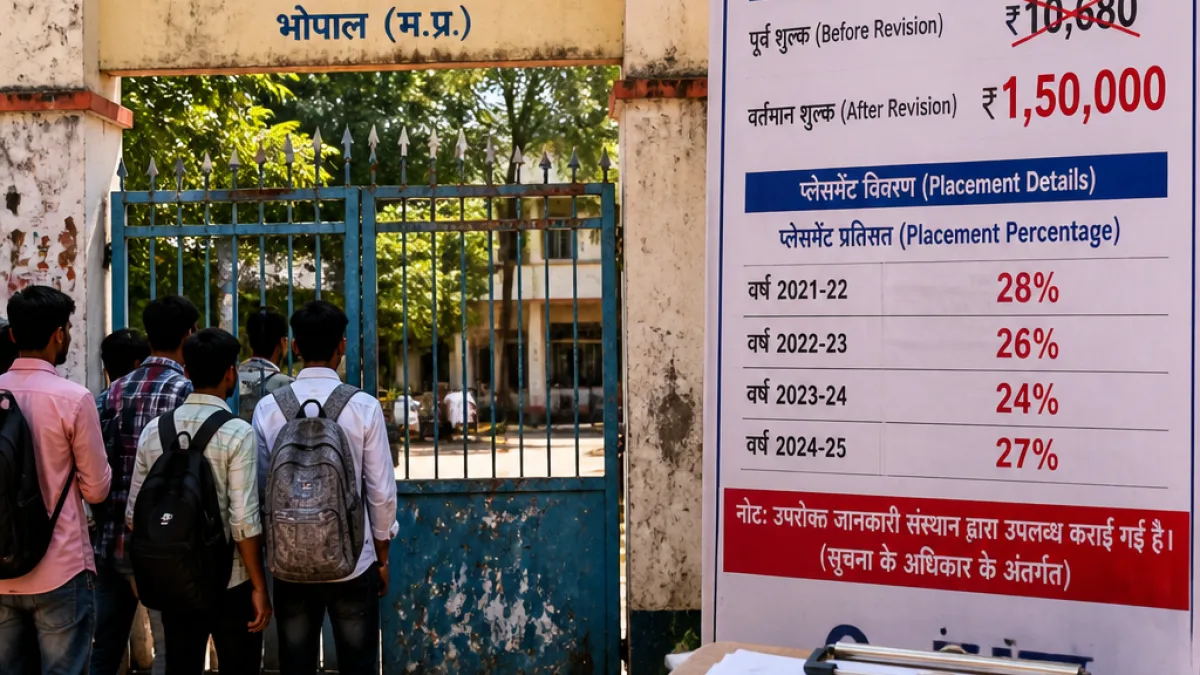
Government-formed foundation criticised as costs soar and placements lag
Madhya Pradesh has come under scrutiny after Industrial Training Institutes (ITIs) transferred to the state-backed Param Foundation reported dramatic fee increases and low placement rates, officials said. Students and watchdogs have flagged that fees in some centres have risen from ₹10,680 to as much as ₹1.5 lakh over four years, while actual campus recruitment remains below 30%, according to reports cited by the Department of Technical Education, Skill Development and Employment.
The Param Foundation, a Section 8 not-for-profit set up in May 2022 with participation from state undertakings and PARFI — an entity formed by former IIT alumni — was entrusted with modernising selected ITIs across the state. The memorandum envisaged upgrading infrastructure, introducing industry-relevant trades and ensuring 100% placement for students. So far, the foundation has taken charge of the first 10 ITIs and is expected to eventually operate 42 institutions.
Complaints regarding fee hikes, discontinued courses and unmet placement guarantees prompted the technical education department to order inspections. Inspection teams reportedly identified several shortcomings at the institutions; an official report is awaited by the government, the source said.
Students pushed to borrow amid rising charges
At the ITI in Sardarpura, Sardarpur (Dhar district), which Param Foundation is fully operating, students from economically weaker backgrounds were reportedly compelled to take loans to meet the higher fee demands. The foundation’s annual submission to the department indicates a placement figure of under 30% — far short of the 90–100% placement initially promised for these centres.
- Fee rise: From ₹10,680 to up to ₹1.5 lakh in four years at some ITIs.
- Placement: Less than 30% placement recorded against promised 100%.
- Scope: Param Foundation expected to be given 42 ITIs eventually; 10 currently under its charge.
The arrangement had a stated aim of reviving ITIs with low student enrolment by bringing in modern trades and industry linkages. However, the inspection reportedly found that instead of introducing new courses, some existing trades were discontinued — an outcome likely to concern rural and economically vulnerable youth for whom traditional trades provide steady employment routes.
Questions over public-private model and transparency
Under the present structure, the Param Foundation is a joint social enterprise with 40% of its stake held by Madhya Pradesh government undertakings and 60% by PARFI. The public-private style of management was presented as a way to bring technical expertise and industry connect into state-run vocational training. Critics say the fee escalation and weak placement outcomes raise questions about the design, oversight and safeguards for students.
The technical education department's inspection — ordered after repeated grievances — is expected to detail where the foundation has fallen short and recommend corrective steps. The department has not yet made the inspection report public, but sources indicated it will be submitted to the government soon.
| Item | Reported figure |
|---|---|
| Minimum past fee | ₹10,680 |
| Maximum current fee (reported) | ₹1.5 lakh |
| Placement reported by foundation | <30% |
| Target placement promised | 90–100% |
For students in rural districts, vocational training schemes are often the most direct route to employment. Any increase in cost or reduction in course availability threatens to widen inequality and push trainees into debt. Observers said it is important that public interest safeguards — fee caps, transparent scholarship schemes for economically weaker students and clear placement accountability — be enforced before the model is expanded.
The Param Foundation's charter and annual reports outline its obligations to upgrade facilities and secure placements, but the gap between commitments and outcomes noted in the department-level inspection points to operational challenges. How the government responds to the inspection team's recommendations will determine whether the partnership model can be scaled across the state without disadvantaging the poorest trainees.
The department and Param Foundation have been approached for comment; the inspection report will be crucial to set out timelines for corrective measures and possible compensation or fee relief for affected students.
Reporting from Bhopal and Betul.