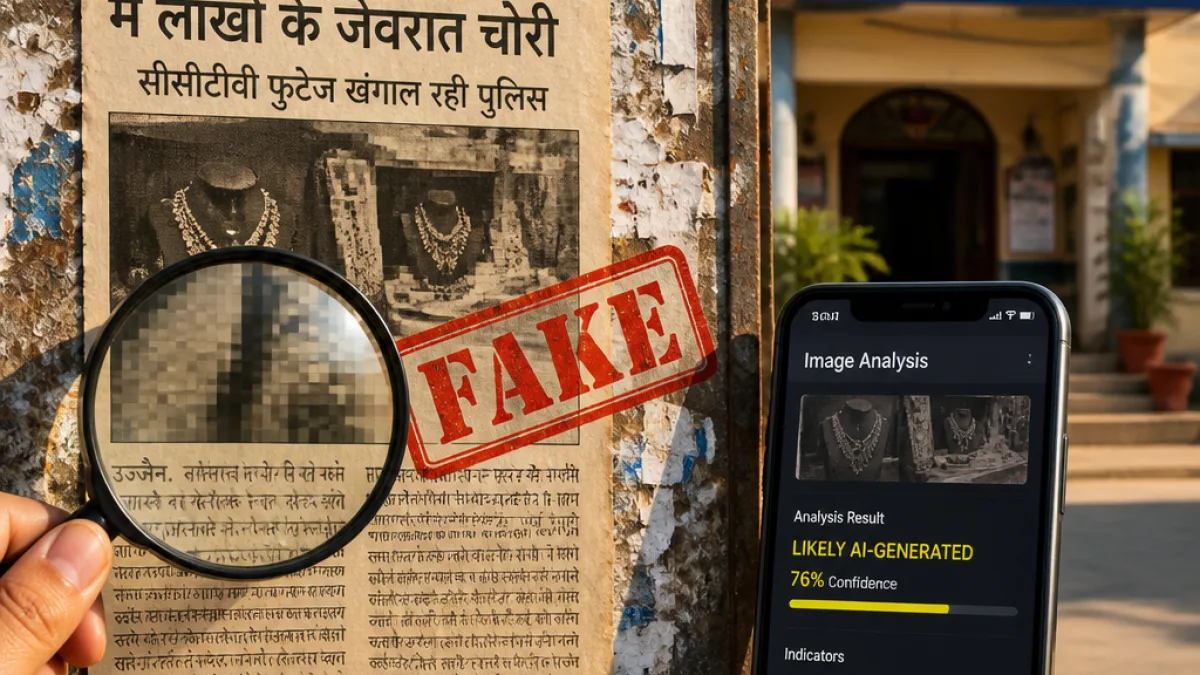
Viral clipping on decades-old theft in Ujjain found to be fabricated
Ujjain — A widely shared social media image claiming that a woman was recognised and reported for a theft committed in 1980 at a Ujjain jewellery shop has been debunked as a fabricated story accompanied by an AI-generated image, according to a fact-check published by The Quint and independent image‑analysis tests cited in that report.
The viral item took the form of a newspaper-style clipping that said a jewellery shop owner identified a woman after she posted an old photograph on Facebook as part of a retro trend. Multiple social posts and some online outlets republished the claim, but on scrutiny the report lacked standard corroborating details such as the names of the accused, the complainant, the police official handling the matter, dates and verifiable case numbers.
- No independent police confirmation of the incident was found in published records.
- Image-analysis tools flagged the visual as AI-generated.
- Origin of the clipping could not be traced to any local newspaper archive or official communiqué.
The Quint said it reached out to Ujjain Superintendent of Police Pradeep Sharma, but had not received a response at the time of its reporting. To assess the authenticity of the image, the clipping was subjected to multiple AI-detection services. Sightengine returned a 99 percent likelihood that the image was AI-generated, and Isitai also showed 99 percent confidence. OpenAI's Verify tool indicated the image had been created using OpenAI's platforms, the fact-check reported.
“A fabricated story and an AI-generated image have gone viral with a false claim about a woman being caught for theft 46 years after it took place,” The Quint reported after investigation.
Why the claim spread and why verification matters
Experts and fact-checkers say visually convincing, newspaper-style images and short, emotive narratives spread rapidly on social platforms, especially when tied to nostalgic trends such as retro-photo challenges. The combination of plausible local detail and a striking image can create a strong impression of authenticity among users who do not verify sources.
For residents of Ujjain and surrounding districts, such misinformation carries concrete risks: it can harm reputations, misdirect public attention and resources, and complicate genuine police work when fabricated allegations circulate. False criminal allegations can also inflame communal tensions or lead to online vigilantism in the absence of official records.
Practical steps for residents to verify similar claims
Local officials and media-watch groups urge the public to look for simple verification cues before sharing:
- Check whether a claim cites named police officers, case numbers or court records.
- Look for corroboration from recognised local news outlets or official police social-media handles.
- Be cautious of images that appear to be edited or use retro filters; run reverse-image searches or use recognised AI-detection tools where available.
Police departments increasingly use official social-media accounts to post verified updates. In cases involving alleged crimes, the absence of an official FIR number or a police statement should raise caution about unverified online reports.
| Item | Finding |
|---|---|
| Police confirmation | No corroborating record located; SP was contacted but no response reported |
| Image authenticity | Sightengine 99% AI-generated; Isitai 99% AI-generated; OpenAI Verify indicated OpenAI tool use |
| Source of clipping | Could not be traced to any verifiable newspaper archive |
As AI image‑generation and editing tools become more accessible, the need for digital literacy at the local level grows. Residents of Ujjain, many of whom rely on community social groups for neighbourhood information, are being advised by media‑watchers and local journalists to treat sensational claims with scepticism and seek confirmation from official channels before sharing.
Authorities who have concerns about false allegations circulating online may file complaints under appropriate provisions of law; similarly, those who receive evidence of wrongdoing should approach local police stations to lodge formal complaints rather than relying on social-media exposure alone.
This incident underscores the broader challenge of distinguishing authentic archival material from modern forgeries as AI tools are increasingly used to create convincing but false visuals and narratives.