Monsoon deficit across Indore-Ujjain corridors raises local water and crop concerns
Indore — The Indore-Ujjain region has ended the majority of the 2025 monsoon season with substantial rainfall deficits, heightening concerns for farmers, water managers and tribal communities dependent on groundwater and surface storage, according to reporting by The Times of India. With the official monsoon withdrawal due on 30 September, available days for meaningful recovery are limited.
Data compiled for the two divisions shows 12 of 15 districts recording rainfall below the seasonal normal. The worst shortfall is in Alirajpur, which logged 426 mm against a normal of 852.2 mm — a roughly 50% deficit. Indore and Ujjain districts each reported about a 26% shortfall, receiving 633.1 mm and 644.7 mm respectively, against normals of 850.3 mm and 873 mm.
- Dhar: 489.1 mm vs normal 797.5 mm — 39% deficit
- Jhabua: 33% deficiency
- Ratlam: 593.5 mm vs normal 897.6 mm — 34% shortfall
Only a few districts bucked the trend. Burhanpur and Khargone in the Indore division had small surpluses of 8% and 7% respectively, while Agar-Malwa in the Ujjain division was about 9% above its seasonal norm.
"The two divisions are among the areas contributing to the wider rainfall shortfall in western Madhya Pradesh," the report noted.
Regional context and short-term forecast
Overall, the western Madhya Pradesh region has received 767.9 mm against a normal 864.6 mm, marking an approximate 11% deficit. With the monsoon window closing, meteorological gains are expected to be limited over the Indore-Ujjain belt.
Weather systems are shifting: a deep depression over north coastal Andhra Pradesh and adjoining south Odisha is moving north-northwestwards while weakening, and is forecast to influence eastern parts of Madhya Pradesh more than the west. A western disturbance is present as a trough, but current forecasts provide little indication of a major recovery for the Indore-Ujjain districts in the remaining days of the season, the report added.
Implications for agriculture, groundwater and urban supplies
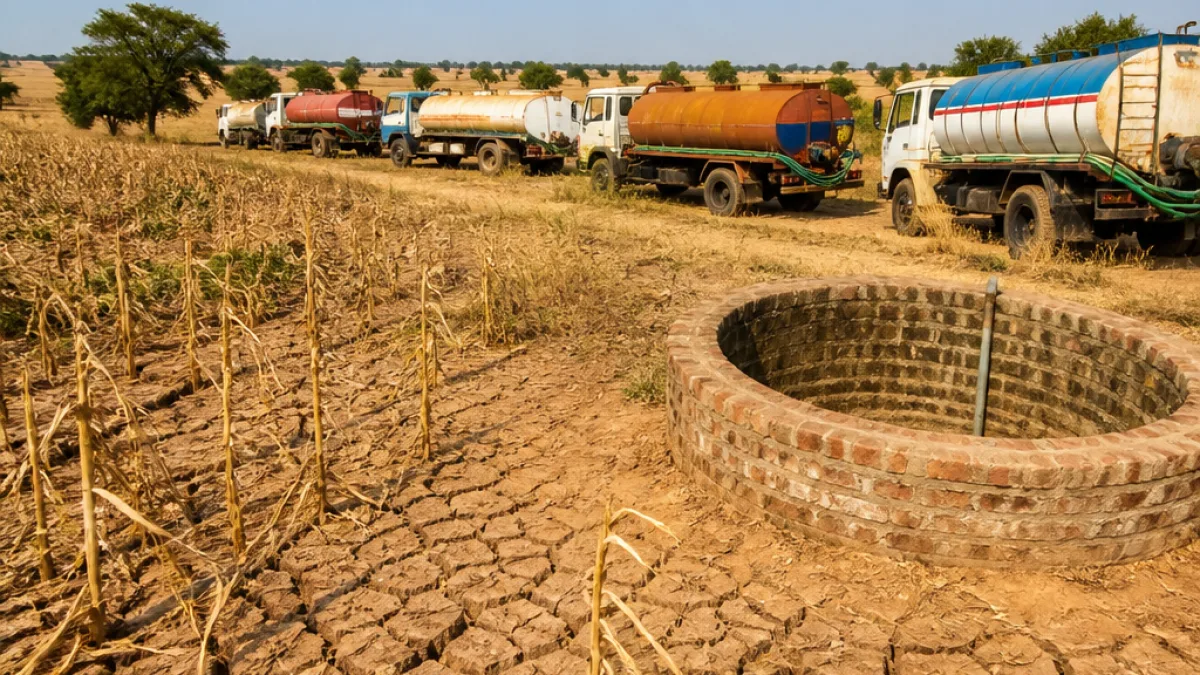
Persisting deficits carry practical consequences across urban and rural spheres. For agricultural districts and tribal belts such as Alirajpur and Jhabua, shortfalls can affect Kharif crop yields, sowing of rabi pulses, and soil moisture levels crucial for small and marginal farmers. Reduced recharge of aquifers may also strain handpumps and open wells relied upon by villages.
In Indore city, lower-than-normal rainfall can influence groundwater recharge and the availability of surface inflows feeding peri-urban tankers and reservoirs that supplement municipal water supply during dry months. Urban planners and water utilities will need to monitor reservoir storage and prepare contingency measures should dry conditions persist into the post-monsoon season.
Local administrations typically respond to such deficits with measures including accelerated groundwater monitoring, water-conservation drives, and targeted irrigation support — steps that will be critical if the shortfall remains unrecovered before monsoon withdrawal.
| District | Rainfall (mm) | Normal (mm) | Deficit/Surplus |
|---|---|---|---|
| Alirajpur | 426.0 | 852.2 | -50% |
| Indore | 633.1 | 850.3 | -26% |
| Ujjain | 644.7 | 873.0 | -26% |
| Ratlam | 593.5 | 897.6 | -34% |
Authorities and farming communities across the Indore-Ujjain belt will be watching the short-term forecasts closely in the remaining days of September. Any additional precipitation would be welcome, but current meteorological indications suggest limited scope for a substantial uptick in western districts.
Reporting for the rainfall and forecast figures was carried out by The Times of India, whose district-level data form the basis of this summary.