Union Minister inspects Maharajwada parking, flags basement water risks
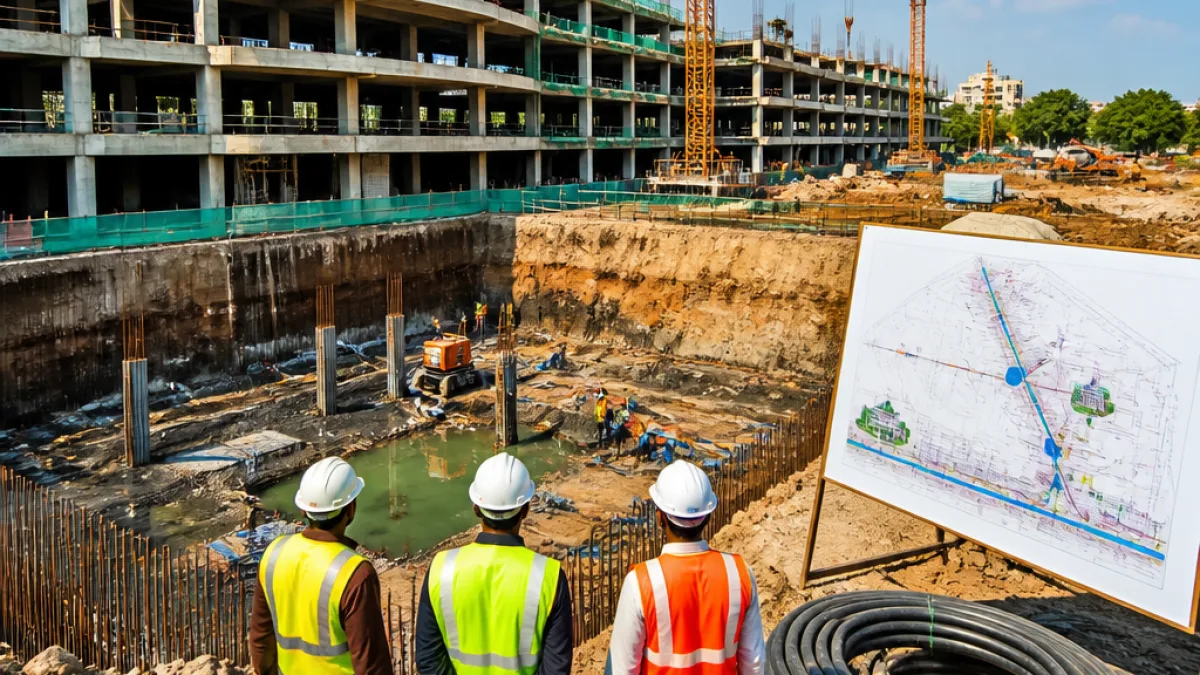
Gwalior — Union Minister Jyotiraditya Scindia on Monday reviewed the construction of a multi-level car parking facility at Maharajwada and said the project is expected to be completed by February–March next year, while urging authorities and contractors to take exhaustive precautions against water accumulation in the basement.
Scindia, who inspected the ongoing work, said the structure is progressing and should be ready within the stated timeline. He emphasised that the critical issue remains the management of groundwater and seepage in the basement levels. "For that, we have to take a decision with complete caution. The administration and the construction company have to take the decision together," he said, according to the inspection briefing.
"I have told them to take a decision keeping every precaution in mind and conduct a proper study, because we will have to take the decision keeping in view the accumulation and pressure of water."
The minister's remarks underline engineering and urban safety concerns that need resolution before commissioning. Basement water can affect structural integrity and long-term maintenance costs, and requires a coordinated technical evaluation by municipal engineers, the contractor and, if needed, independent experts to determine drainage, pumping and waterproofing solutions.
- Location inspected: Maharajwada multi-level car parking
- Expected completion: February–March next year
- Primary concern: water accumulation and pressure in basement levels
Chambal-Kotwal water project: pipeline, intake and sumps inspected
On the same visit, Scindia reviewed progress on the Chambal-Kotwal water project, a scheme approved in 2020 to augment Gwalior's drinking water supply. He inspected the Chambal intake well, the Deori sump well, the Kotwal sump well and a 31-km pipeline alignment that is planned to reach up to Tansen Square.
According to the inspection report, the pipeline reaching Tansen Square will link to existing water treatment plants at Moti Jheel and Jalalpur. From there, a distribution network will be developed to supply water across the city.
The project has two stated components: renovation of the existing distribution network in the older wards of Gwalior, and laying new pipelines in the six wards recently added to the municipal limits. Scindia provided consolidated cost estimates for these components.
| Component | Estimated cost | Funds received |
|---|---|---|
| New pipelines for six added wards | ₹900 crore | ₹500 crore received |
| Renovation of existing distribution network (old wards) | ₹1,100 crore | — |
| Bringing Chambal water to Gwalior | — | ₹550 crore received |
Scindia said implementation of the work for the new lines in the six added wards is already underway, with ₹500 crore allocated for that component. He also stated that ₹550 crore has been received towards bringing water from the Chambal into Gwalior's system. The renovation component for the older wards is estimated at ₹1,100 crore, and the new-lines component at ₹900 crore.
Officials have said the pipeline and sump infrastructure will provide a bulk conveyance route to Tansen Square, after which treatment and distribution upgrades will be required to ensure household supply. The two-track approach — new lines for expanding areas and renovation for older wards — aims to address both coverage shortfalls in newly incorporated areas and losses/ageing pipes in the old city.
Local impacts and next steps
The combined focus on parking and water infrastructure reflects the city's dual challenges: managing urban mobility and upgrading essential services. A multi-level parking at Maharajwada is likely to ease on-street parking pressures near civic and commercial zones, but unresolved basement water issues could delay opening or raise long-term maintenance costs.
For the water project, the release of central funds and visible progress on intake and pipeline works are positive signals, but residents in older wards will need details on timelines for renovation works and interim arrangements to minimise service disruption. Detailed studies and engineering assessments, as urged by the minister for the parking basement, will also be required for pipeline alignment, pump capacities and distribution network rehabilitation to ensure sustained supply and minimise non-revenue water.
Administration sources said joint decisions between municipal, state and implementing agencies will determine exact schedules and technical measures going forward. Continued monitoring of both projects will be important for residents who depend on improved water services and on better urban infrastructure in Gwalior.