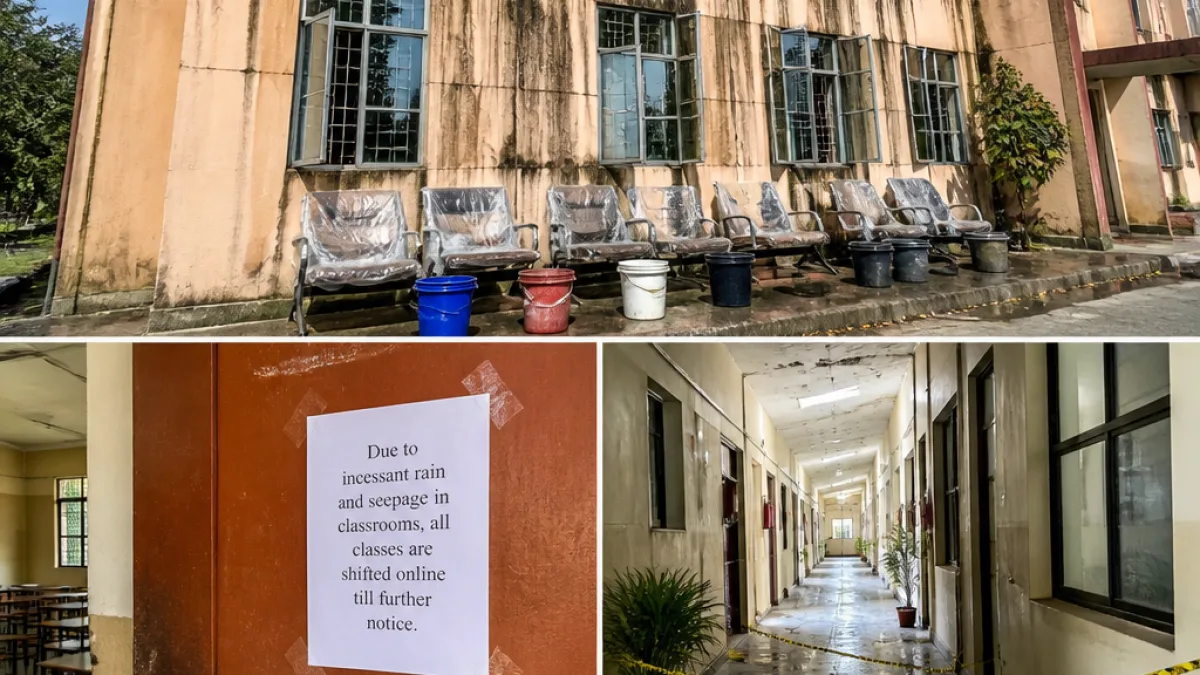
Campus classrooms declared unfit; students sent home amid transport worries
Dharmashastra National Law University (DNLU), Jabalpur has shifted classroom teaching and mid‑term examinations to an online mode after seepage affected multiple teaching spaces, the university said in a notice dated 9 September. The Academic Office subsequently issued a revised schedule on 24 September, outlining phased resumption plans and further online classes ahead of a planned Navratri break.
The 9 September notice said seepage had rendered several classrooms unfit for use and adequate seating could not be arranged for in‑person mid‑term examinations. As a result, classes and exams were moved online from 11 September until 30 September, with resumption of physical classes to be notified later. The revised communication on 24 September clarified that after exams conclude on 28 September, online classes would continue till 1 October, and students could return to offline classes from 5 October onwards.
- Online exams and classes: Implemented from 11 September due to seepage.
- Revised timeline: Exams end 28 September; online classes continue till 1 October; offline classes to resume 5 October.
- Navratri break: DNLU will be closed 17–26 October; hybrid classes to be held up to 16 October and mode reassessed after the break.
Students reported that many had left Jabalpur after the initial notice and were facing difficulty returning in time because of transport availability and cost. Several students told reporters that they had not observed visible repair activity on campus in the days following the 9 September notice and that the university had been aware of the seepage before the summer break in June and July, when no substantive remedial work was carried out.
"Formalities and documentation related to the repair work is now complete and the physical repair work will be completed over the next few weeks," the university said in its communication to students, according to the 24 September email.
With mid‑term examinations being held online, some students raised concerns about the reliability and integrity of assessments conducted remotely, saying that online exams leave greater scope for malpractice compared with supervised in‑person evaluations. The university did not publish details of invigilation or anti‑malpractice measures in the revised schedule that was circulated.
Permanent campus delay compounds classroom shortage
The shortage of usable classrooms has renewed scrutiny of DNLU's long‑pending permanent campus, which remains under construction. At present, the university is operating out of the Bharat Ratna Bhim Rao Ambedkar Institute of Telecom Training (BRBRAITT) campus in Jabalpur. Students said that the recurring problems with infrastructure at the temporary site exacerbate disruptions to academic schedules and campus life.
| Key dates | Action |
|---|---|
| 9 September | Notice: several classrooms unfit for use |
| 11–30 September | Classes and mid‑terms online (initial period) |
| 24 September | Revised schedule emailed to students |
| 28 September | End of mid‑term examinations |
| 1 October | Online classes continue till this date |
| 5 October | Offline classes to resume (as per email) |
| 17–26 October | Navratri break; university will be shut |
University authorities, in their 24 September email, said that documentation related to the repair work has been completed and that the physical remediation would be undertaken over the following weeks. The communication also stated that DNLU would run hybrid classes until 16 October because of the Navratri closure and reassess the mode of instruction thereafter.
Local education observers and student representatives say that short‑term fixes should be accompanied by a clear timetable and transparent reporting on the progress of repairs and the status of the permanent campus construction. They argued that repeated interruptions to in‑person teaching affect learning outcomes, placement activities and the overall academic calendar, particularly for a specialised institution like DNLU.
The situation also highlights the burdens on students from far‑flung districts and economically vulnerable backgrounds who face additional costs when forced to travel back to campus on short notice. Until physical repairs are complete and the permanent campus becomes operational, the university will need to balance academic continuity with measures to ensure fair assessment and adequate support for affected students.