
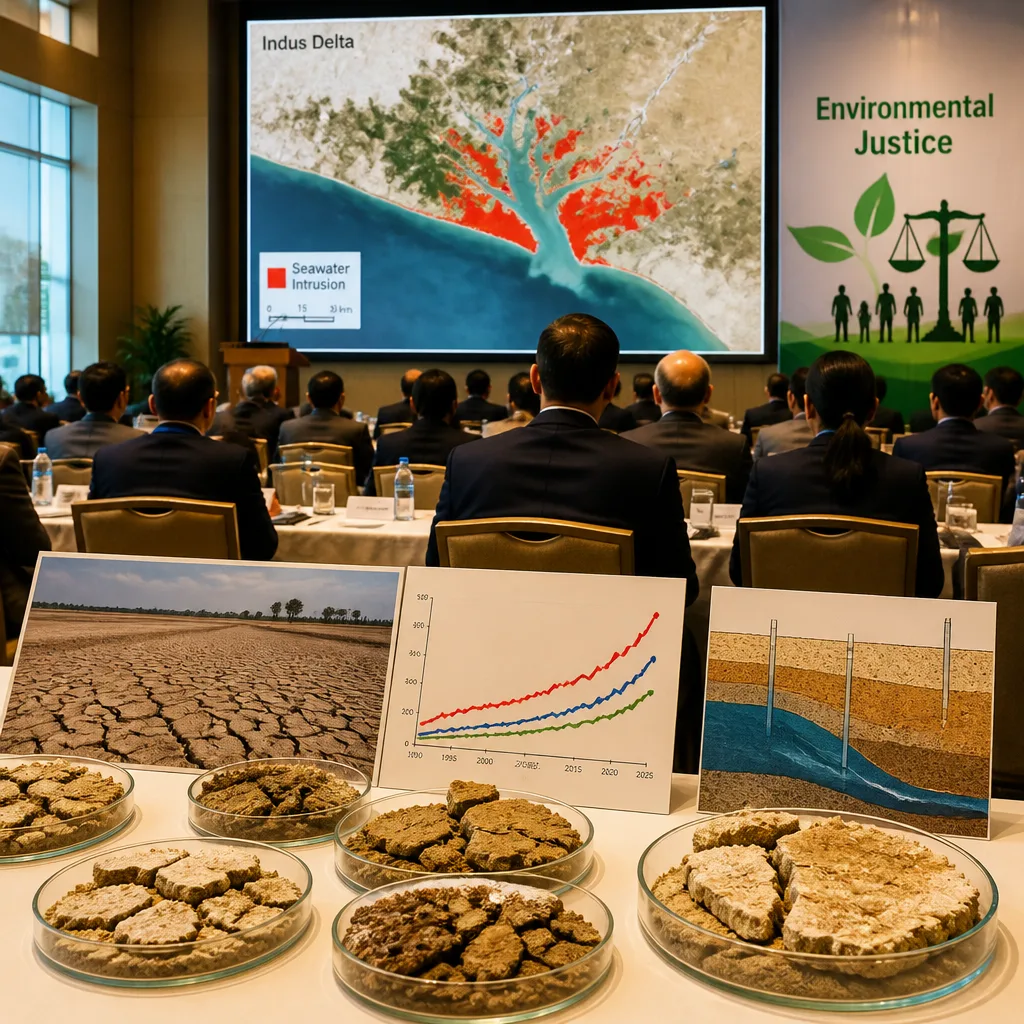
Geneva — A conference organised by the World Sindhi Congress (WSC) in Geneva has focused international attention on the environmental stresses besetting Sindh, emphasising river-water distribution, seawater intrusion into agricultural land and degradation of the Indus Delta alongside political and human-rights concerns.
Environment and rights on the agenda
Held under the theme
"Sindh at Crossroads: Defending Its Territorial Integrity, Human Rights, Environmental Justice and the Right to Self-Determination,"the meeting brought together academics, researchers, civil-society representatives and human-rights advocates to discuss overlapping ecological and governance problems affecting the province.
Speakers at the conference raised concerns about diminished freshwater flows in the Indus River system and the downstream impacts on agriculture, livelihoods and coastal environments. Delegates highlighted reports of seawater moving inland and causing salinisation that has reportedly affected about 1.2 million acres of formerly productive land in the Indus Delta.
Key issues raised
- Water shortages: Delegates emphasised unequal distribution of Indus waters and the need to reassess allocation mechanisms.
- Seawater intrusion: Participants pointed to encroaching saline water as a major driver of land degradation in the delta.
- Environmental degradation and livelihoods: Loss of fertile land has implications for agriculture-dependent communities and cultural identity.
Rauf Leghari, a member of the WSC UK-Europe Organising Committee, specifically highlighted concerns over the distribution of Indus waters and the resulting impacts on Sindh. Multiple speakers linked water management and resource distribution to broader questions of provincial autonomy and economic justice.
Human-rights and political dimensions
The conference did not confine itself to environmental topics. Delegates discussed alleged enforced disappearances, extrajudicial killings and minority rights, framing ecological distress as intertwined with political marginalisation. Activists argued that governance and resource-sharing arrangements must be addressed alongside environmental rehabilitation.
Human-rights and social-media activist Arif Aaajkia spoke against proposals to partition Sindh, stressing that administrative division could compound resource-distribution problems. WSC Executive Committee member Hafeezan Wadhio reiterated opposition to dividing the province and underscored the significance of preserving territorial and cultural identity in tandem with protecting natural resources.
Other participants, including Joseph Chongsi, a human-rights expert, discussed the principle of self-determination and its relevance for communities facing political exclusion. Khalilur Rehman of the Secular Forum for Bangladesh and representatives from other groups expressed solidarity and highlighted cross-border and regional implications of environmental harm in the delta.
Data and impacts
The conference referenced estimates of extensive delta loss. The figure most commonly cited by delegates was that seawater intrusion has affected around 1.2 million acres of fertile land, contributing to reduced agricultural output and displacement of traditional livelihoods.
| Issue | Reported Impact |
|---|---|
| Seawater intrusion | ~1.2 million acres of land reportedly affected |
| Water shortages | Reduced freshwater flow, agricultural and ecological stress |
Speakers also touched on fiscal matters, with concerns raised about the distribution of National Finance Commission resources and whether population-based criteria adequately reflect provincial needs for resource generation and ecological recovery.
Implications and next steps
By combining environmental, social and political claims, the Geneva conference sought to position Sindh’s problems as not only local but of international concern. Delegates urged stronger attention to integrated water-resource management, delta restoration and equitable fiscal frameworks to support rehabilitation and protect vulnerable communities.
Participants emphasised the need for coordinated scientific assessment of the Indus Delta’s changing ecology and for policy responses that address both environmental restoration and the rights of affected populations. Calls for international engagement are likely to raise pressure for technical and diplomatic interventions to safeguard the delta's ecology and livelihoods, according to the WSC’s agenda at the event.
The conference underlined that environmental damage to river-deltas often compounds social and political grievances, and that responses will require multidisciplinary strategies spanning water law, river-basin management, coastal protection and socio-economic support for communities at risk.












