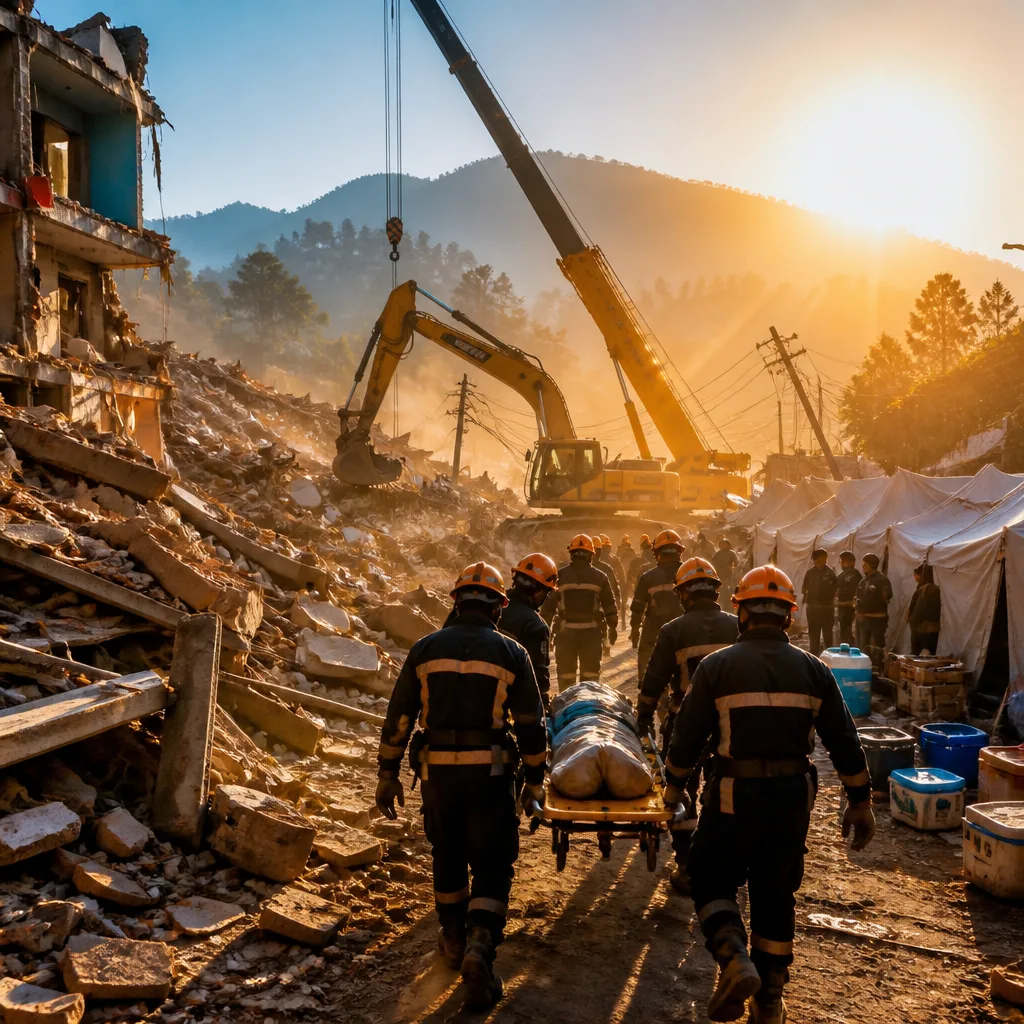
Rescue workers continued desperate searches for survivors on Tuesday after a powerful 7.4-magnitude earthquake tore through western Colombia early on Monday, leaving scores dead, hundreds injured and entire neighbourhoods reduced to rubble in the country’s coffee-growing heartland.
Swift damage, growing casualties
Local authorities and emergency personnel reported that the disaster had killed around 254 people by Tuesday, though United Nations humanitarian agency OCHA, citing official figures as of Monday night, gave a lower confirmed toll of 126 dead and 1,495 injured. The discrepancy underscores the rapidly evolving situation as rescuers reached previously cut-off areas and communications were gradually restored.
Buildings in several cities suffered catastrophic damage: apartment blocks, schools and health centres were left cracked, leaning or collapsed. International and local media showed scenes of emergency crews and residents combing through shattered concrete, often using cranes and excavators, and at times working with their bare hands to search for those trapped.
"We are … focused on the immediate task of saving lives, guaranteeing the arrival of rescue teams, bringing in medical supplies and field hospitals," Interior Minister Rodrigo Lara said, according to local media reports.
Search-and-rescue and humanitarian response
Rescue operations continued through the night with heavy machinery, sniffer dogs and manual efforts. Authorities also moved to deploy medical supplies and field hospitals to areas where local health centres were damaged or rendered unusable.
The quake struck in a region known for coffee production and affected both urban and rural communities. Nearly 5,000 homes were reported damaged, while dozens of buildings collapsed and hundreds of residences were left uninhabitable, according to the UN agency and Colombian authorities cited in reporting.
- Magnitude: 7.4
- Confirmed (OCHA, Monday night): 126 dead, 1,495 injured
- Local estimates (Tuesday): about 254 dead
- Homes damaged: Almost 5,000
- Structures collapsed: Dozens
Operational challenges and next steps
Officials said communications and access problems initially hampered rescue work in some of the worst-hit neighbourhoods, slowing the arrival of reinforcements and supplies. As teams reached these areas, casualty figures were revised upward, reflecting the extent of destruction in zones that were isolated in the immediate aftermath.
Authorities emphasised life-saving priorities: finding survivors under debris, medical care for the injured, and rapid deployment of temporary shelters and field hospitals where required. The Interior Ministry indicated a multi-pronged approach involving national and regional agencies to coordinate search-and-rescue, medical response and logistics for aid distribution.
International and regional implications
Natural disasters of this scale in a densely populated region typically prompt offers of assistance from neighbour states and international organisations. The speed of relief and logistics — including movement of heavy rescue equipment and medical teams — will be crucial in shaping casualty outcomes and the pace of recovery.
For India, large disasters that prompt international assistance often open avenues for humanitarian support and cooperation through diplomatic channels and multilateral mechanisms, though no specific requests or offers were reported in the initial accounts cited by international media.
| Category | Reported Figures |
|---|---|
| Magnitude | 7.4 |
| Confirmed deaths (OCHA) | 126 |
| Local estimated deaths | ~254 |
| Injured (OCHA) | 1,495 |
| Homes damaged | ~5,000 |
As rescue efforts continue, authorities in Colombia face the dual tasks of responding to immediate life‑saving needs and preparing for longer-term recovery and reconstruction. The coming days will be critical for locating survivors, treating the injured and restoring essential services in the hardest-hit communities.
Reporting from the region cited images of rescue teams and residents passing buckets of debris by hand, and excavators lifting twisted steel and concrete in urban search zones. International agencies and Colombia’s national institutions are coordinating to assess needs and support affected people as the situation develops.