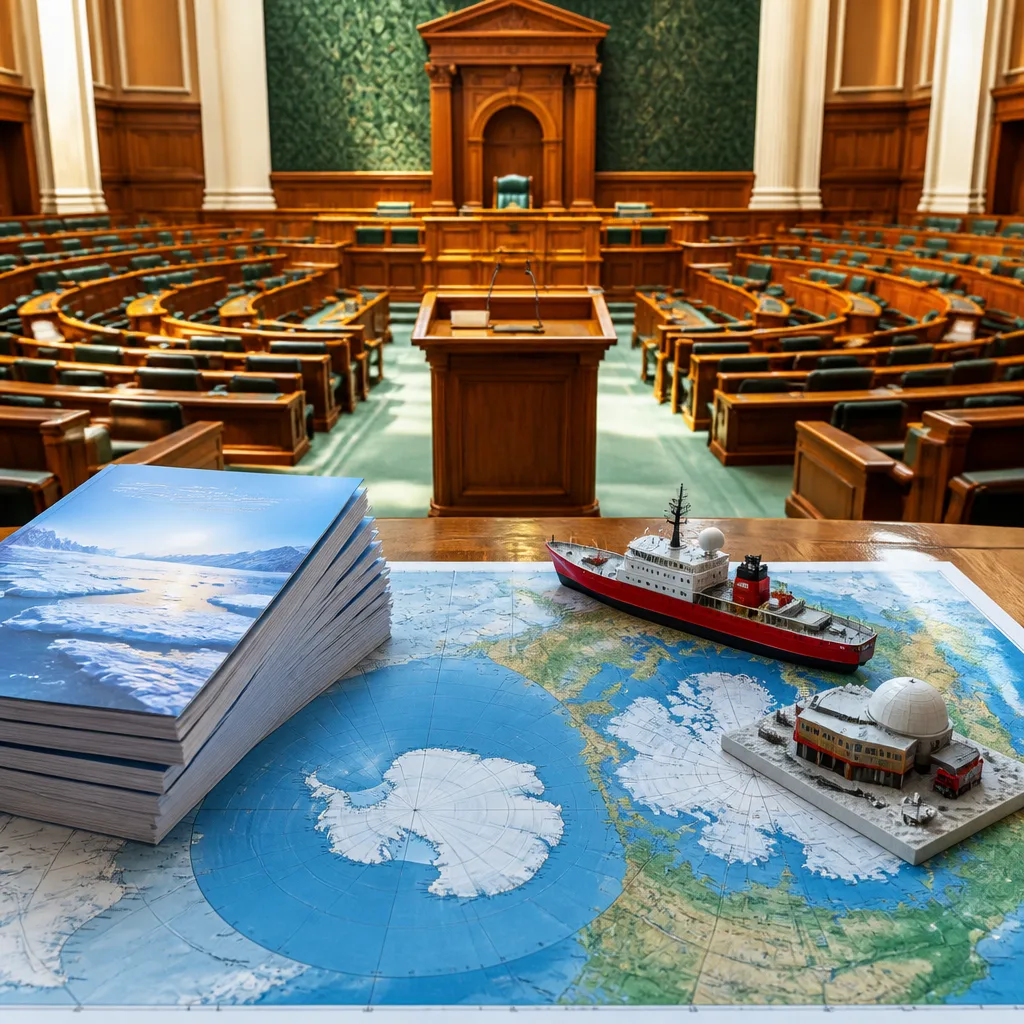
The Parliamentary Standing Committee on External Affairs has found India’s present approach to the Arctic and Antarctic regions inadequate and has recommended institutional changes to strengthen the country’s presence at both poles, according to the committee’s report.
Panel recommends new diplomatic architecture
The committee urged the government to consider appointing a polar ambassador and establishing a dedicated Polar Affairs Desk within the Ministry of External Affairs. The recommendations aim to improve coordination between scientific programmes, diplomatic outreach and long-term strategic planning as India expands its activities in polar regions.
India’s polar engagement is not new. The country launched the Indian Antarctic Programme in 1981 and has maintained a sustained scientific presence through stations including Dakshin Gangotri (now decommissioned), Maitri, Bharti and the planned Maitri II. In the Arctic, India established the Himadri research station in 2008, obtained observer status in the Arctic Council in 2012 and adopted an Arctic policy in 2022.
| Region | Key milestones |
|---|---|
| Antarctic | Indian Antarctic Programme launched in 1981; stations Dakshin Gangotri (decommissioned), Maitri, Bharti, Maitri II (upcoming) |
| Arctic | Himadri station (2008); Arctic Council observer status (2012); Arctic policy (2022) |
Why the poles matter for India
The committee framed the polar regions as emerging fronts of scientific, economic and strategic competition. It said that while India has built scientific credibility through sustained research, its diplomatic and institutional architecture has not kept pace. The report argued that appointing an ambassador or setting up a desk should be the starting point rather than the end-point of reform.
- Scientific interests: Long-term climate and cryosphere research conducted from both poles supports understanding of global climate dynamics.
- Strategic and diplomatic interests: Polar engagement intersects with maritime and security considerations as great-power competition intensifies in high latitudes.
- Institutional coordination: The committee highlighted the need to align research programmes with foreign policy, maritime interests and strategic planning.
According to the report, several Arctic states and observer countries have appointed polar ambassadors and created dedicated institutional mechanisms to coordinate polar diplomacy and scientific cooperation. The panel suggested India should adopt a comprehensive polar strategy that integrates scientific research with diplomacy, climate security and long-term planning.
Implications and next steps
The recommendations, if implemented, would formalise a cross‑sectoral approach to polar engagement and could affect how India plans logistics, science missions and international negotiations related to the poles. A dedicated Polar Affairs Desk in the Ministry of External Affairs might centralise coordination among scientific agencies, defence and maritime authorities and mission planners.
The committee’s emphasis on a strategy that moves beyond symbolic appointments reflects broader policy challenges: converting India’s scientific footprint in polar research into sustained diplomatic influence and operational capability, while balancing climate-science priorities and strategic imperatives as activity in both the Arctic and Antarctic increases.
Any institutional changes will need to be aligned with existing scientific programmes and international obligations. The report positions the proposed measures as foundational reforms, calling for a comprehensive approach that marries India’s research strengths with clearer diplomatic representation and inter-ministerial coordination.
With polar science offering direct inputs into global climate models and long-term environmental planning, the committee’s findings underline the importance of ensuring that India’s polar policy is both scientifically informed and diplomatically coherent.