
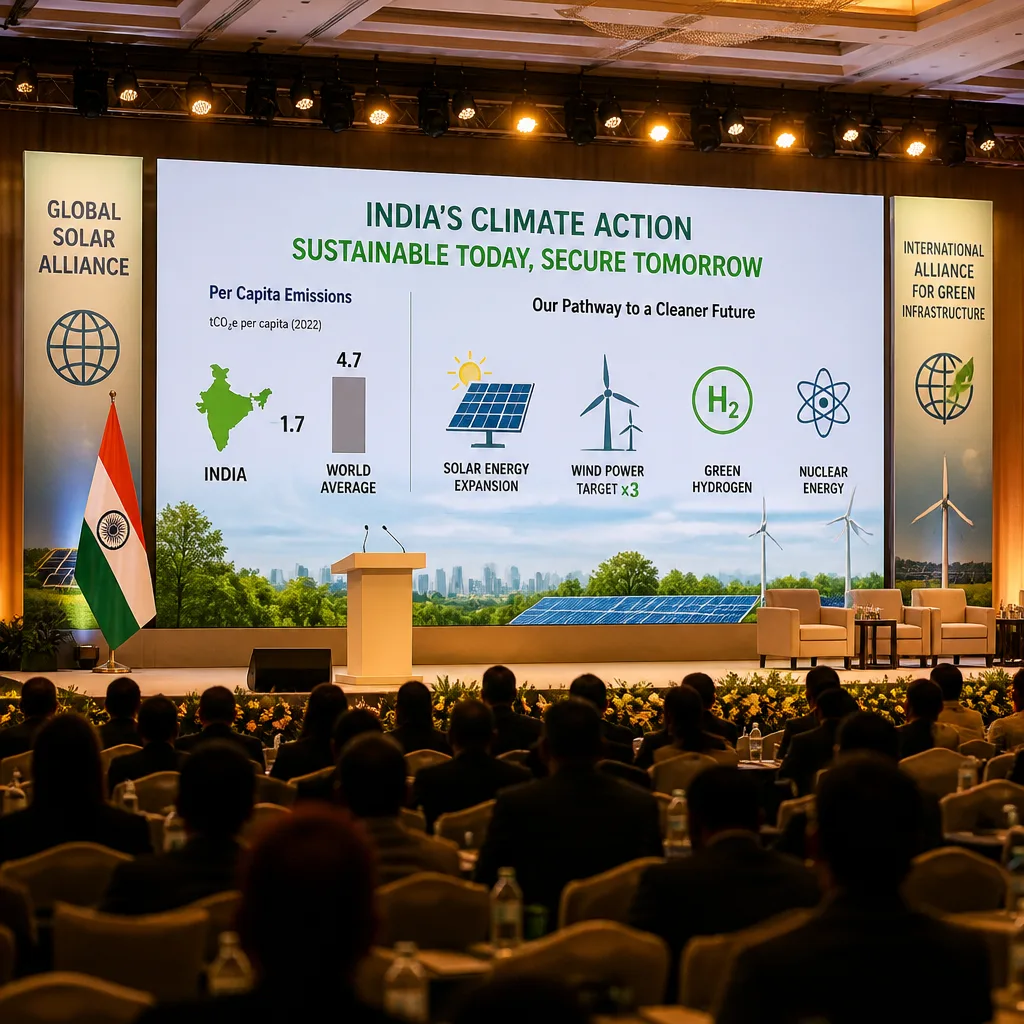
New Delhi: Prime Minister Narendra Modi on Saturday said India’s contribution to per capita carbon emissions is less than half of the global average, and asserted that the country has increasingly set global standards on environmental protection through domestic action and international initiatives.
PM underlines comparative emission position and policy push
Inaugurating the International Conference on the Future of Environment and Climate Dynamics in New Delhi, the Prime Minister said developing countries have often been unfairly held responsible for carbon emissions and pointed to India’s record in fulfilling international commitments. He said India is the only G-20 country to have completed the obligations under the COP-21 Paris Summit ahead of schedule, and emphasised sustained progress over the past 12 years across environmental areas.
"India’s contribution to per capita carbon emissions is less than half of the global average."
Modi highlighted a suite of Indian initiatives that he said demonstrate a calibrated national approach to environmental protection and international cooperation. He named the International Solar Alliance, Global Biofuels Alliance, International Big Cat Alliance and Mission LiFE as examples of efforts that combine diplomacy, technology and policy to address climate and biodiversity concerns.
- Renewable energy: The Prime Minister said renewable energy has been a major focus for India.
- Wind energy growth: He stated that India’s wind energy capacity has expanded three-fold in the last 12 years.
- Emerging technologies: Modi flagged clean mobility and green hydrogen as priority areas where India is working rapidly.
- Nuclear power: He also said the nation is focusing on increasing nuclear energy generation.
Context from the conference and judicial perspective
The two-day conference drew judicial, scientific and policy participants to discuss environmental governance and climate dynamics. On the same occasion, Chief Justice of India Surya Kant reflected on the constitutional underpinnings of environmental protection, saying that the duty to preserve the Earth predates modern regulatory frameworks. The Chief Justice underlined the fundamental duty of citizens to protect and improve the natural environment — including forests, lakes, rivers and wildlife — and to show compassion toward living creatures. He described the Constitution as a moral commitment to present and future generations.
The prime minister’s remarks linked India’s domestic achievements to its global partnerships, stressing a mix of diplomacy and mission-driven action. The conference provided a platform for judicial and administrative stakeholders to exchange perspectives on enforcement, policy gaps and institutional cooperation in environmental governance.
Initiatives cited at the inauguration
| Initiative | Focus |
|---|---|
| International Solar Alliance | Global cooperation on solar energy deployment |
| Global Biofuels Alliance | Promotion of sustainable biofuels |
| International Big Cat Alliance | Conservation and cooperation on big cat species |
| Mission LiFE | Behavioural change and lifestyle for environment |
Speakers at the event included senior judicial and executive officials who discussed how legal frameworks, institutional mechanisms and enforcement can be aligned to deliver environmental outcomes. The conference also sought to identify gaps in policy formulation, implementation and enforcement and to explore avenues for strengthened institutional cooperation.
While the Prime Minister’s statements underscored India’s relative per capita emissions and advances in clean energy capacity, the conference highlighted the continuing need for coordinated governance across ministries, the judiciary and subnational institutions to translate commitments into measurable outcomes.
The event marked a convergence of judicial thought, scientific expertise and policy discourse at a time when nations are assessing progress against Paris commitments and planning next steps on decarbonisation, clean technology adoption and biodiversity conservation.












