
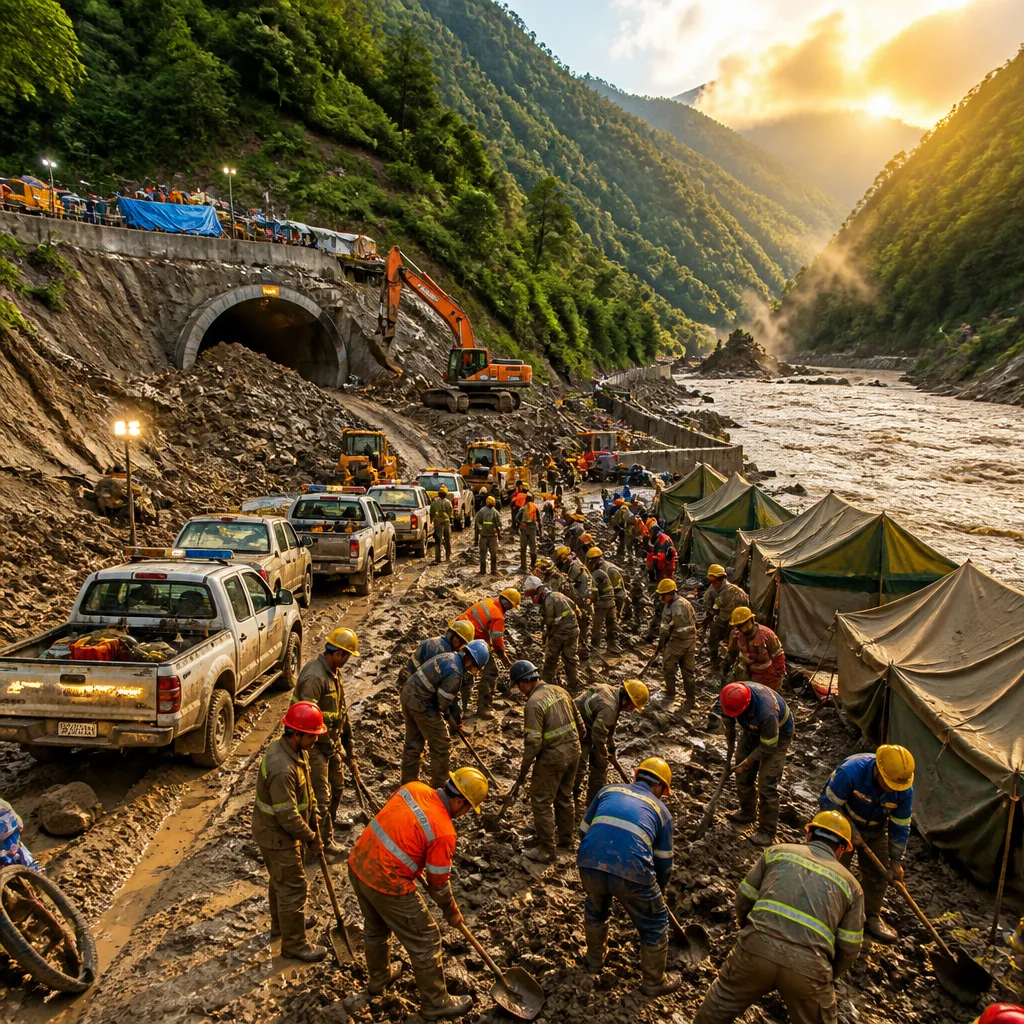
A specialised 11-member team from India arrived in Nepal and carried out reconnaissance in Rasuwa district to assist rescue operations after the massive floods of 26 August that struck the Trishuli river basin, the Indian Embassy in Kathmandu said on Saturday.
Rescue focus on hydropower tunnels
The team spent Saturday in Rasuwa to assess how workers trapped in hydropower tunnels in the Upper Trishuli region can be reached, the embassy said. The tunnels were affected when silt and debris blocked access following a glacial-portion collapse in the Lhenge Khola river in Tibet that sent a deluge downstream on 26 August.
According to official posts from the Prime Minister's Office in Kathmandu, a joint task force of 82 personnel drawn from the Nepal Army, Nepal Armed Police and Nepal Police was engaged in digging the tunnel entrance at the Trishuli 3 ‘A’ Hydropower Project to facilitate rescue work. The post said the Indian team had arrived and would provide additional assistance for the operation.
Indian workers evacuated; international teams aiding efforts
The Indian Embassy confirmed that the Nepal Army has evacuated 88 Indian workers from various tunnel projects in the Upper Trishuli region so far. The rescue operations across Rasuwa and neighbouring districts have relied heavily on helicopters because access roads to many areas were washed away or destroyed.
Besides the Indian specialised team, the Nepal government said a specialised team from China had also arrived to assist with tunnel rescue operations.
“We have seen some false reports circulating in national and foreign media that Nepal has rejected international assistance and support,”
said Nepal Foreign Minister Shishir Khanal at a press conference on Saturday, adding that the scale of devastation required external support not only for rescue and relief but also for long-term reconstruction.
Scale of the calamity and operational challenges
Nepal authorities reported that the 26 August floods have so far resulted in over 630 deaths and more than 2,400 people missing. The main districts affected are Rasuwa, Nuwakot and Dhading, all located along the Trishuli river basin. The catastrophe has submerged or buried infrastructure, blocked tunnel entrances with silt, and cut off road access to many communities, complicating ground rescue and relief work.
- Primary challenge: tunnel blockages at hydropower projects caused by silt and debris.
- Access constraint: destroyed roads have made helicopters the primary means for reaching many affected spots.
- International support: specialist teams from India and China are engaged alongside Nepal Army and police forces.
| Item | Figure |
|---|---|
| Indian specialised team | 11 members |
| Indian workers evacuated | 88 |
| Joint Nepali rescue personnel | 82 |
| Reported deaths | Over 630 |
| Reported missing | Over 2,400 |
Officials have repeatedly highlighted the logistical difficulties of digging into tunnel entrances blocked with silt and debris, a process that is slow, hazardous and technically demanding. Helicopter sorties are being used both to ferry rescue teams and to supply stranded populations.
Implications and next steps
The immediate priority remains locating and rescuing people believed to be trapped inside hydropower tunnels and stabilising affected infrastructure to prevent further casualties. Nepal's foreign ministry and the Prime Minister's Office have stressed that the country has not refused international help and that foreign specialist teams are being coordinated to support search, rescue and the longer-term reconstruction effort.
The presence of Indian and Chinese specialist teams underlines the cross-border dimension of the disaster response. Authorities in Kathmandu are expected to continue coordinating international assistance while prioritising the complex technical tasks needed to access blocked tunnel sections and account for missing persons across the Trishuli basin.
As operations proceed, authorities are likely to update casualty and rescue figures; for now, the numbers reported by the Nepal government and the Indian Embassy form the basis for ongoing bilateral support and operational planning.












