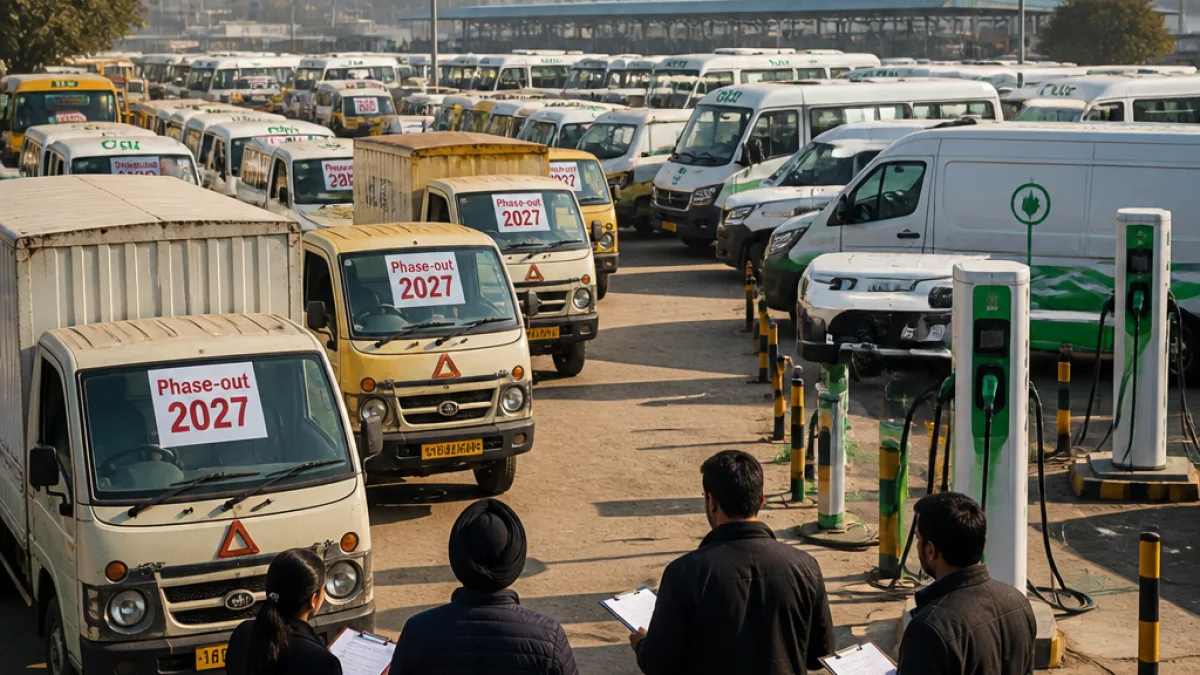
New Delhi — Delhi authorities have announced a major move to phase out 150,000 compressed natural gas (CNG) buses and light trucks as well as diesel light vehicles, beginning in the city from January 2027 and extending to suburban areas from July, officials said at the 8th India Clean Air Summit in Bangalore.
Policy shift targets CNG as well as diesel
The Commission for Air Quality Management (CAQM) in its press briefing attributed the decision to concerns over emissions from CNG light goods vehicles used in courier services and city deliveries. Tarun Pithode, Member Secretary of the CAQM, said the move forms part of a broader transition to electric vehicles (EVs).
“We’re transitioning to total clean fuel,” Tarun Pithode said, referring to the switch to electric vehicles.
Officials at the summit noted that while CNG generally produces lower particulate matter than diesel, it emits higher oxides of nitrogen (NOx), which can contribute to secondary particulate formation. The CAQM highlighted that interactions of NOx and ozone contribute to haze episodes.
Emissions data cited by airshed officials
CAQM officials presented comparative emission figures for light trucks across fuel types, emphasising the scale of particulate emissions relative to current standards. According to figures cited at the summit:
- CNG light trucks emit more than 57 times PM2.5 compared with a baseline; and
- Bharat Stage 6 (BS6) diesel light trucks emit approximately 130 times more PM2.5.
CAQM officials observed these figures despite vehicles meeting the prevailing BS6 emission standards, which are roughly comparable to Euro 6 norms.
Timeline and scope
The CAQM announced a two-stage timeline for the phase-out, with the initial city-wide rollout followed by suburban inclusion several months later. The agency linked the measure to a larger push for electrification of public and light goods transport within the Delhi airshed.
| Measure | Start date |
|---|---|
| Phase-out in Delhi city | January 2027 |
| Extension to suburban areas | July 2027 |
Calls for an airshed approach nationally
The announcement in Bangalore also drew attention from other states and international partners attending the summit. Delegates called for wider adoption of an airshed methodology to coordinate pollution control beyond municipal boundaries.
“The airshed methodology must be accepted by all,” Neeraj Narayan of the Bihar Pollution Control Board said at the summit, according to the event reporting.
Speakers at the 8th India Clean Air Summit highlighted that many of the 131 cities examined in recent national assessments continue to struggle with urban air pollution and will require coordinated regional strategies.
Consequences and questions for implementation
The CAQM’s planned phase-out directly affects vehicle fleets used for last-mile deliveries and small-scale goods movement across the capital. Transitioning 150,000 vehicles away from CNG and diesel toward EVs will require rapid expansion of charging infrastructure, incentives for fleet replacement, and measures to manage the economic impact on drivers and small operators.
- Fleet operators and delivery services will need clarity on timelines, compliance mechanisms and any financial support for switching to EVs.
- Urban planners and utilities will face pressure to scale public and private charging networks in time for the January 2027 start.
- Enforcement and monitoring arrangements within the Delhi airshed will determine the practical pace of the transition.
The CAQM and Delhi administration have not yet released detailed implementation guidelines or funding mechanisms in the material presented at the summit. Officials framed the move as a decisive step to reduce secondary particulate formation and curb seasonal haze, but the operational details that will affect commuters, businesses and municipal services are expected to follow in subsequent notifications.
Delegates at the Clean Air Summit also urged other states to adopt coordinated airshed strategies, signalling that Delhi’s approach may serve as a model for regional policy responses to India’s persistent urban air pollution challenges.