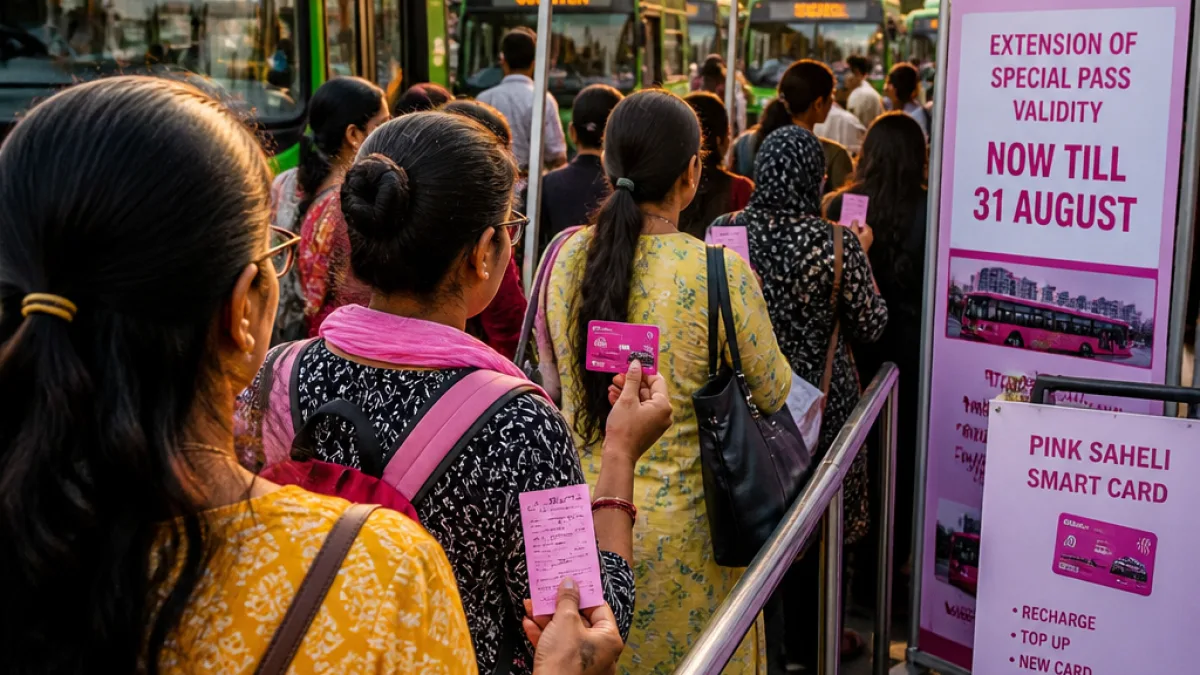
The Delhi government has extended the paper-based pink ticket facility for women passengers on Delhi Transport Corporation (DTC) and Delhi Cluster buses until 31 August, a Transport Department order said on Sunday. The extension comes as authorities continue to roll out the new Pink Saheli smart card intended to replace the paper ticket as the primary instrument for free travel by eligible women.
Why the extension was ordered
The paper ticket system was scheduled to end on 15 August, with the Pink Saheli smart card due to become mandatory from 16 August. However, the Transport Department said additional time was required to enable more women to obtain the smart cards and to avoid disruption of travel for those yet to be enrolled.
Officials told reporters that the government plans a gradual phase-out of paper pink tickets, moving fully to the smart card system once coverage and public awareness reach satisfactory levels. To facilitate conversion, the administration has set up dedicated issuance centres and intensified outreach.
Rollout progress and issuance infrastructure
According to the order, approximately 18 lakh Pink Saheli cards have been distributed till date across the national capital. The transport department has authorised 50 centres for card issuance, spread across the city to improve access.
| Item | Detail |
|---|---|
| Paper-based pink ticket validity | Extended till 31 August |
| Smart card issued | Pink Saheli smart card (around 18 lakh issued) |
| Card issuance centres | 50 authorised centres in Delhi |
Public awareness and implementation steps
The Transport Department has directed authorities to step up public awareness campaigns using depot and in-bus announcements, social media, print media and other channels. The move is intended to ensure eligible women are informed about the smart card and the locations where they can apply.
- Extended deadline: Paper pink tickets usable till 31 August.
- Conversion push: Fifty authorised centres to issue Pink Saheli cards.
- Awareness drive: Depot/in-bus announcements, social and print media campaigns to increase uptake.
Operational and commuter impact
The extension aims to prevent inconvenience to women commuters who depend on free travel concessions on city buses. Transport officials indicated that a staged transition would allow those who have not yet been able to visit issuance centres—owing to work, caregiving or mobility constraints—additional time to secure the smart card without losing entitlement.
For daily users, retaining the paper option temporarily removes the risk of being denied boarding where ticket-readers for smart cards may not be uniformly in place or where card activation is pending. The authorities have also flagged the need for heightened outreach in peripheral areas and among vulnerable groups to accelerate inclusive coverage.
Next steps and monitoring
The government said it will monitor the pace of card issuance and gradually phase out the paper ticket once a pre-determined coverage threshold is met. Transport Department officials will also review the effectiveness of awareness activities and the geographic distribution of the 50 centres to address any access gaps.
Commuters are advised to check announcements at local depots, official social media channels and print notices for details of issuance centre locations and timings. The order emphasises that the paper ticket extension is temporary and part of a transition to the digital Pink Saheli system.
Implementation of the smart-card scheme remains an administrative priority as the city seeks to modernise passenger concessions while ensuring minimal disruption to a large cohort of women who rely on public transport for daily mobility.