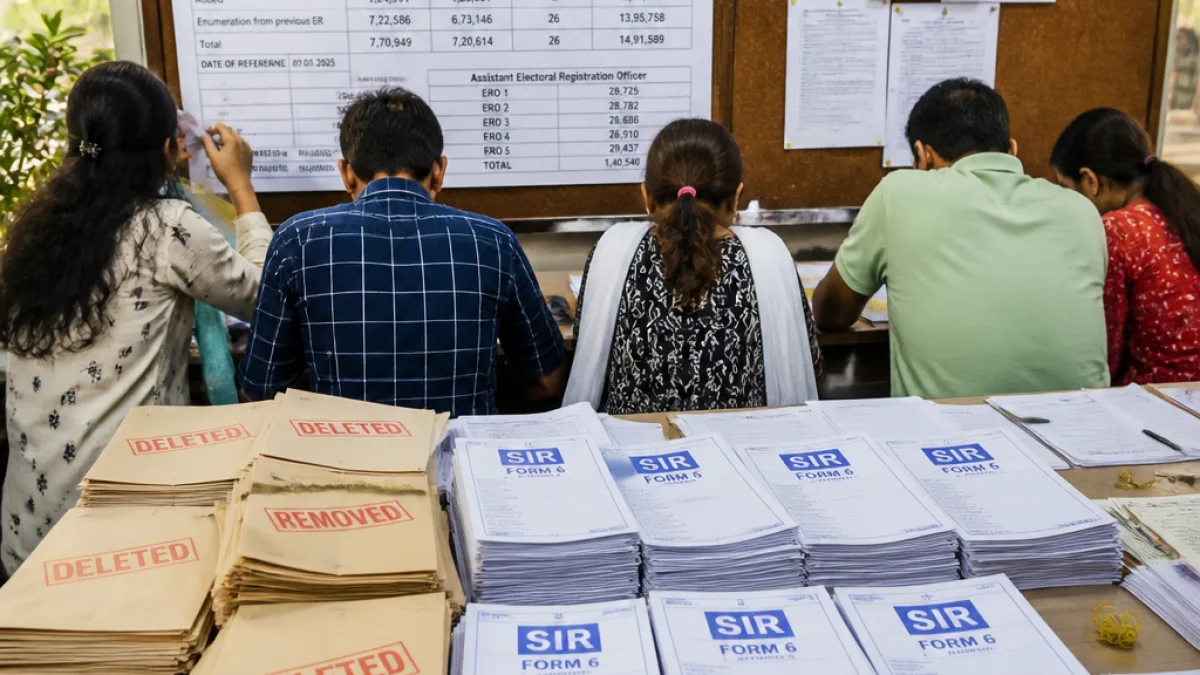
New Delhi: Election Commission data analysed by media outlets shows that almost 1.1 million names were removed from Delhi’s electoral roll between January 2025 — when the rolls were frozen ahead of the February 2025 assembly elections — and June 2026, before the city-wide special intensive revision (SIR) began on June 30.
Large deletions precede SIR
The first phase of the SIR itself deleted nearly 4.8 million names, roughly a third of the Capital’s electorate as of June 20. Overall, Delhi’s electoral roll fell from 15.6 million electors in January 2025 to 14.5 million by June 2026.
Of the deletion tally, the roughly 1.1 million names removed in the 16 months before SIR represent about 7.07% of the city’s electorate as recorded in 2025 and about 11.32% of the current roll. Officials say additions and deletions are continuous processes, but the scale of deletions in this interval is markedly larger than in comparable earlier periods.
Practical impact on voters
The pre-SIR deletions had immediate consequences during the SIR exercise. Several people across the Capital found that their partially filled SIR forms were never generated because their names were absent from the rolls, meaning booth-level officers did not receive the forms and these electors did not get the chance to complete the enrolment process.
“When SIR started, everybody in my family received an SIR form except me. We went to the BLO multiple times, but he said my name is not there and I should register afresh later using Form 6,”
The domestic worker quoted in reporting, who said she had voted in the 2020 assembly and 2024 Lok Sabha elections, lives in Mubarakpur Dabas in northwest Delhi. Her case highlights how deletions can leave regular voters unaware that they must re-enrol by standard forms rather than through the SIR process.
Why deletions happen and how they compare historically
Election rolls are subject to continuous revision: additions via Form 6 and deletions via Form 7 can occur when the rolls are not frozen. Data points cited alongside the deletions show the roll grew by 0.4 million between the 2020 assembly polls and the 2024 Lok Sabha polls, and again by 0.4 million between the 2024 Lok Sabha and the 2025 assembly polls — indicating additions exceeded deletions in those earlier stretches.
However, nearly 0.3 million of the 1.1 million deletions were recorded between May and June 2026 during the pre-SIR mapping phase, a concentrated burst that further reduced the register ahead of the intensive revision.
Table: Electorate figures and deletions
| Period / Figure | Number |
|---|---|
| Electors (January 2025) | 15.6 million |
| Electors (June 2026) | 14.5 million |
| Names deleted during SIR first phase | 4.8 million |
| Names deleted Jan 2025 – Jun 2026 (pre‑SIR) | ~1.1 million |
| Deletions May–Jun 2026 (pre‑SIR mapping) | ~0.3 million |
Administrative and voter remedies
Electoral officials note that when rolls are frozen ahead of exercises, ordinary additions do not carry forward in the same manner and those intending to enrol may need to use Form 6 outside the SIR notice-and-rectify process. The absence of SIR forms for those deleted pre-SIR meant affected persons had to approach their booth-level officers or submit Form 6 directly, potentially delaying their re‑inclusion.
- Who to contact: Booth‑level officers (BLOs) for local clarifications.
- How to re‑enrol: Submit Form 6 to be added to the rolls if your name is missing.
- Where to check: Electors should verify their names on the ECI portal or local electoral office.
Political and civic implications
The scale of deletions has immediate implications for representation and turnout in parts of the city, especially among habitual voters who may be unaware their names were removed. Civil-society activists and political parties often monitor roll revisions closely because changes in the register can affect micro-level electoral calculations.
Election Commission procedures allow for continuous updating, but electoral experts stress that communication and transparency are crucial so that electors deleted during interim periods receive timely guidance on how to regain enrolment.
As Delhi proceeds with SIR phases and subsequent checks, election authorities will face pressure to ensure those whose names were removed get clear, accessible routes back onto the rolls ahead of any future polls.