New Delhi: The office of the Chief Electoral Officer (CEO), Delhi on Monday released the draft electoral roll for the national capital, revealing that 47.7 lakh electors out of a total electorate of 1.45 crore have been marked as excluded under the new revision exercise.
House‑to‑house enumeration digitised most but not all forms
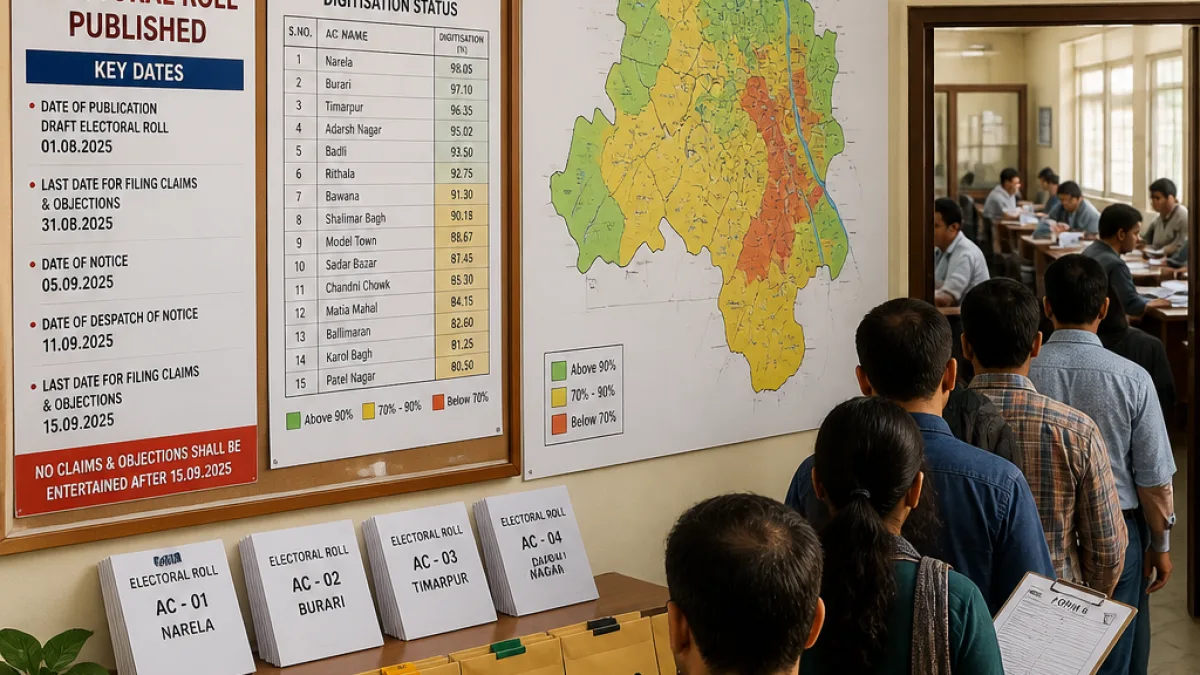
The draft roll shows that around 97.5 lakh electors were included after their enumeration forms were received and digitised during a Special Intensive Revision (SIR), a door‑to‑door exercise that ran from June 30 to August 17. Overall, forms of about 67.18 per cent of Delhi's 1,45,10,299 electors were digitised during the process.
The CEO's office categorised the remaining 47.7 lakh electors as "uncollectable" under the ASDDO rubric — Absent, Shifted, Dead, Duplicate and Others — and consequently they do not figure in the draft roll published on Monday.
"Those excluded can file their claims till September 30 through Form 6 and supporting documents," said the Chief Electoral Officer, according to the notification.
Claims, objections and the timetable
Under the revised schedule issued by the Election Commission, claims and objections arising from the draft roll will be examined and notices issued where required. The disposal process for these matters will continue until October 29. The final electoral roll is slated to be published on November 4.
Electors whose forms were not collected during the SIR have been allowed to seek inclusion in the roll through the prescribed claims and objections mechanism. The CEO's office has specified Form 6 as the route for such claims and has required supporting documents to be submitted with the form.
- Draft roll published: Monday (date of notification)
- Last date to file claims (Form 6): September 30
- Claims and objections disposal period: up to October 29
- Final roll publication: November 4
Variation across constituencies
The extent of digitisation varied widely among Delhi's 70 Assembly constituencies. Rohini recorded the highest digitisation rate at 83.43 per cent, while Tughlakabad registered the lowest at 52.15 per cent, indicating uneven coverage of the house‑to‑house enumeration across the city.
| Metric | Figure |
|---|---|
| Total electors (approx.) | 1,45,10,299 |
| Electors digitised in SIR | 97.5 lakh (≈67.18%) |
| Electors labelled ASDDO (excluded) | 47.7 lakh |
| Highest constituency digitisation | Rohini — 83.43% |
| Lowest constituency digitisation | Tughlakabad — 52.15% |
What electors should do
Electors who find they have been excluded from the draft roll need to act within the timelines set by the CEO's office. Inclusion requests must be filed via Form 6 along with the prescribed proofs of identity, address and age as applicable. Claims submitted during the window will be considered before the final roll is published on November 4.
Election officials will issue notices and examine objections; where discrepancies or duplicate entries are found, inquiries will be conducted and appropriate corrections made before the final roll is sealed.
Context and implications
The Special Intensive Revision was undertaken to update the electoral roll through primary enumeration rather than relying solely on claims received online or through periodic updates. Such large‑scale door‑to‑door exercises are designed to improve the accuracy of the roll but can also produce significant numbers of entries marked ASDDO when enumerators are unable to obtain or verify information at a dwelling.
The exclusion of almost a third of the electorate in the draft has implications for voter outreach and administrative follow‑up over the next two months. Political parties, civic groups and individual electors will be watching the claims and objections window closely to ensure eligible voters are not left off the final list.
Further details, including the procedure for filing Form 6 and a list of required supporting documents, are available through the CEO, Delhi, and the Election Commission's official portals.