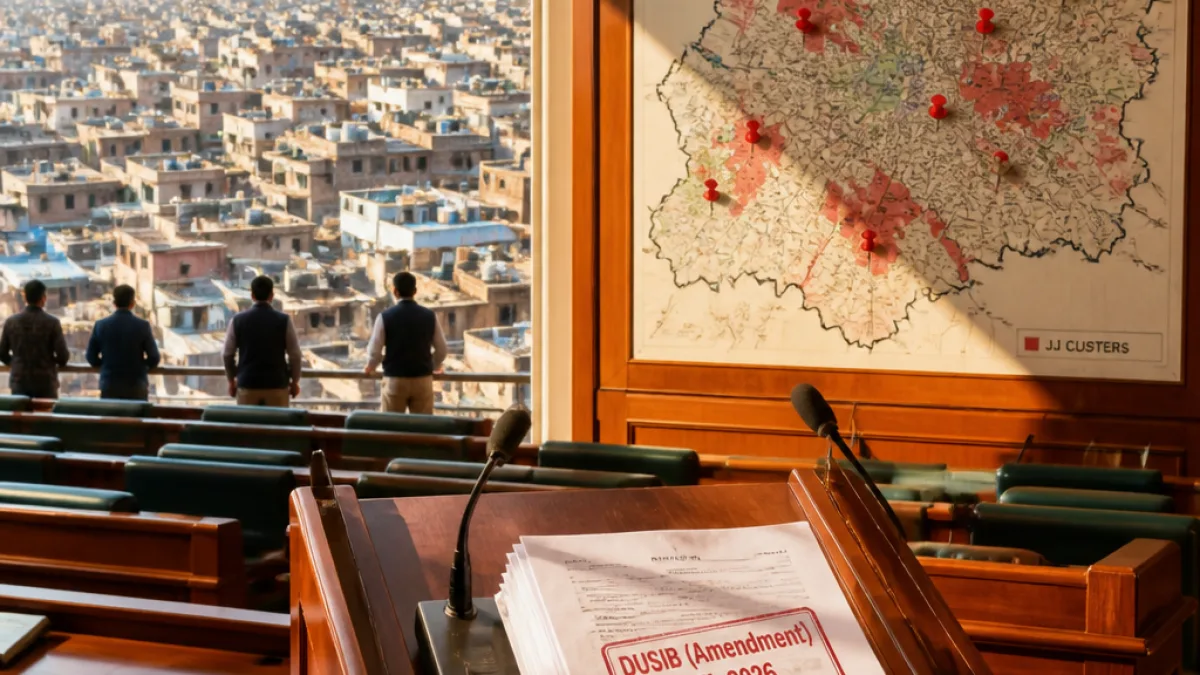
The Delhi government on Monday introduced a bill in the Assembly to advance the statutory cut-off date for recognising jhuggi jhopri (JJ) clusters, a move that could expand eligibility for rehabilitation, relocation and basic services to settlements established in the past two decades.
Key change in the DUSIB Act
The Delhi Urban Shelter Improvement Board (Amendment) Bill, 2026 was tabled by Urban Development Minister Ashish Sood. The proposed amendment seeks to alter the DUSIB Act, 2010 by replacing the current cut-off date of 1 January 2006 with 1 January 2025 for the purpose of identifying a cluster as a JJ basti.
Under the existing statute a cluster is eligible for recognition if it has at least 50 households and had been in existence as of 1 January 2006. The bill keeps the 50-household threshold but shifts the qualifying date forward by 19 years, potentially allowing settlements formed between 2006 and 2025 to be treated as JJ bastis under law.
Government rationale and policy link
The amendment is presented as necessary to harmonise the DUSIB Act with the Delhi Slum and Jhuggi Jhopri Rehabilitation and Relocation Policy, 2026. The bill states the 2026 policy was framed to provide a "contemporary and realistic framework" for relocation and rehabilitation of eligible slum-dwellers, and that the legal change is needed to give the policy a statutory foundation and enable implementation.
"The 2026 policy was framed to provide a ‘contemporary and realistic framework’ for the relocation and rehabilitation of eligible slum-dwellers," the bill notes.
An official involved in policy implementation said the amendment could "significantly expand" the number of JJ clusters eligible for government intervention. Current official records show 675 recognised JJ clusters in Delhi, while officials estimate the actual number to be about 750, with several settlements coming up after 2015.
What DUSIB is empowered to do
If enacted, the amendment will allow the board to bring more settlements under statutory protection and subject them to the board’s duties under sections 10, 11 and 12 of the DUSIB Act. Those provisions require DUSIB to prepare resettlement schemes and provide basic amenities including toilets, water supply, drainage and paved lanes.
| Provision | Existing law | Change proposed |
|---|---|---|
| Cut-off date for JJ recognition | 1 January 2006 | 1 January 2025 |
| Minimum household threshold | 50 households | Remains 50 households |
| Statutory duties | Sections 10–12: resettlement, amenities | No change — enables wider application |
Potential impact on residents and city planning
JJ clusters host thousands of working-class families — drivers, domestic workers, vendors and auto-rickshaw operators — who form a large part of Delhi’s informal economy. Bringing newer settlements within the DUSIB framework could open avenues for planned redevelopment, basic-service provision and formal resettlement schemes.
Officials say formal recognition would mean eligible bastis can be included in resettlement schemes and benefit from sanctioned works for water, sanitation and lanes that DUSIB is required to undertake.
- Who benefits: Residents of clusters formed after 2006 and before 2025 that meet the 50-household threshold.
- What changes: Eligibility for resettlement schemes and basic amenities under DUSIB responsibilities.
- What stays the same: Household threshold and the board’s duties under sections 10–12 of the Act.
The government will need to finalise identification and verification mechanisms to determine which settlements qualify under the new date. That process is likely to require surveys, documentation and coordination with municipal agencies and resident groups.
Political and legal context
The bill follows the framing of the 2026 rehabilitation and relocation policy and represents a legislative step to align the statute with policy intent. Final passage will depend on Assembly debates and may attract scrutiny from civil-society groups, resident associations and legal stakeholders concerned about criteria for recognition, resettlement standards and safeguards for affected households.
For now, the proposed amendment signals the Delhi government’s intent to broaden the legal scope of slum rehabilitation efforts and to provide a statutory basis for newer policy measures aimed at informal-settlement redevelopment.
City: New Delhi