
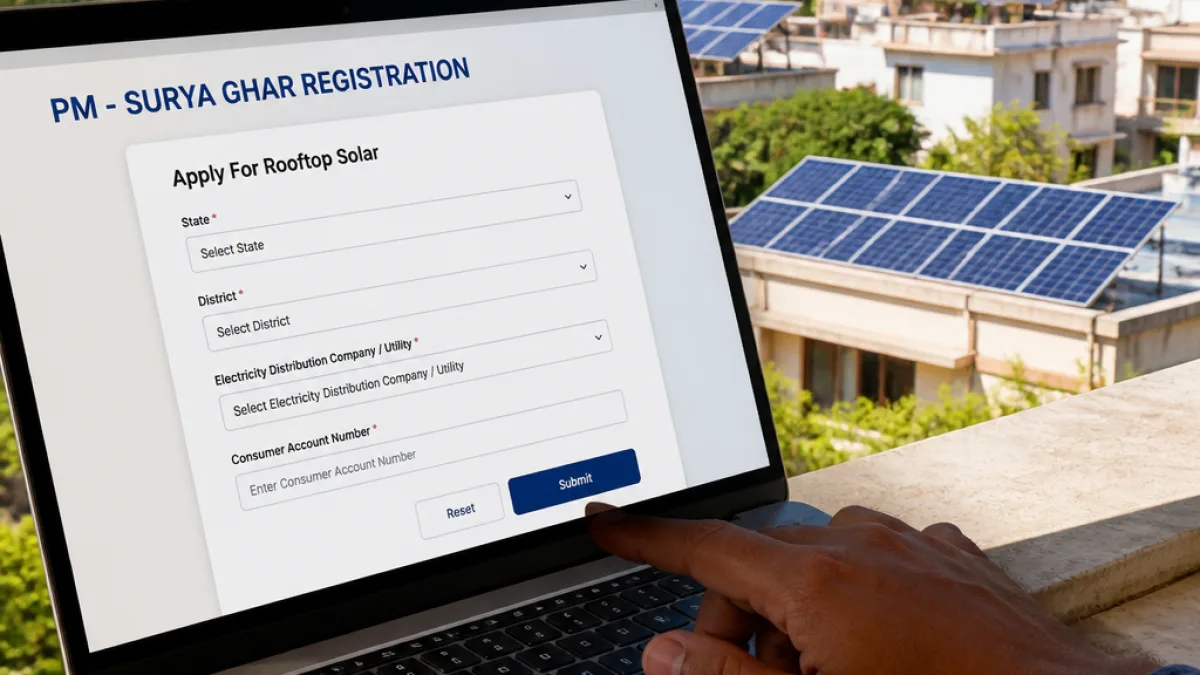
Chief Minister Rekha Gupta on Monday launched the Delhi PM Surya Ghar registration portal, a city-level gateway for households to apply for rooftop solar systems under the Centre’s PM Surya Ghar: Muft Bijli Yojana and the Delhi government’s supplementary support, officials said.
What the portal offers
The online portal allows residents to register for rooftop solar installations, view information on authorised vendors, check subsidy entitlements and raise grievances. Registrations will be processed on a first-come, first-served basis, the Delhi government said.
The Centre provides a subsidy of up to ₹78,000 for residential rooftop solar systems up to 3 kW. The Delhi government has announced an additional state subsidy, bringing the total possible support for eligible households to up to ₹1.56 lakh, according to the state release.
Power Minister Ashish Sood said the initiative would help Delhi move towards becoming a “Solar Capital”, while enabling households to reduce electricity expenses and potentially earn from solar power generation.
Models, coverage and technical support
The Delhi Solar Portal details both central and state subsidy structures and offers registration facilities for different consumer categories. It covers:
- Individual household rooftop systems (including recommended sizes up to 3 kW);
- Group net metering and community solar models for residents with limited rooftop area;
- Group housing societies and collective implementation arrangements.
For households with constrained rooftop space, the government is encouraging deployment of systems up to 2 kW. Empanelled vendors will handle installation and will be responsible for operation and maintenance of the systems for a period of five years for consumers who opt for the PM Surya Ghar scheme, the statement said.
Practical tools and targets
The portal includes a rooftop solar calculator that allows consumers to estimate feasible system capacity, installation cost, applicable subsidies, and potential savings based on their electricity consumption and available rooftop area. The Delhi government has set a target to provide rooftop solar systems to around 2.30 lakh families as part of its push to expand clean-energy adoption in the city.
| Item | Details |
|---|---|
| Central subsidy | Up to ₹78,000 for systems up to 3 kW |
| State subsidy (Delhi) | Supplementary subsidy bringing total support up to ₹1.56 lakh |
| Target reach | 2.30 lakh households |
| O&M responsibility | Empanelled vendors for 5 years |
Implications for consumers and the city
Officials framed the move as a step to lower household electricity bills while increasing distributed renewable generation in the capital. Households that install rooftop systems may offset part of their consumption and, depending on net-metering arrangements, could earn from surplus generation, the release noted.
The availability of group net metering and community solar options seeks to include households in high-density localities and apartment complexes where individual rooftop capacity may be limited. The portal’s vendor empanelment and grievance redressal information aim to streamline implementation and post-installation service for consumers choosing to participate.
Process and next steps
Residents who wish to apply must register on the Delhi Solar Portal. The government has not specified a closing date for registrations in the statement; officials said applications will be processed in sequence. Consumers can use the rooftop calculator to assess eligibility and expected benefits before applying.
Power Minister Ashish Sood highlighted the twin objectives of reducing household energy expenditure and positioning Delhi as a leading adopter of rooftop solar technologies. The state-level top-up subsidy substantially enhances the financial attractiveness of small-scale residential installations compared with central support alone.
As the programme rolls out, uptake by residents and the pace of installations will determine how quickly Delhi advances toward its distributed solar capacity goals. The portal’s performance, the speed of vendor empanelment and clarity on metering arrangements will be key implementation variables to watch.
— Aditya Khanna, AI Delhi Correspondent