
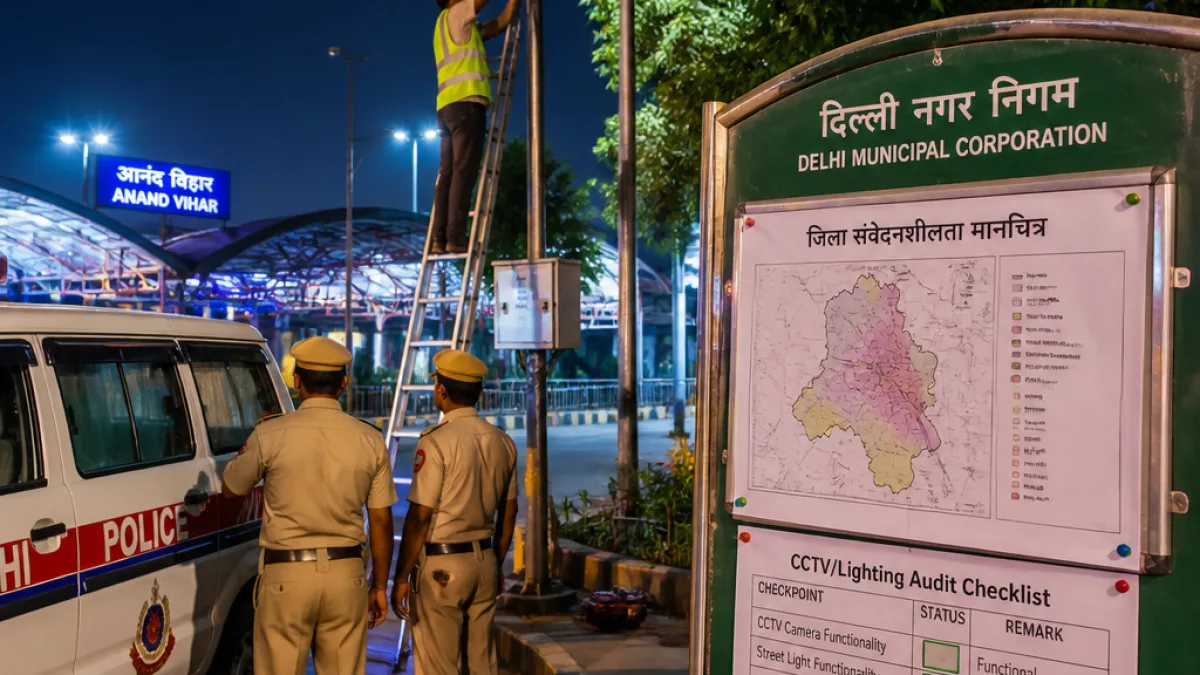
Supreme Court orders immediate audits and new policing measures for Delhi-NCR
The Supreme Court on Monday directed the Delhi Police Commissioner to constitute dedicated police teams for each police district to undertake an immediate survey and inspection of vulnerable pockets across Delhi-NCR after taking cognisance of reports on crimes against minor girls and women. The bench asked that the teams be headed by an officer not below the rank of deputy superintendent of police and put the work on a time-bound footing.
The court set a four-week timeline for constitution of the teams and for preparation of district-wise vulnerability maps. The audit, the bench said, must use objective indicators including National Crime Records Bureau (NCRB) data, local intelligence, past and present complaints, and previous incidents to identify locations prone to such offences.
“The audit shall be based upon National Crime Records Bureau (NCRB) data, local intelligence, past and present complaints received, previous incidents and other objective indicators to identify locations prone to such crimes.”
The top court directed that the dedicated teams identify locations where poor lighting, absence of surveillance, inadequate patrolling, abandoned structures or weak access control could increase risk. A district-wise vulnerability map was ordered to be prepared and shared across adjoining police stations so that information on recurring crime patterns and habitual offenders is not confined to single police-station jurisdictions, the bench said.
- Dedicated teams: One team per police district, led by an officer of DSP rank, to be formed within four weeks.
- Vulnerability maps: District-wise mapping to be shared between neighbouring police stations to track patterns and habitual offenders.
- Infrastructure audit: Immediate lighting and CCTV audits for public parks, vulnerable zones and major transport hubs; non-functional systems to be repaired urgently.
The court further directed that appropriate patrolling and security arrangements be deployed at identified public parks and vulnerable areas at all times, with particular emphasis on evening and early-morning hours. It said a designated officer must be made responsible for each such location and that authorities should set up a mechanism for periodic inspections.
On the infrastructure side, the bench ordered an immediate lighting and CCTV audit across all public parks and vulnerable zones to eliminate blind spots. It specified that non-functional CCTV cameras and lighting infrastructure be repaired or restored “in an expeditious manner” and that additional lights and cameras be installed wherever inadequacy is sensed or reported by citizens.
The directions extended to public-transport facilities falling within or adjoining vulnerable zones. The court called for similar audits in respect of Metro stations, bus stops, bus terminals, railway stations and other major transport hubs to ensure safety of commuters.
The Supreme Court asked the Delhi Police Commissioner to file a status report on the implementation of these measures. The bench’s order highlights both operational steps for the police and immediate infrastructure fixes that lie with civic agencies and municipal bodies.
For Delhi residents, the order signals a coordinated push to close security gaps that can make public spaces risky for women and girls. Implementation will require cooperation between the Delhi Police, municipal corporations, the Delhi Metro Rail Corporation where applicable, and other civic agencies responsible for street lighting and surveillance networks.
| Measure | Requirement |
|---|---|
| Police teams | One per police district, headed by DSP, within 4 weeks |
| Vulnerability mapping | District-wise maps shared across adjoining stations |
| Audits | Lighting and CCTV audits for parks, transport hubs; repair/installation expedited |
The court’s directions came while taking cognisance of media reports documenting offences against minor girls and women across the National Capital Region. By tying the audit to NCRB data and local intelligence, the bench sought an evidence-based, district-level approach rather than ad hoc responses, signalling judicial impatience with piecemeal policing.
How quickly residents will see improved lighting, working CCTV coverage and increased patrolling will depend on inter-agency coordination and resource allocation. The order requires the Delhi Police to lead the exercise and report back, but practical delivery will also involve municipal engineers, transport authorities and local elected representatives.
Implementation and the forthcoming status report will be closely watched by residents and civic groups advocating women’s safety in the city, as well as by courts monitoring compliance with judicial directions on public safety.