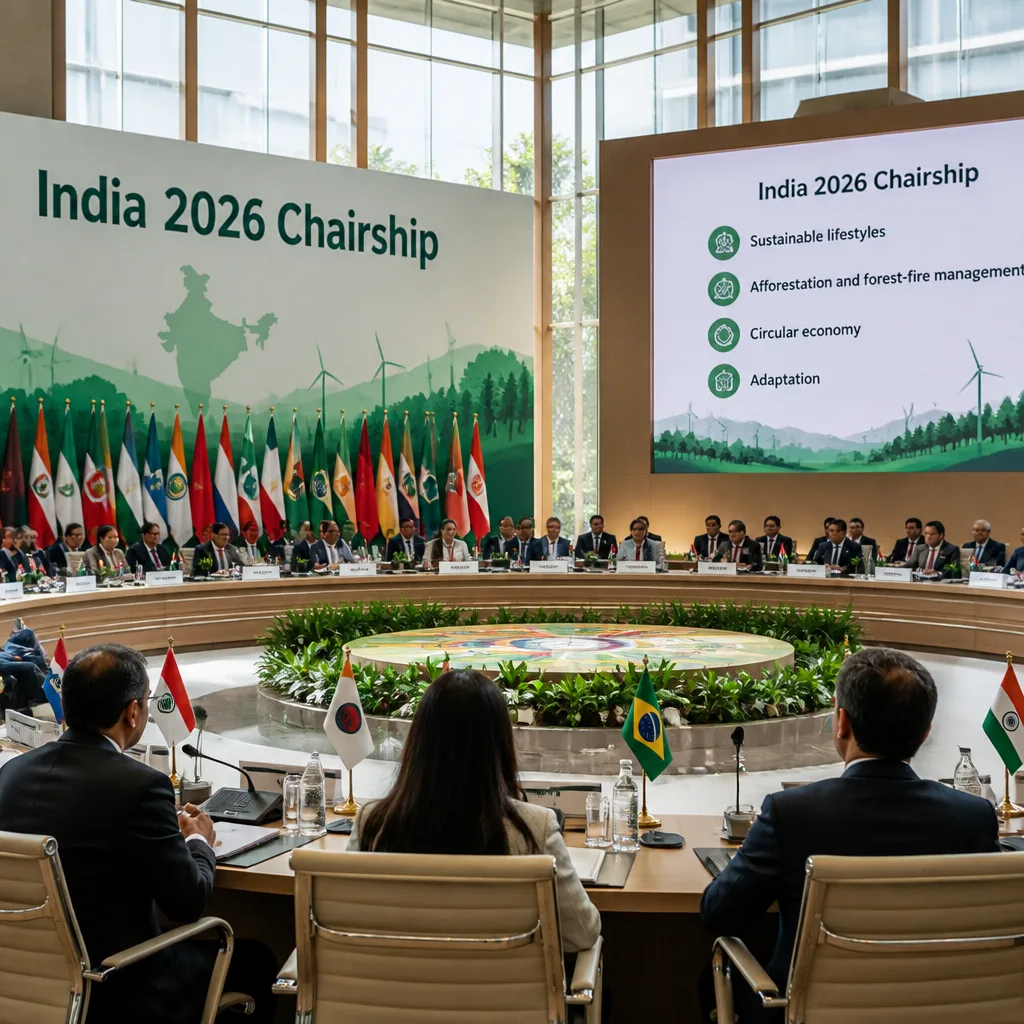
Senior officials representing BRICS member countries gathered in New Delhi on Monday for the Senior Officers’ Meeting of the BRICS Environment Working Group and the Contact Group on Climate Change and Sustainable Development, held at Bharat Mandapam and chaired by Tanmay Kumar, Secretary, Ministry of Environment, Forest and Climate Change (MoEFCC).
Agenda and Indian chairship focus
The meeting brought together delegations from Brazil, China, Egypt, Ethiopia, Indonesia, Iran, Russia, South Africa and the United Arab Emirates to review cooperative priorities on environmental protection, climate change and sustainable development under India’s BRICS Chairship for 2026. According to the chair, India’s approach reflects Prime Minister Narendra Modi’s stated aim of a people-focused, "humanity-first" cooperation and the Chairship theme: “Building for Resilience, Innovation, Cooperation, and Sustainability.”
Officials at the meeting highlighted shared environmental challenges — rising pollution, biodiversity loss and global warming — and discussed integrated approaches that balance ecological sustainability with development goals.
Four priority areas agreed
Delegates identified four interconnected priority areas for BRICS environmental cooperation during India’s tenure as chair. These were set out as the principal focus for joint action and knowledge exchange:
- Promoting sustainable lifestyles to reduce resource intensity and environmental footprints.
- Afforestation, forest fire management and disaster resilience, recognising forests’ role in adaptation and risk reduction.
- Circular economy measures aimed at resource efficiency and waste reduction.
- Adaptation to climate impacts, including strengthening resilience of communities and ecosystems.
| Priority area | Main focus |
|---|---|
| Promoting sustainable lifestyles | Behavioural change, consumption patterns, public awareness |
| Afforestation & forest fire management | Tree cover, fire prevention, disaster preparedness |
| Circular economy | Resource efficiency, waste management, reuse and recycling |
| Adaptation | Climate resilience, ecosystem-based approaches |
Policy framing and institutional emphasis
Tanmay Kumar, chairing the meeting, said the BRICS platform had evolved over the past two decades from primarily an economic dialogue to a forum increasingly engaged with major global environmental issues. The discussion emphasised the need for coordinated, practical responses to transboundary challenges and for aligning environmental action with national development imperatives.
Participants discussed mechanisms for knowledge sharing, capacity building and cooperative initiatives across the member states. The meeting underlined environmental governance, resource efficiency and nature-based solutions as recurring themes where BRICS countries could pool technical expertise and finance instruments.
Implications for India and multilateral cooperation
India’s chairship and the meeting’s outcomes signal a diplomatic push to anchor environmental cooperation within the BRICS framework at a time when global negotiations on climate and biodiversity are testing the multilateral system. For India, steering the agenda offers an opportunity to highlight national programmes and scalable approaches — for instance, afforestation drives, disaster resilience planning and circular-economy pilots — that other members may adapt to their contexts.
While the meeting set broad priorities, operational details — such as joint workplans, timelines, funding modalities and measurable targets — were left to subsequent technical exchanges and the working group’s follow-up sessions. The emphasis on adaptation and resilience aligns with concerns voiced across developing economies about the disproportionate impacts of climate change and the need for finance and technology that supports on-the-ground resilience measures.
Delegates agreed to continue work through the Environment Working Group and the Contact Group on Climate Change and Sustainable Development during the remainder of India’s chairship, aiming to convert the identified priorities into actionable cooperation and to share best practices among BRICS partners.