
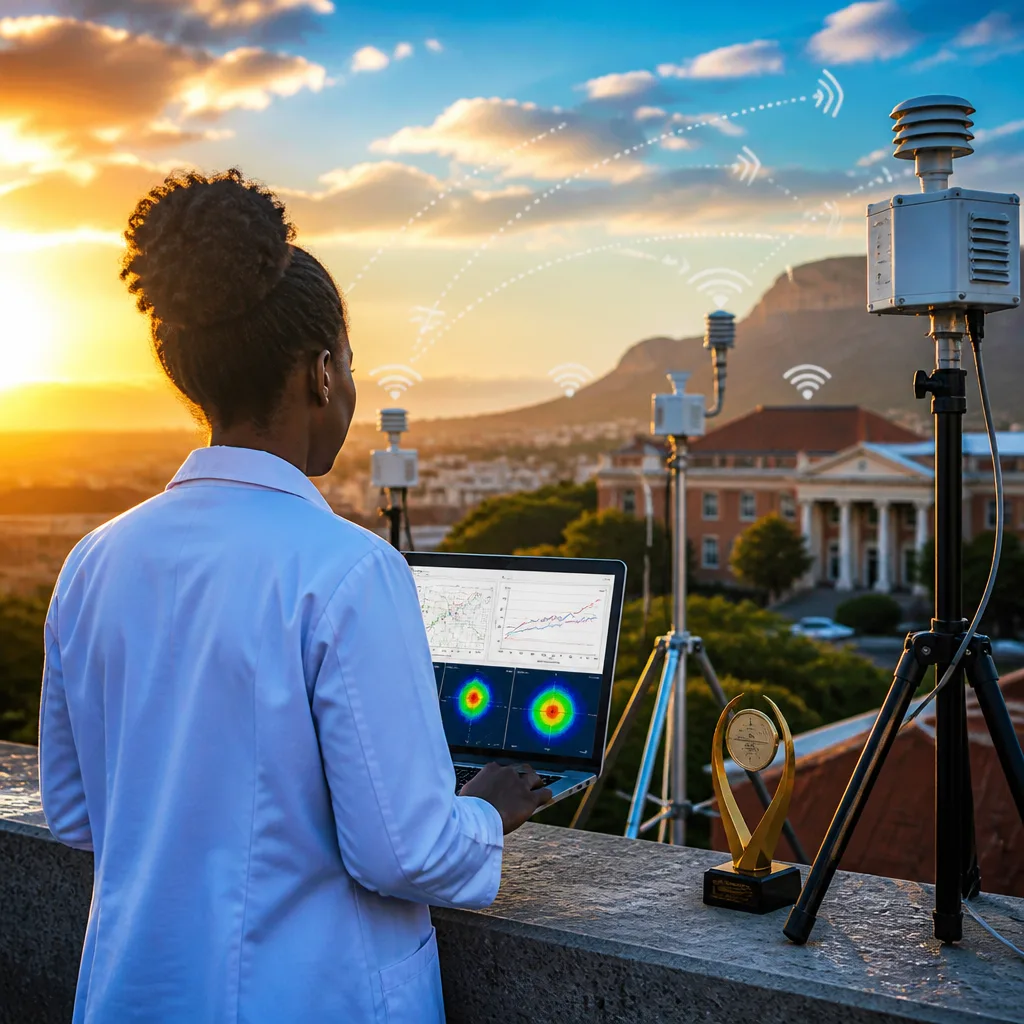
Researchers at the University of the Witwatersrand (Wits) have translated decades of particle‑physics expertise into an artificial intelligence system that identifies dangerous air pollution before it harms people. The platform, called AIrSynQ, combines low-cost sensors, wireless networks and machine learning and was recognised with the 2025/2026 NSTF‑South32 Innovation Award for Small, Medium and Micro Enterprises.
From subatomic particles to airborne hazards
The project was led by a physicist who spent much of his career designing detectors for subatomic particles. According to Wits reporting on 18 August 2026, the same principles that underpin sensitive particle detectors were adapted to measure and interpret airborne particulate matter and other pollutants in urban and institutional settings.
AIrSynQ is the product of the South African Consortium of Air Quality Monitoring (SACAQM) and Wits’s AI_r research platform. The system has been trialled in a variety of environments including schools, hospitals, libraries, research centres and community facilities, where early detection can prevent exposure and guide responses.
“Bruce, you need to think broadly. Identify those areas in your research that could be useful for other people and have an impact in society,”
Wits said this admonition, offered by the late Dr Daniel Adams when the lead researcher moved from the United States, prompted a shift in emphasis from pure particle physics to practical environmental monitoring.
How AIrSynQ works
- Affordable sensors — small, low-cost detectors that report levels of particulate matter and related air-quality metrics.
- Wireless communication — networks that transmit sensor readings in near‑real time to central servers.
- Artificial intelligence — machine-learning models that detect patterns, forecast deteriorations in air quality and flag hazardous conditions before they occur.
Researchers emphasise that the system is designed to be scalable and deployable in resource-constrained settings, offering an environmental risk service that can be used by institutions and municipalities to manage exposure and inform policies.
Awards and validation
The NSTF‑South32 Innovation Award acknowledges technological developments with clear potential to benefit society and the economy. Wits reported that AIrSynQ won the award for Small, Medium and Micro Enterprises in the 2025/2026 cycle, signalling peer recognition from the national science and technology community.
| Item | Detail |
|---|---|
| Project name | AIrSynQ |
| Lead group | South African Consortium of Air Quality Monitoring (SACAQM), Wits |
| Award | NSTF‑South32 Innovation Award — 2025/2026 (SME category) |
Context and potential impact
Air pollution remains a significant public‑health issue in South Africa, particularly in cities and near industrial zones. Real‑time, affordable monitoring helps authorities and community institutions understand where risks are highest, and when interventions are required. By applying techniques from particle physics, the Wits team aims to lower the cost barrier to continuous monitoring and to provide predictive warnings rather than retrospective readings.
The project builds on earlier collaborative work that connected South African researchers to international facilities and expertise. Wits reported that SACAQM evolved out of partnerships and has tested its platform in diverse real‑world locations to refine models and detection thresholds.
Researchers caution that technological solutions are part of a broader response: accurate monitoring must be paired with regulatory action, emission reduction strategies and public‑health planning to cut exposures effectively. Nevertheless, AIrSynQ represents a practical example of scientific translation — taking methods developed for fundamental physics and shaping them to deliver environmental and social benefits.
Further deployment and independent evaluation will determine how widely the system can be rolled out across municipalities and institutions. The NSTF‑South32 award indicates national recognition but does not substitute for regulatory adoption or large‑scale operational testing.
What to watch next:
- Further field trials in municipal and industrial settings.
- Independent validation studies comparing AIrSynQ outputs with reference monitoring stations.
- Engagement between developers, local government and public‑health agencies about scaling and integration into early‑warning systems.









