
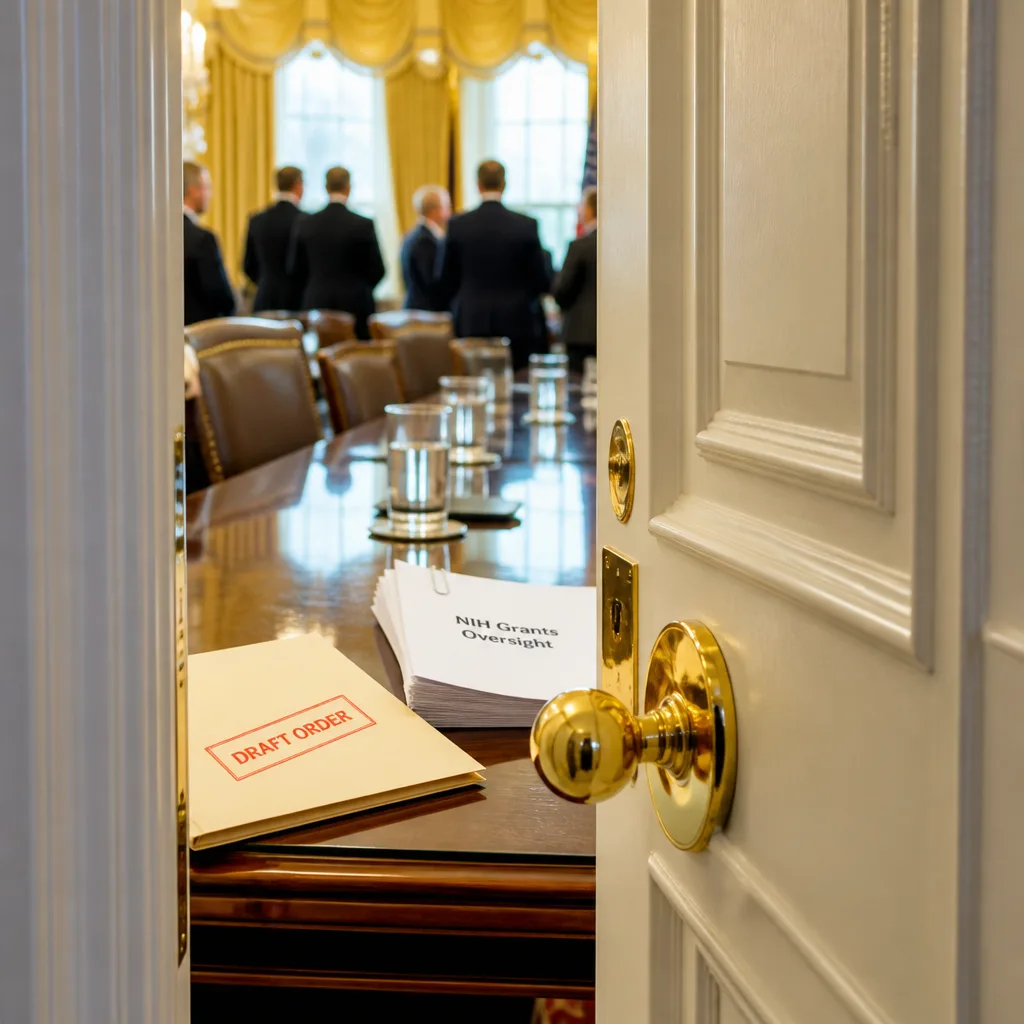
The White House discussed creating a political board to supervise and potentially overrule National Institutes of Health (NIH) grant decisions, according to reporting by Politico. The proposal, raised at a meeting attended by the president and senior aides, would mark a significant shift from the long‑standing scientific peer‑review system that governs federal health research funding.
Who was in the meeting
Those identified as present at the meeting included the president, Office of Management and Budget (OMB) official Russell Vought and public health economist Jay Bhattacharya. Education Secretary Linda McMahon was also present but is reported not to have participated in the disagreement. Others named were Treasury Secretary Scott Bessent, White House Deputy Chief of Staff Stephen Miller, White House Counsel Will Scharf, and OMB General Counsel Mark Paoletta. The OMB declined to comment on the meeting.
| Person | Role (as reported) |
|---|---|
| Russell Vought | OMB official advocating greater political oversight |
| Jay Bhattacharya | Public health economist, present at the meeting |
| Linda McMahon | Education Secretary; present but not participating |
| Scott Bessent | Treasury Secretary |
| Stephen Miller | Deputy Chief of Staff |
| Will Scharf | White House Counsel |
| Mark Paoletta | OMB General Counsel |
What the proposed change would do
For decades, NIH grant applications have followed a two‑level review system. First, scientific peer‑review panels assess the technical and scientific merit of applications. Second, advisory councils make recommendations. Final funding decisions are typically taken by the directors of NIH’s 27 institutes and centres, most of whom are career government employees.
The proposal discussed would create a politically appointed board with broader authority to review, terminate or block grants that it deems inconsistent with administration priorities. The change would expand the power of political appointees over federal grant‑making, critics warn, and could shift decision‑making away from scientific experts.
Context and reaction
OMB has previously signalled its intent to increase political oversight of grants. In May, the office proposed a government‑wide rule to give political appointees greater power to block funding they consider incompatible with administration policy. That draft rule attracted criticism from lawmakers across the political spectrum, scientists and several state attorneys general, who warned it might inject politics into research funding choices.
When asked about the meeting, the White House directed inquiries to the Department of Health and Human Services (HHS), which oversees the NIH. An HHS spokesperson provided a statement affirming the agency’s commitment to the NIH mission.
“[The department] is committed to the core mission of the NIH” and “NIH grant monies will be disbursed.”
Observers argue that vesting more authority in political appointees could favour projects aligned with ideological priorities rather than scientific merit, potentially undermining public trust in federally supported research. Proponents of the change, according to the reporting, including Mr Vought, contend that political oversight is necessary to ensure taxpayer funds align with administration goals and to curb perceived bias by career bureaucrats.
- Risk to peer review: Experts say the two‑level peer review system protects scientific integrity and merit‑based funding.
- Centralisation of power: A political board could permit executive branch intervention in individual grant decisions.
- Broad criticism: Lawmakers, scientists and state officials have already criticised OMB’s earlier proposal to expand political control.
The reporting did not provide details of any drafted executive order, nor suggest that a final directive had been issued. The OMB declined to comment on the meeting itself. HHS’s assurance that NIH funds will be disbursed aims to reassure researchers that grant payments will continue while the debate unfolds.
Changes to how health research is funded in the United States could have international consequences, affecting global collaborations and multi‑nation studies. Researchers and institutions in other countries who partner with NIH‑funded teams will be watching developments closely. Anyone with concerns about the effects of such policy shifts on clinical care or treatment access should consult their healthcare provider or clinic for guidance rather than attempting to interpret research policy for personal health decisions.











