More than 120,000 babies acquire HIV each year worldwide. A new preclinical study suggests a one‑off combination of three therapies given very early could permanently clear the virus in newborns, a finding that, if replicated in humans, would transform how congenital HIV is prevented and treated.
What researchers did
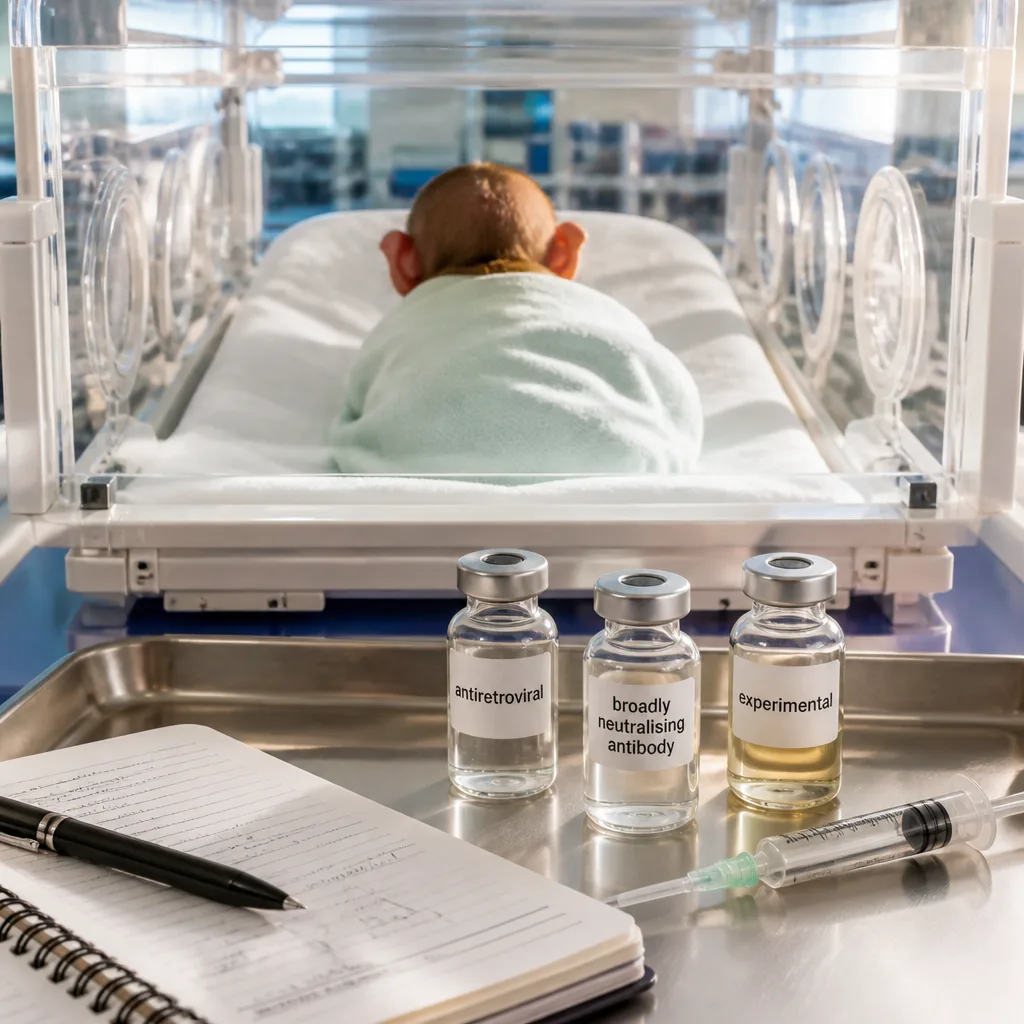
The study, published in Nature Microbiology and led by Oregon Health & Science University (OHSU), treated newborn nonhuman primates within three days of exposure to HIV. Over several weeks the animals received a combination of:
- standard antiretroviral therapy — the drugs widely used to suppress HIV replication;
- broadly neutralising antibodies — laboratory‑made antibodies that can neutralise diverse strains of HIV; and
- leronlimab — an experimental monoclonal antibody that blocks the CCR5 receptor, a protein HIV uses to enter immune cells.
Results and immediate significance
According to the paper and the OHSU team, the combined regimen succeeded in permanently clearing detectable virus in the newborn primates. Individual approaches — antiretrovirals, broadly neutralising antibodies or leronlimab alone — had been tested previously without achieving permanent clearance. The novelty of this work lies in the synergy produced by combining the three modalities early after exposure.
"The really exciting part is that it could go to clinical trials immediately to eliminate HIV infection in newborns," said Jonah Sacha, Ph.D., co‑lead author and professor and chief of pathobiology and immunology at OHSU's Oregon National Primate Research Center and Vaccine and Gene Therapy Institute.
Who was involved and next steps
The experiments involved nonhuman primates housed at the Oregon and California national primate research centres and were the result of a multi‑institutional collaboration. Co‑lead author Nancy Haigwood, Ph.D., a virologist and immunologist, said pairing leronlimab with existing therapies was the idea that drove the study; she described the findings as "astounding" and "overjoying."
The authors note that antiretroviral therapy is already approved for people, while broadly neutralising antibodies and leronlimab are investigational. They identified an immediate pathway towards clinical trials in newborns and emphasised testing in newly exposed adults as a subsequent priority.
Context and caution
It is important to be clear about the limits of the current evidence. The experiment was performed in nonhuman primates, not human infants. Preclinical success is a necessary but not sufficient step toward an effective and safe human therapy. Differences in immune development, drug dosing and safety profiles mean that human trials are needed to establish efficacy and risks in newborns.
For South Africa — where the burden of HIV is among the world’s highest — an intervention that could permanently prevent infant infection would carry major public‑health benefits. However, practical questions remain about cost, manufacturing and delivery of monoclonal antibodies and whether health systems can implement an early‑postnatal protocol that requires very rapid diagnosis and treatment within days of birth.
Summary table of the three components
| Approach | Mode of action |
|---|---|
| Antiretroviral therapy | Suppresses HIV replication |
| Broadly neutralising antibodies | Neutralise diverse HIV strains |
| Leronlimab | Blocks CCR5 receptor, preventing viral entry into immune cells |
The study opens a plausible route to trials in human newborns and possibly in newly exposed adults, but it does not yet change clinical practice. The next steps are carefully designed clinical studies to establish safety, dosing and whether the viral clearance seen in primates translates to durable remission or cure in people.