
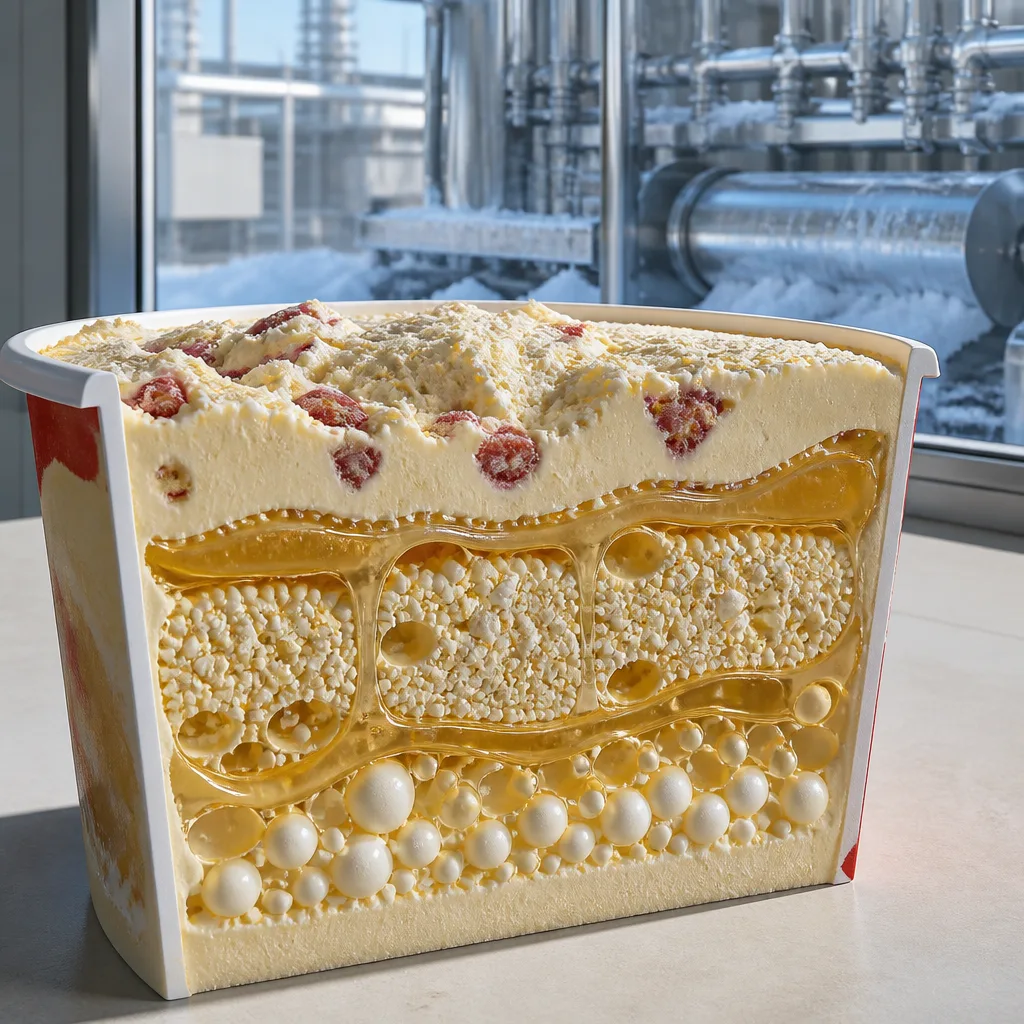
Ice cream is a three-part engineering feat, not merely cream, sugar and flavour frozen together. What you spoon into a cone or tub is a composite of three interacting phases that together produce the texture and stability we expect from the dessert.
What makes up a scoop?
At the microscopic level a commercial scoop contains:
- An unfrozen serum phase — liquid water carrying dissolved lactose, salts and proteins.
- A structural network of fat and ice — millions of tiny fat globules partially coalesced around microscopic ice crystals to form a branching scaffold.
- Air cells (overrun) — intentionally incorporated bubbles that keep the product light rather than heavy.
Each element performs a job: the serum phase supplies free water and soluble components, the fat–ice network gives body and mouthfeel, and air controls density and perceived creaminess.
How industrial production preserves texture
Commercial ice cream makers use specialised scraped‑surface freezers in which rotating blades continuously shear the mix. This action keeps ice crystals tiny and forces fat globules into positions where they can form the load‑bearing framework that stabilises the whole product. The continuous churning and scraping are essential to produce uniform microscopic structures that home methods rarely match.
Another layer of protection comes from additives that are nevertheless common and natural in many recipes: long‑chain hydrocolloids such as guar gum, xanthan gum and carrageenan. These molecules increase viscosity by binding free water, slowing its mobility so that the cream remains smooth despite the temperature shifts encountered during shipping, retail storage and home freezing.
Why homemade ice cream can go grainy
Domestic freezers are not as stable as commercial cold rooms. They experience temperature cycles — periods when the contents warm slightly before re‑freezing. During these cycles, the smaller ice crystals melt and water molecules migrate by diffusion to larger crystals, which then grow in a process called recrystallisation. The result is coarse, crunchy crystals and a degraded mouthfeel.
The stabilising gums reduce this effect by immobilising water and raising the mixture's viscosity; the industrial fat network also helps resist structural collapse. Without these protections, and without the finely controlled mechanical processing of factory equipment, home batches are far more susceptible to texture loss over time.
Why some melted ice cream won’t form a puddle
There are viral demonstrations where an ice cream sandwich or scoop left in the sun appears to melt but not liquefy into a puddle. That behaviour is explained by the same internal architecture: as the ice crystals melt the fat network and stabilising agents continue to hold the mass together. It may become softer and lose shape, but the matrix prevents it from simply collapsing into a liquid pool.
| Component | Role |
|---|---|
| Serum phase (liquid) | Dissolves flavours, sugars and proteins; supplies free water |
| Fat–ice network | Gives structural rigidity and mouthfeel |
| Air (overrun) | Controls density and perceived creaminess |
Practical takeaways for consumers
- Factory pints last longer because they are processed to create tiny ice crystals and a strong fat network, and because stabilisers reduce ice‑crystal growth during temperature changes.
- If you make ice cream at home, keep it at a consistently low temperature and limit the number of times you thaw and refreeze it to preserve texture.
- Don’t be surprised if an ice cream item softens but does not pool when left in warmth: structural ingredients can keep the mass intact even when some melting has occurred.
Understanding these physical and chemical processes shows how modern food science and engineering work together to make a familiar treat reliable in taste and texture across long supply chains. The next time you enjoy a scoop, you can appreciate the tiny crystals, fat networks and air cells doing the hard work behind that smooth mouthfeel.









