
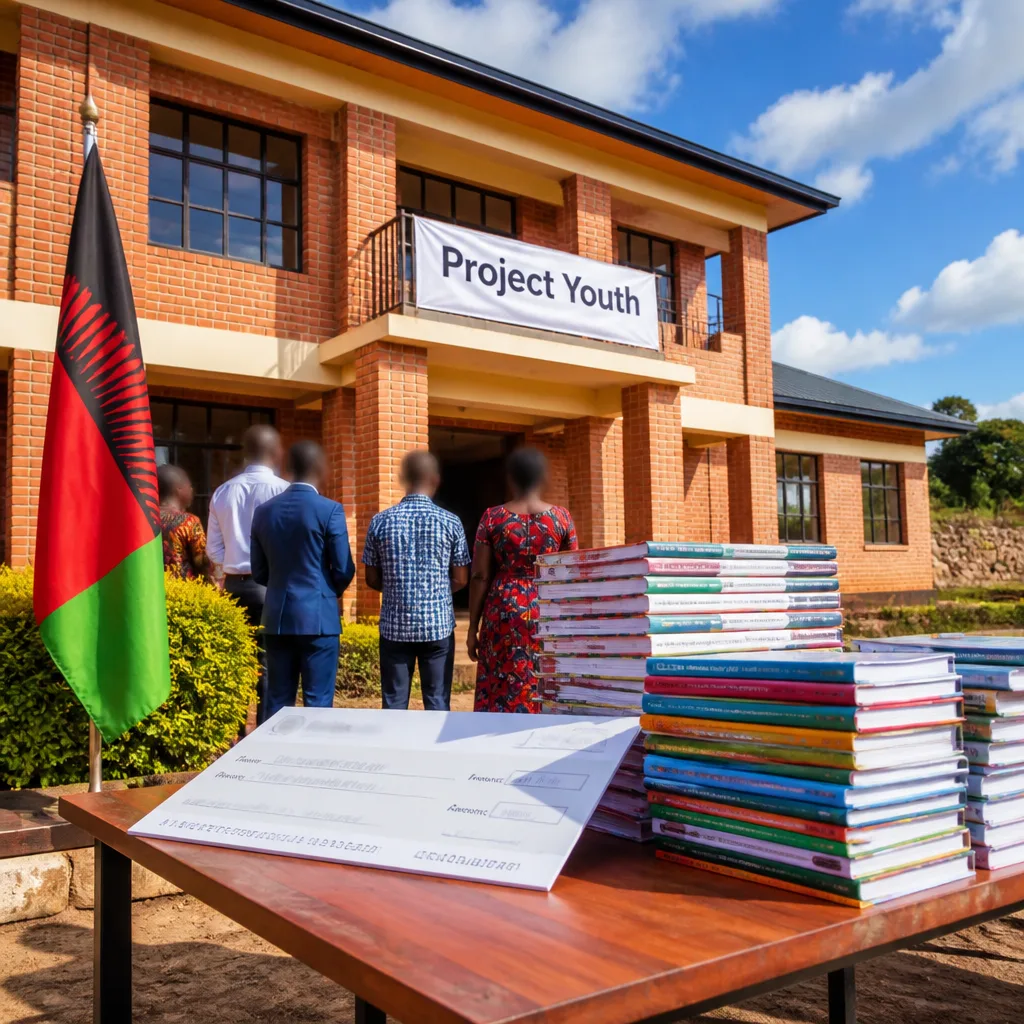
Standard Bank Plc has announced a consolidated education initiative, Project Youth, committing more than K500 million to strengthen schooling, university endowments, vocational training and youth support across Malawi, Steria Manda reported on Monday.
Funds targeted across the education pipeline
The bank said the programme will pool its existing education and youth activities under a single umbrella to offer sustained support at multiple stages of learning — from primary and secondary schools through to universities and vocational institutions.
Of the total commitment, K100 million has been allocated to endowment funds at the Malawi University of Business and Applied Sciences (MUBAS) and the Malawi University of Science and Technology (MUST). MUBAS Vice-Chancellor Nancy Chitera said the timing of the contribution is important for bolstering support for students facing financial hardship.
“Project Youth reflects our belief that education is the greatest enabler of national growth,”
Standard Bank chief executive Phillip Madinga described the programme as a long-term, strategic approach designed to move beyond one-off donations and instead back learners throughout their educational journeys.
Major allocations and implementing partners
The bank outlined a number of specific allocations to implementing partners and projects:
- K261 million for construction of a new block at Chivumbe Community Day Secondary School;
- K64 million to Press Trust to establish a secondary school merit scholarship fund;
- K40 million to Development Aid from People to People (DAPP) Malawi for vocational training;
- K33 million to Hope for the Blind;
- K20 million to CARE Malawi to support its SOAR mentoring project for girls.
The bank also emphasised support for a range of youth-centred organisations, alongside the school and university interventions.
| Recipient/Project | Allocation |
|---|---|
| MUBAS & MUST endowment funds | K100 million |
| Chivumbe Community Day Secondary School (new block) | K261 million |
| Press Trust (secondary school merit scholarships) | K64 million |
| DAPP Malawi (vocational training) | K40 million |
| Hope for the Blind | K33 million |
| CARE Malawi (SOAR girls' mentoring) | K20 million |
Government response and wider implications
Malawi’s education minister, Bright Msaka, welcomed the initiative and said the country requires additional investment in classrooms, teachers and learning materials to expand access and improve transitions from primary to secondary schooling. He highlighted the need for more schools and trained teachers to absorb the numbers of learners completing primary education.
The project’s mix of capital investment, scholarship funding and vocational support reflects growing attention across the region to two persistent challenges: inadequate physical infrastructure in schools and constrained access to post‑school opportunities for learners without financial backing.
For South African readers, the initiative offers a comparative example of a major financial institution taking a multi-pronged approach to education investment in a neighbouring country. The combination of endowment funding to sustain tertiary support and capital investment to expand school capacity illustrates one pathway for private-sector partnerships to strengthen the education pipeline.
How the funds will be managed over time, the specific selection criteria for scholarship beneficiaries, and monitoring mechanisms for construction and training projects were not detailed in the announcement. Civil-society groups and education stakeholders typically seek clarity on such governance arrangements to ensure transparency and that resources reach learners most in need.
Project Youth’s stated emphasis on long-term backing, rather than episodic donations, positions it as a potential model for sustained private investment in education — but its long-term impact will depend on implementation, coordination with government planning, and measurable improvements in access and learner outcomes.
Further reporting from Malawi, including project timelines and beneficiary lists, will be needed to assess whether the investment delivers on the stated aims of increasing school capacity and widening access to higher and vocational education.











