
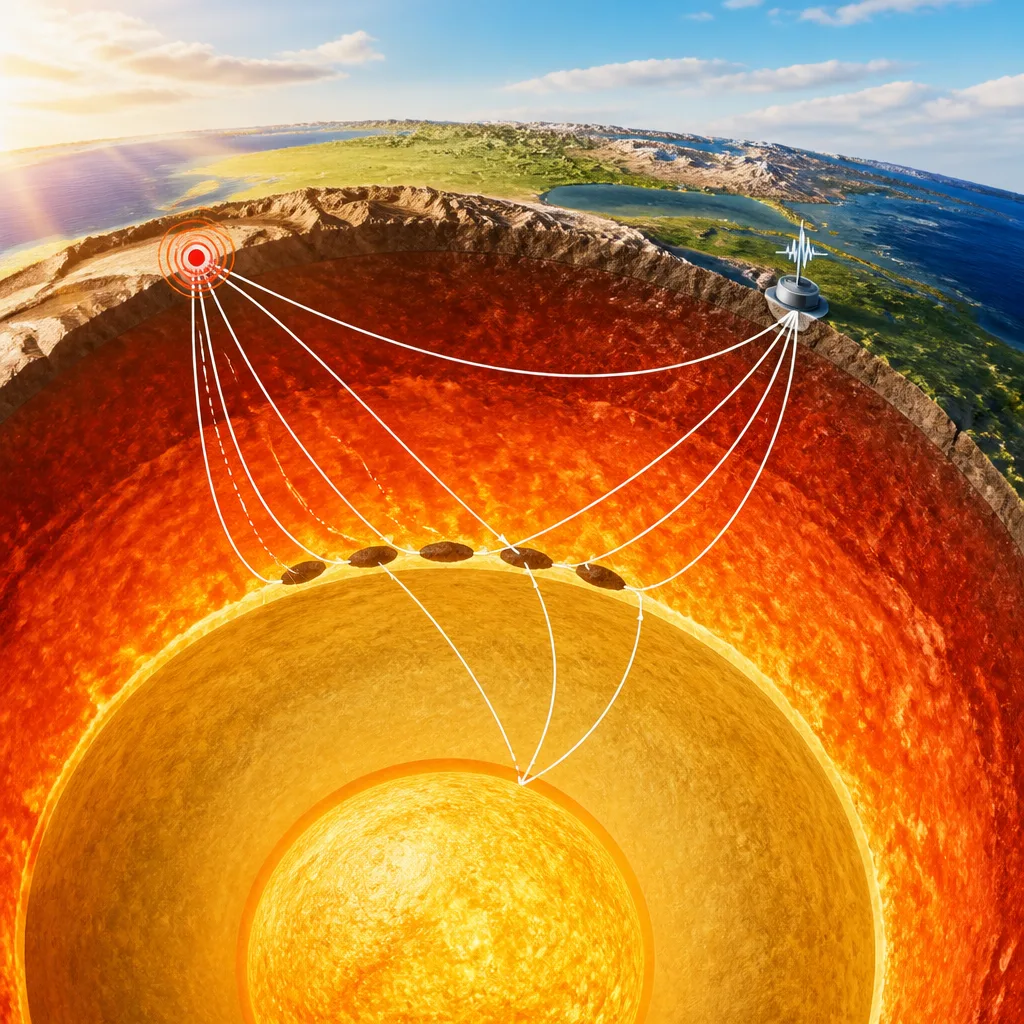
Scientists report the detection of six distinct structures at the boundary between Earth’s liquid iron core and the overlying rocky mantle, roughly 2,900 kilometres beneath the surface. The result, based on analysis of a special class of seismic signals, adds new detail to an area long known to be critical to the planet’s internal heat flow, material recycling and long-term tectonic behaviour.
How do we see so deep?
Direct access to the deep Earth is not possible: the deepest borehole ever drilled, the Kola Superdeep Borehole, reached only 12,263 metres — barely a fraction of the crust. To probe deeper, scientists rely on seismic waves generated by earthquakes and other sources. The recent study focussed on a particular kind of wave known as PKP precursors. These are small, early-arriving features in seismic records that can be scattered or deflected by tiny inconsistencies located just above the core–mantle boundary.
“This boundary is crucial for heat transfer and material cycling inside the planet, yet its fine-scale details remain poorly understood,” the authors wrote.
Because PKP precursors interact sensitively with small-scale heterogeneities, they are useful probes of hidden deep-Earth features that are otherwise invisible to more conventional seismic imaging.
What was found and what it could mean
The analysis indicates the presence of six anomalous regions — small-scale heterogeneities — clustered at the top of the core. The study refrains from asserting a single interpretation for these structures: such heterogeneities might represent compositional differences, patches of distinct temperature, or accumulations of material produced by long-term interactions between the core and the mantle.
Why does this matter for surface processes? Heat and material exchange across the core–mantle boundary influence mantle convection patterns. Those convection patterns, in turn, are a driving force behind plate tectonics, volcanic activity and aspects of the seismic cycle. Although the newly reported structures lie thousands of kilometres beneath the surface, they could contribute to mantle flow configurations that eventually help control where volcanoes form or how stress accumulates along fault systems.
Careful inference, not direct imaging
It is important to distinguish between direct observation and inference. The PKP-precursor method does not produce a photograph; it extracts information from tiny perturbations in seismic waveforms. That makes the technique powerful but also subject to interpretational limits. The study’s authors acknowledge that the features they detect are best viewed as robust signals of heterogeneity rather than a fully resolved map of composition or temperature.
- Deep Earth structure is divided into core, mantle and crust; the core–mantle boundary lies at ~2,900 km depth.
- PKP precursor waves are sensitive probes of small heterogeneities immediately above that boundary.
- The new analysis identifies six such heterogeneities, but their precise nature—thermal, compositional or mixed—remains uncertain.
Context and next steps
Discoveries like this are incremental advances in a field where data are inherently indirect. Future work will test whether the six structures are localised anomalies or part of broader patterns beneath different oceanic and continental regions. Combining PKP-precursor analysis with other seismic methods, mineral physics experiments and numerical models will be essential to constrain temperature, composition and the dynamics of these features.
For South Africa and other nations, improved knowledge of the deep-Earth engine helps refine our broader understanding of tectonics and long-term geohazard risk. While the newly reported structures themselves will not change immediate hazard forecasts, they provide valuable constraints for models that link deep-mantle flow to surface deformation over geological timescales.
As with all deep-Earth studies, the results emphasise a measured approach: the existence of small, distinct heterogeneities at the core–mantle boundary is now better supported, but their interpretation will sharpen only through further seismic sampling and cross-disciplinary work.









