
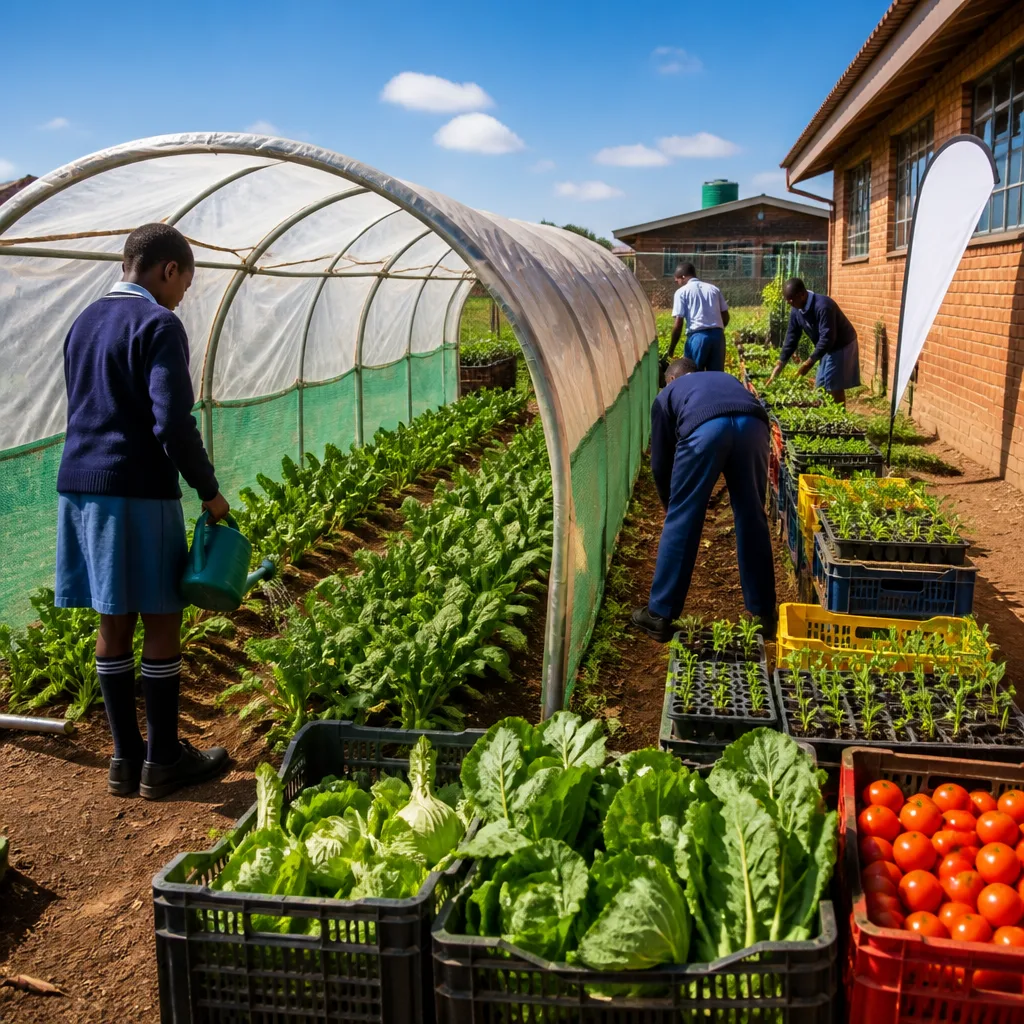
Reiger Park, Ekurhuleni — A horticultural tunnelling programme at Oosrand Commerce and Entrepreneurship School in Reiger Park, east of Johannesburg, is converting classroom theory into commercial gardening skills and reinforcing local food security, according to reporting on the project.
Hands-on agriculture for a generation of learners
The project, established by the Shoprite Foundation two years ago, has enabled the school to move from largely theoretical agricultural lessons to practical, income-generating cultivation. The tunnels allow an entire class of 42 learners to work simultaneously on crops including spinach, cabbage, tomatoes, green peppers, chillies and eggplant.
Over the past two years the initiative has produced approximately 5 000 units of crops, with sales used to sustain the programme by buying compost, seedlings and other inputs. The harvest also supplements the school's feeding scheme, which provides lunch to about 90% of the school's 2 200 learners, the reporting said.
“The school now harvests enough produce to supply the wider Reiger Park community and neighbouring Ramaphosa informal settlement,” said agricultural studies educator Joyce Ngcobo, 51.
From classroom skills to household livelihoods
Educator Joyce Ngcobo told reporters that learners take seedlings and skills home, where space allows, and that some sell produce to neighbours. The practical training is designed to build livelihoods and entrepreneurial capacity among young people, particularly in communities where formal employment opportunities are scarce.
Ngcobo highlighted another social benefit: parents are learning home cultivation techniques from their children, including watering in the evening to conserve moisture. She also noted a shift in perceptions about who can farm; teaching agriculture has challenged the idea that farming is a male preserve and is encouraging young women to consider careers in agriculture.
Community impact and sustainability
The tunnels are large enough for full-class practical lessons, a step up from the school’s previous, smaller tunnel that limited hands-on participation. Sales revenue helps cover ongoing programme costs, making it more sustainable and less reliant on recurrent external grants.
- Produce grown: spinach, cabbage, tomatoes, green peppers, chillies, eggplant
- Harvests: about 5 000 units over two years
- Feeding scheme reach: lunch for approximately 90% of 2 200 learners
- Class size for practical lessons: 42 learners
| Metric | Figure |
|---|---|
| Learners attending school | 2 200 |
| Class size for practical lessons | 42 |
| Produce units harvested (2 years) | ~5 000 |
| Feeding scheme coverage | ~90% |
Skills, gender and local economic potential
The programme intersects several priorities familiar to policymakers and business: food security, youth skills development, and small-scale entrepreneurship. Practical agricultural training at school can reduce barriers to market entry for young farmers by providing starter knowledge, early access to inputs, and a route to generate modest incomes. It also helps retain value within communities by supplying local markets and feeding schemes.
Educators see long-term promise: besides immediate benefits to learners and school meals, the programme can foster a pipeline of smallholders who may supplement household incomes or build micro-enterprises. That matters in peri-urban areas such as Reiger Park, where formal job creation has not kept pace with demand.
The Shoprite Foundation’s role demonstrates how corporate social investment can be structured to produce tangible outcomes — yields that feed into school nutrition, skills that translate into livelihoods, and revenue that supports programme sustainability. For households, the combination of free school meals and the ability to grow or buy cheaper, locally produced vegetables can ease pressure on tight food budgets.
Educators and programme managers now hope the initiative will inspire more schools to adopt similar models and that alumni of the programme will go on to professional work in agriculture or start their own small-scale enterprises, contributing in time to local food systems and job creation.
WE NEWS does not provide financial or investment advice. Figures and quotes are drawn from reporting on the Shoprite Foundation-supported programme at Oosrand Commerce and Entrepreneurship School.













