
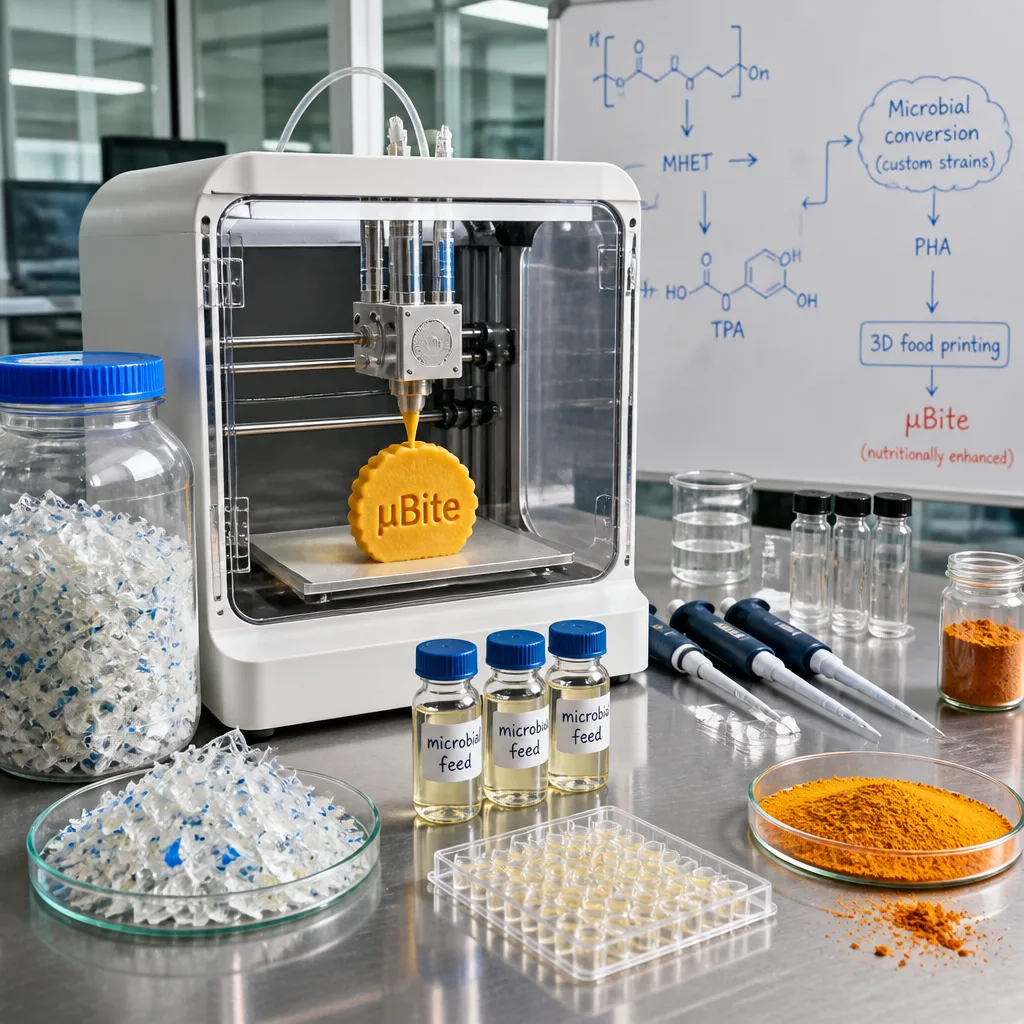
Researchers have devised a way to convert waste plastics into edible, 3D‑printed snacks that could feed astronauts on long missions — and, its inventors say, people on Earth after disasters. The product, called µBites (pronounced “microbites”), is made by chemically breaking down plastics and feeding the resulting molecules to genetically engineered microbes that produce fats, proteins and flavour compounds. The process and its potential were described in a paper in Trends in Biotechnology.
From PET bottles to a printable dough
The team, led by microbiologist Lahiru Jayakody at Southern Illinois University Carbondale for NASA’s Deep Space Food Challenge, targeted common waste streams such as PET (polyethylene terephthalate) water bottles and agricultural residues like corn husks and stalks. In the laboratory, these materials are broken down into smaller molecules using oxygen in a chemical process. Those smaller molecules are then fed to strains of genetically engineered microbes that metabolise them into basic food components.
After the microbes produce acids, fats and proteins, researchers add starch, fibre and a sweetener to produce a dough‑like substance. That dough is then 3D‑printed into high‑protein cookies — the µBites. In the team’s experiments they also used engineered microbes to make flavour and micronutrients, notably vanillin (a vanilla flavour compound) to improve taste, and beta‑carotene as a source of vitamin A precursor.
“It is becoming increasingly evident that developing novel, game‑changing food technologies that enable a circular economy is necessary to safeguard the future of humankind,” Jayakody said in the paper.
Why this matters
The work sits at the intersection of several trends and concerns. Plastics are pervasive in modern life and have contaminated food chains: the paper notes that humans now ingest an estimated 78,000–211,000 microplastic particles every year. Converting waste plastics into food components offers a provocative way to close material loops, turning a pollutant into nutritional value.
NASA’s Deep Space Food Challenge aims to find sustainable ways to provide safe, palatable nourishment for crew on long missions, where resupply is impossible. But the researchers argue the technology could also be useful on Earth, for example in post‑disaster situations where food systems are disrupted and waste streams are abundant.
- Inputs: PET plastic waste and agricultural residues.
- Biological step: Genetically engineered microbes convert breakdown products into food components.
- Outputs: Dough supplemented with starch, fibre and sweetener, 3D‑printed into high‑protein cookies (µBites).
Promises, limits and questions
The research is at laboratory stage and raises scientific, regulatory and societal questions. Key technical issues include ensuring the safety of microbes and the absence of harmful residues from the plastic‑breaking chemical step. For any food made from unconventional feedstocks, rigorous toxicology and food‑safety testing will be required before human consumption is allowed.
There are also questions about taste, nutrition and scalability. The team’s use of microbial vanillin and beta‑carotene addresses flavour and a key micronutrient, but a single product such as a cookie would not substitute for a varied diet. The researchers describe µBites as a high‑protein food and a possible emergency ration or space‑mission supplement rather than a full dietary replacement.
Finally, transforming plastic waste into food carries ethical and public‑perception challenges. Many people find the idea unsettling; regulatory authorities will need to judge whether microbes and chemical precursors can be fully removed or rendered safe. Any deployment in South Africa would require approvals from relevant food‑safety and biotechnology regulators.
| Topic | Fact reported |
|---|---|
| Annual human microplastic ingestion | 78,000–211,000 particles |
| Feedstocks used | PET bottles and agricultural residues |
| Engineered outputs | Proteins, fats, vanillin, beta‑carotene |
The research is an example of how space programmes can drive dual‑use technologies with terrestrial benefits. For South Africa, which faces both waste management challenges and regular climate‑related disasters that disrupt food supply chains, the idea of turning abundant plastic waste into emergency nutrition is an intriguing prospect. But the road from laboratory demonstration to field‑ready emergency rations is long: safety testing, regulatory approval and the establishment of processing infrastructure would be needed before µBites or similar products could be used in the national context.
For now, µBites are a laboratory proof‑of‑concept that illustrates how biological and chemical engineering might one day close material loops — converting a persistent pollutant into energy and nutrients. Whether that future arrives, and on what timescale, will depend on further research and robust safety evaluation.









