
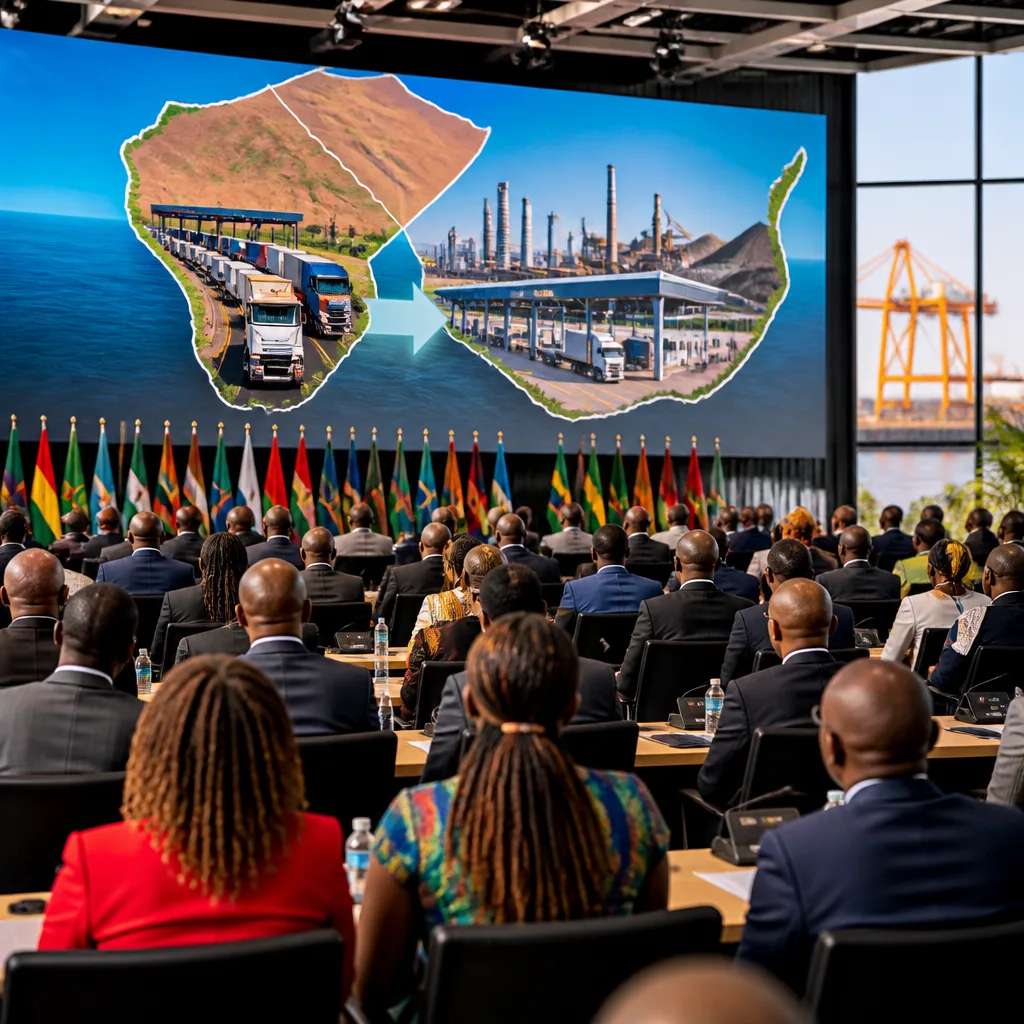
President Cyril Ramaphosa on Monday closed the 46th Southern African Development Community (SADC) Summit in Durban by urging member states to speed up the establishment of One‑Stop Border Posts so that trucks carrying goods do not «spend days waiting at borders». IOL reported that Ramaphosa took over as chairperson of SADC at the summit held under the theme: “Resilient, sustainable and inclusive industrialisation through Infrastructure Development, Agricultural and Critical Minerals Transformation in Pursuit of a Just World”.
Border efficiency and industrialisation at the top of the list
Ramaphosa told delegates the summit reaffirmed that the future prosperity, security and development of individual countries are inseparable from that of the region as a whole, IOL reported. He called for deeper regional integration and a vision of borders that “facilitate the movement of people and goods rather than create barriers”.
“Our meeting today (Monday) was preceded by a rich programme of engagements, including a successful SADC Industrialisation Week, meetings of Senior Officials and the Council of Ministers, and a public lecture that stimulated important discussion on the future of regional integration and development.”
The summit’s agenda, as reported by IOL, prioritised a cluster of policy objectives that speak directly to South Africa’s economic and strategic interests:
- stop exporting critical minerals in raw form and instead develop upstream and downstream industries that add value and create jobs;
- accelerate regional transformation through investment in infrastructure, energy, water and digital connectivity;
- strengthen regional peace and security and address migration pressures;
- build climate‑resilient food systems to support agricultural transformation.
Who benefits — and who pays?
Ramaphosa’s push for One‑Stop Border Posts and value‑adding industries offers clear winners: regional exporters, transport operators and manufacturers stand to gain from lower clearance times, reduced logistics costs and better market access. The policy of retaining and processing critical minerals inside the region aims to capture more of the value chain locally — potentially creating jobs and new investment opportunities.
But these aims also carry costs. Building cross‑border infrastructure, upgrading customs systems and establishing industrial plants requires sizeable public and private capital, long lead times and complex co‑ordination across sovereign states. IOL reported Ramaphosa’s call for increased investment, implicitly acknowledging that financing and implementation are immediate hurdles.
There are political trade‑offs as well. Faster border posts and deeper integration require concessions on national administrative control and enhanced co‑operation between customs, immigration and other agencies — measures that can provoke domestic resistance if not managed carefully.
Process and next steps
The summit, IOL said, was preceded by SADC Industrialisation Week and meetings of senior officials and ministers, which Ramaphosa described as laying a strong foundation for deliberations. He welcomed the political commitment shown by member states during the sessions and urged a collective approach to confronting regional challenges.
A simple table summarises the summit’s stated priorities and the immediate policy implications for South Africa:
| Summit priority | Implication for South Africa |
|---|---|
| One‑Stop Border Posts | Reduced transit times, lower logistics costs, requires customs/immigration reform |
| Minerals beneficiation | Opportunity for local industries and jobs, needs investment in processing capacity |
| Infrastructure & connectivity | Improved trade links, requires public/private funding and regional coordination |
Ramaphosa’s remarks, as reported by IOL, stressed the importance of involving business, labour, academia, young people and civil society in building the region. The president framed the summit’s output as not only technical reforms but a political project of solidarity and shared prosperity.
For South African policymakers the challenge now is to translate those commitments into actionable plans with realistic financing and timelines — and to manage the domestic economic and political consequences while pursuing greater regional integration.












