
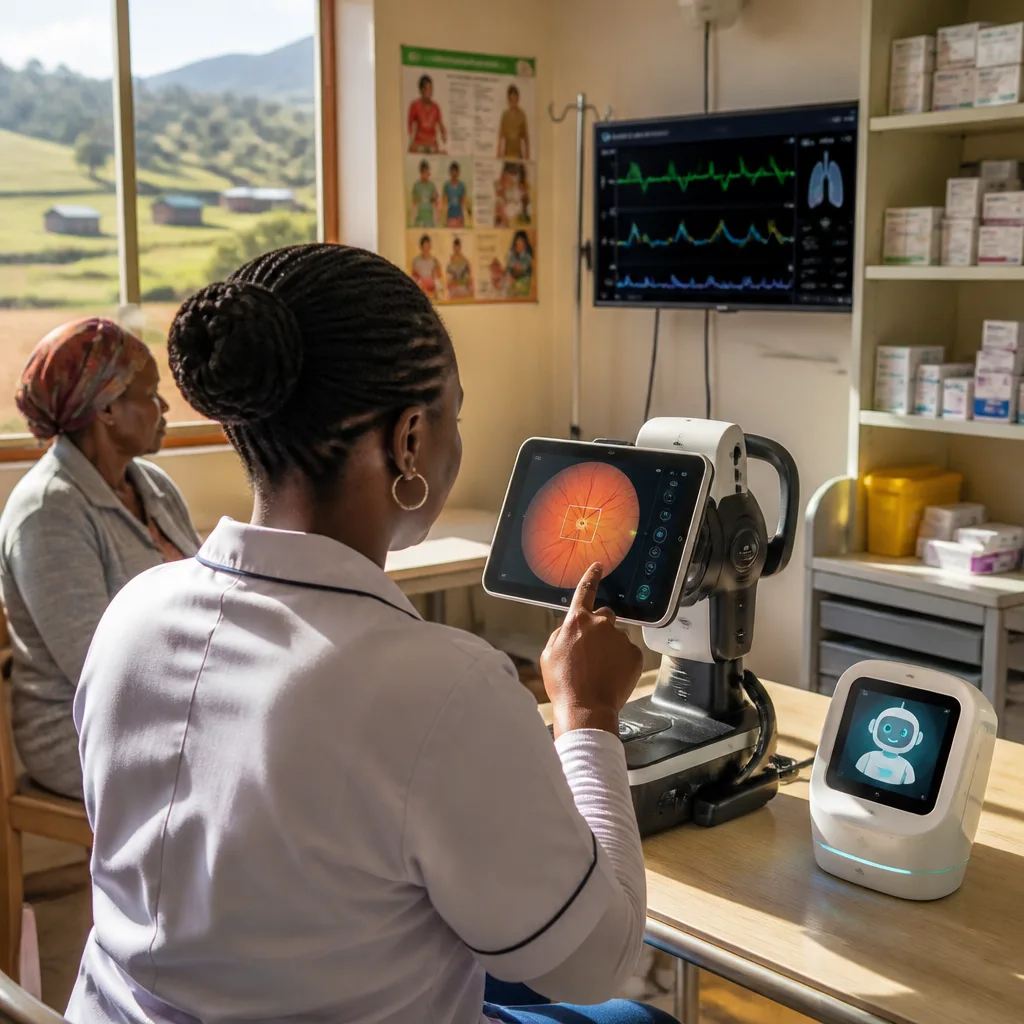
Researchers at the North-West University (NWU) are converting digital health ambitions into practical tools aimed at narrowing gaps in access to quality healthcare across South Africa. The university's Digital Health and HealthTech Innovation programme brings together engineering, business and health faculties to produce technology designed specifically for resource-constrained settings.
Addressing inequity with targeted technology
For many South Africans, access to healthcare remains uneven and is often determined by where a person lives, the skills available locally and whether medicines are in stock. The NWU programme aims to counter those constraints by developing technology that extends the reach of clinicians, supports remote monitoring and turns routine health data into actionable information.
The programme is multidisciplinary by design, combining the Faculty of Engineering, the NWU Business School and the Faculty of Health Sciences. This structure reflects a deliberate emphasis on matching technological possibility to clinical need rather than deploying technology for its own sake.
“We should not begin by asking, ‘What can we do with AI, an app or a new sensor?’ We should begin with, ‘What is the problem we are trying to solve?’”
The quotation is attributed in the programme reporting to Prof. Leenta Grobler, associate professor in Digital Health Innovation at NWU, who argues that digital health must be used intelligently to make care more accessible, effective, efficient and person-centred.
Practical projects under development
NWU researchers have already produced several tangible solutions, including:
- AI-enabled retinal image analysis — a system intended to screen retinal images and support eye-care decisions where specialists are not available.
- Remote ventilator-monitoring — a solution to allow off-site clinicians to monitor ventilator parameters and respond to deterioration without being physically present.
- AI-enhanced digital wellbeing companion — a tool designed to support patients' self-management and mental wellbeing with digital prompts and monitoring.
These projects reflect the programme's focus on connectivity, sensing, data, optimisation and automation — engineering principles applied to clinical problems such as patient monitoring, treatment adherence and clinical decision support.
From engineering to health impact
Prof. Grobler, a computer and electronic engineer by training, began applying engineering approaches to healthcare problems around 2016. Her work has moved beyond proof-of-concept to applied tools intended to function in real-world clinics, including rural and under-resourced facilities where specialist skills and infrastructure are limited.
The NWU initiative seeks to avoid a common technology trap: implementing solutions without first defining the clinical problem. Instead, researchers prioritise questions such as which task needs automation, what information clinicians require at the point of care, and how a tool will be maintained and scaled in constrained settings.
| Programme partners | Role |
|---|---|
| Faculty of Engineering | Technology development, sensors and connectivity |
| NWU Business School | Implementation models, sustainability and scale |
| Faculty of Health Sciences | Clinical validation, user needs and patient safety |
By combining technical design with business modelling and clinical oversight, the programme aims to produce devices and software that are feasible to run in provincial and district health systems and deliver measurable benefits for patients.
While innovation offers promise, the programme's reporting stresses that technology is not a substitute for clinical care. Instead, it is a tool to extend professional reach and support decision-making where human resources are thin.
Readers should consult their local clinic or a healthcare professional for personal medical advice rather than relying on digital tools alone. Digital health solutions require careful evaluation, regulatory oversight and integration with existing services before they become standard practice.
The NWU work represents a focused attempt to make that integration happen in South Africa by aligning engineering creativity with real health-system challenges.











