
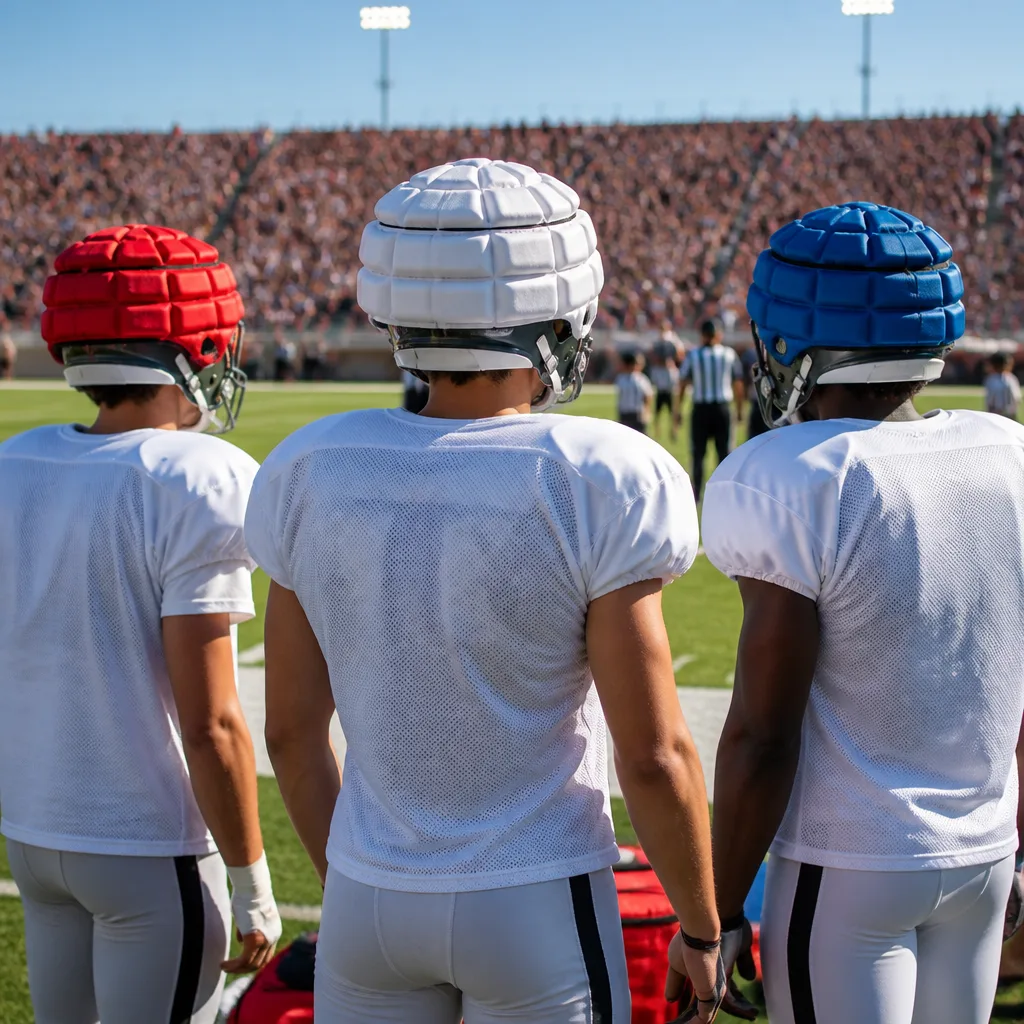
Several NFL players have begun wearing padded helmet covers, known as Guardian Caps, during games as concern grows about repeated concussions and long-term brain health. The covers add a layer of padding over a standard helmet and are designed to reduce the linear and rotational accelerations transmitted to the head during impacts.
What is being used on the field?
The version described in recent reporting weighs about 340 grams and the league approved a slimmer, customisable model for the 2026 season called the Guardian Cap NXT 2.0. The covers were first mandated during parts of pre-season from 2022 for specific groups of players and have been permitted during regular-season games since 2024.
On the field, the device has drawn attention because of players with histories of multiple concussions choosing to wear it. New Orleans Saints receiver Chris Olave, who has suffered at least four concussions in his first 39 NFL games, wore a Guardian Cap while catching 10 passes for 182 yards in a Week 1 match. Olave said the decision was driven by concern for life after football.
“I have kids now. I want to be able to live a normal life after football. I don't care about how it looks anymore.”
Another example is Colts cornerback Charvarius Ward, who experienced three concussions in 14 weeks in the previous season and chose to wear the cover after describing fear of being knocked out again. Ward said he still felt a headache after a match and was uncertain whether the padding had altered that outcome, but intended to continue wearing it.
“I was really scared of getting knocked out again. I'm going to keep wearing it for my safety.”
What the Guardian Cap aims to do — and what we do not yet know
The Guardian Cap is a padded shell that fits over a conventional helmet. Its stated purpose is to absorb some of the energy from impacts and to limit both linear and rotational accelerations — forces linked to brain injury. In plain terms, the product attempts to lessen how strongly the skull and brain move when a player is hit.
However, current reporting stresses that the scientific community has not reached consensus that these covers prevent concussions. Early tests and laboratory measures can show reductions in certain types of acceleration, but translating those mechanical reductions into fewer concussions in real-world play is a more complex problem.
- Mechanics: The caps are designed to reduce impact energy and head acceleration.
- Policy: Use moved from mandatory in some pre-season groups in 2022 to permitted in games from 2024, with a refined model approved for 2026.
- Evidence gap: Laboratory measures do not automatically prove clinical protection against concussion in live matches.
The difficulty lies in isolating the cap's effect in the variable, high-speed environment of contact sport. Concussion is diagnosed clinically, often without a single objective biomarker, and results can vary with the angle and velocity of impacts, prior injury history, and individual biological vulnerability.
| Year | Policy or product milestone |
|---|---|
| 2022 | Mandatory use for some player groups during pre-season |
| 2024 | Permitted during regular-season games |
| 2026 | Approval of Guardian Cap NXT 2.0 for the season |
Players with repeated concussions are understandably cautious. High-profile cases like Olave's and Ward's illustrate why athletes might adopt additional padding even when the evidence is not definitive: the potential to reduce risk has immediate personal appeal, particularly for those who have already suffered multiple head injuries.
For clinicians, policymakers and sporting bodies the central questions remain: can the caps reduce the incidence or severity of concussions in real play, and are there any unintended consequences such as changes in player behaviour that might offset benefits? Answering these questions requires large, well-controlled field studies that link use of the covers to objectively measured outcomes over time.
Until such studies produce robust findings, the Guardian Cap sits in a middle ground. It is a plausible, mechanically grounded intervention that many players find attractive, but it is not yet supported by conclusive, real-world evidence that it prevents concussion.
For South African athletes, medical teams and sports administrators observing international developments, the Guardian Cap story is a reminder of the difference between promising technology and proven clinical protection. Careful evaluation, transparent reporting of results and attention to player welfare should guide any decision about wider adoption.









