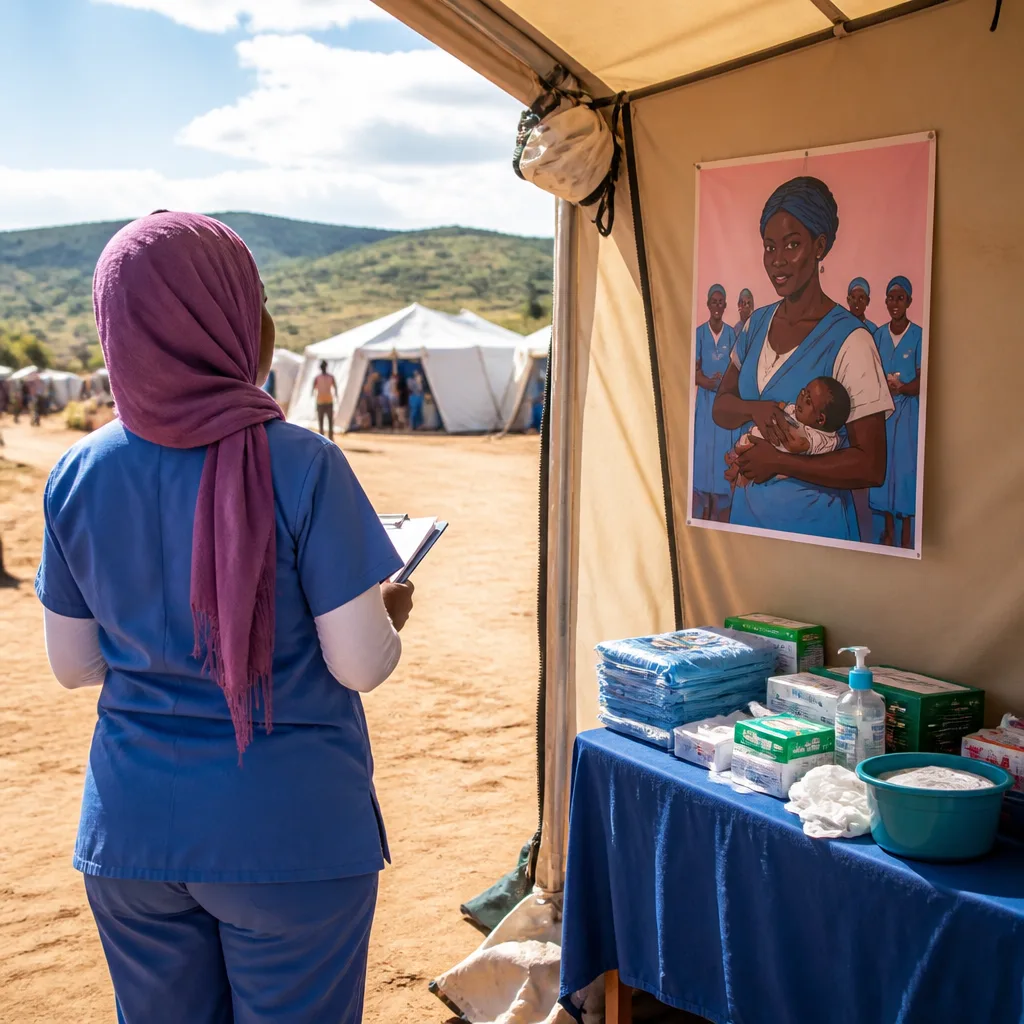
The United Nations Population Fund (UNFPA), with technical input from the International Confederation of Midwives (ICM) and other partners, has published a programme designed to formalise the role of midwives in humanitarian settings. The resource, titled Programmatic Guidance to Position Midwives as Leaders and Frontline Providers in Humanitarian Response: Linking Strategy with Action, lays out practical steps for integrating midwives across all stages of emergency planning and delivery.
Three-phase model targets systems as well as individuals
The guidance is structured around a tripartite model—Preparedness, Response and Recovery—and contains tools that can be adapted across national contexts. It stresses that midwives are often the sole providers of sexual, reproductive, maternal and newborn health services in crisis-affected areas, and that excluding them from planning undermines the continuity and quality of care.
| Phase | Focus |
|---|---|
| Preparedness | Strengthening policies, education, financing and workforce planning; integrating midwifery and essential sexual and reproductive health services into national emergency plans. |
| Response | Rapid deployment of midwives; inclusion in humanitarian coordination; and attention to midwives’ safety, wellbeing and mental health during crises. |
| Recovery | Retaining the midwifery workforce after emergencies and using lessons learned to bolster policies, services and health systems. |
Practical tools and intended users
The resource provides operational tools aimed primarily at UNFPA country offices, but it explicitly addresses a wider audience: governments, national midwives’ associations, educators, employers and humanitarian organisations. The guidance can be tailored to different humanitarian and national situations, offering checklists and approaches that managers and planners can adapt.
- Policy strengthening: embedding midwifery in national emergency frameworks and workforce plans.
- Operational readiness: mechanisms for rapid deployment and inclusion in coordination platforms during a response phase.
- Workforce protection: measures for safety, wellbeing and mental health of midwives working in austere environments.
A central theme is the need to recognise and empower national midwives’ associations. The guidance argues that well-resourced, transparent and unified associations are pivotal in advancing education, standards, workforce management and policy advocacy. Because these organisations typically have membership that extends from urban centres to village and community levels, the guidance frames them as strategic partners for preparedness and response planning.
Implications for national health systems
By laying out a clear set of steps, the UNFPA document seeks to change how humanitarian actors and health planners view midwives—not only as clinical service providers but as leaders who can shape emergency policy and service continuity. For middle- and low-income countries, where midwives frequently deliver the bulk of maternal and newborn services, the guidance offers a route to sustain care when health systems are disrupted by conflict, natural disasters or other crises.
Although the guidance is global in scope, its emphasis on institutional capacity and workforce planning has direct resonance for national policymakers and humanitarian agencies in contexts such as South Africa. Strengthening the institutional role of midwives and ensuring their inclusion in emergency frameworks could help preserve access to essential sexual, reproductive and maternal-newborn services during shocks, and support recovery strategies that rebuild stronger, more resilient health systems.
The document also highlights the importance of attention to midwives’ mental health and security—an operational detail sometimes overlooked in emergency planning but critical to maintaining a functioning frontline workforce over prolonged crises.
In sum, the guidance offers a practical blueprint for elevating midwives within humanitarian architecture, pairing policy change with on-the-ground tools so that midwives can lead and sustain essential services when communities are most vulnerable.