The United Arab Emirates used its address to the United Nations General Assembly to press for a stronger global reliance on diplomacy, mediation and dialogue to resolve armed conflicts, calling for concrete measures to end the fighting in Gaza and to safeguard regional maritime corridors.
Calls for negotiated settlements and maritime security
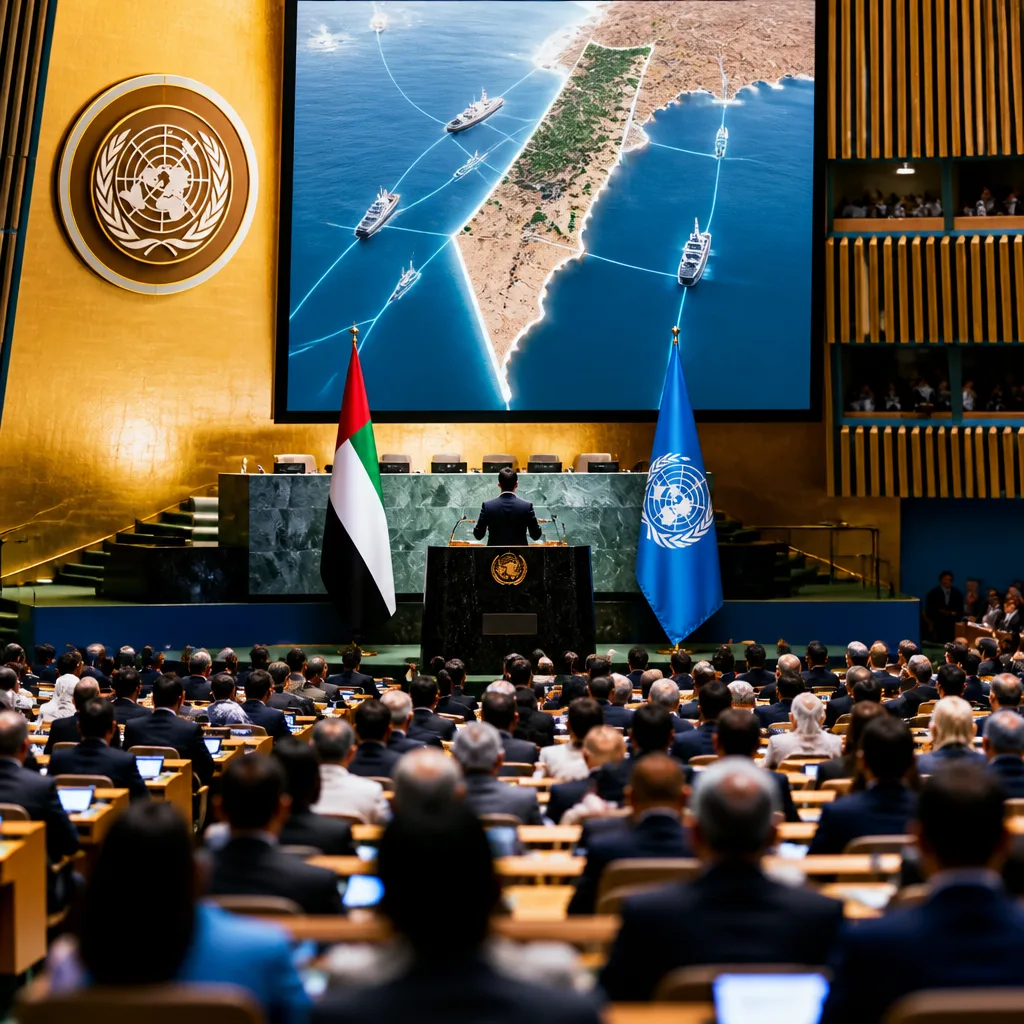
In remarks delivered to the assembly on 28 September 2026, UAE Minister of State Khalifa Shaheen Al-Marar reiterated his country's rejection of unlawful use of force and emphasised the centrality of state sovereignty and the UN Charter in settling international disputes, according to Arab News reporting.
Al-Marar singled out threats to freedom of navigation as a priority, arguing that uninterrupted transit through sea lanes is vital for global supply chains, trade and energy flows. He said that protecting maritime routes under international law is essential for food security and economic development.
“These are pillars of food security, development and prosperity of nations,” the minister said, according to the report.
Gaza, Iran and regional territorial claims
Addressing the war in Gaza, the minister reiterated the UAE's support for an international framework to end the conflict. He outlined elements he said should form part of any settlement, including a withdrawal from Gaza, the disarmament of Hamas and a political track to follow.
Al-Marar also referred to long-standing Emirati grievances over what he described as Iran’s occupation of three islands — Greater Tunb, Lesser Tunb and Abu Musa — and said the UAE favours a peaceful resolution, whether through bilateral talks or recourse to the International Court of Justice, reported Arab News.
Mediation across multiple conflicts
The UAE highlighted its wider diplomatic activity across Africa, the Middle East and beyond, noting support for peace processes in Yemen, Libya, the Sahel, the Democratic Republic of Congo, Myanmar, Haiti and Western Sahara, according to the report.
On the Ukraine conflict, Al-Marar cited a series of mediation operations his country has supported, saying the UAE facilitated the exchange of nearly 8,000 prisoners between Russia and Ukraine. He characterised these efforts as part of a push for “a comprehensive and lasting peace in Ukraine” based on respect for sovereignty and territorial integrity.
| Issue | UAE position / activity (as reported) |
|---|---|
| Gaza | Support for framework requiring Israeli withdrawal, disarmament of Hamas and political process |
| Maritime security | Calls to protect freedom of navigation and transit passage under international law |
| Territorial dispute with Iran | Rejection of Iranian control of Greater Tunb, Lesser Tunb and Abu Musa; preference for peaceful settlement or ICJ |
| Mediation record | 26 mediation operations cited; ~8,000 prisoners exchanged in Ukraine operations |
Sudan and wider regional stability
Turning to Sudan, the minister described the humanitarian crisis there as dire and urged an immediate, unconditional ceasefire, followed by a civilian-led political transition. He called on conflict parties to engage seriously with international peace initiatives, according to the report.
The UAE framed these interventions as part of a broader strategy to reduce escalation and to create conditions for political solutions rather than military ones. The speech linked preservation of international norms — notably sovereignty and lawful transit — with practical outcomes for trade, food security and energy markets.
- UAE stresses diplomacy and mediation as primary tools for conflict resolution.
- The country elevated maritime security and freedom of navigation as global priorities.
- It cited concrete mediation results, including prisoner exchanges in the Russia–Ukraine conflict.
For South Africa and other trading nations, the UAE’s emphasis on keeping sea lanes open and upholding international law underscores a shared interest: disruptions to maritime routes can affect global supply chains, energy supplies and food imports. The UAE’s statement at the UN reflects an active regional actor seeking diplomatic avenues across multiple theatres of conflict while also asserting its own territorial claims.
This report is based on coverage by Arab News of the UAE minister’s address to the UN General Assembly on 28 September 2026.