
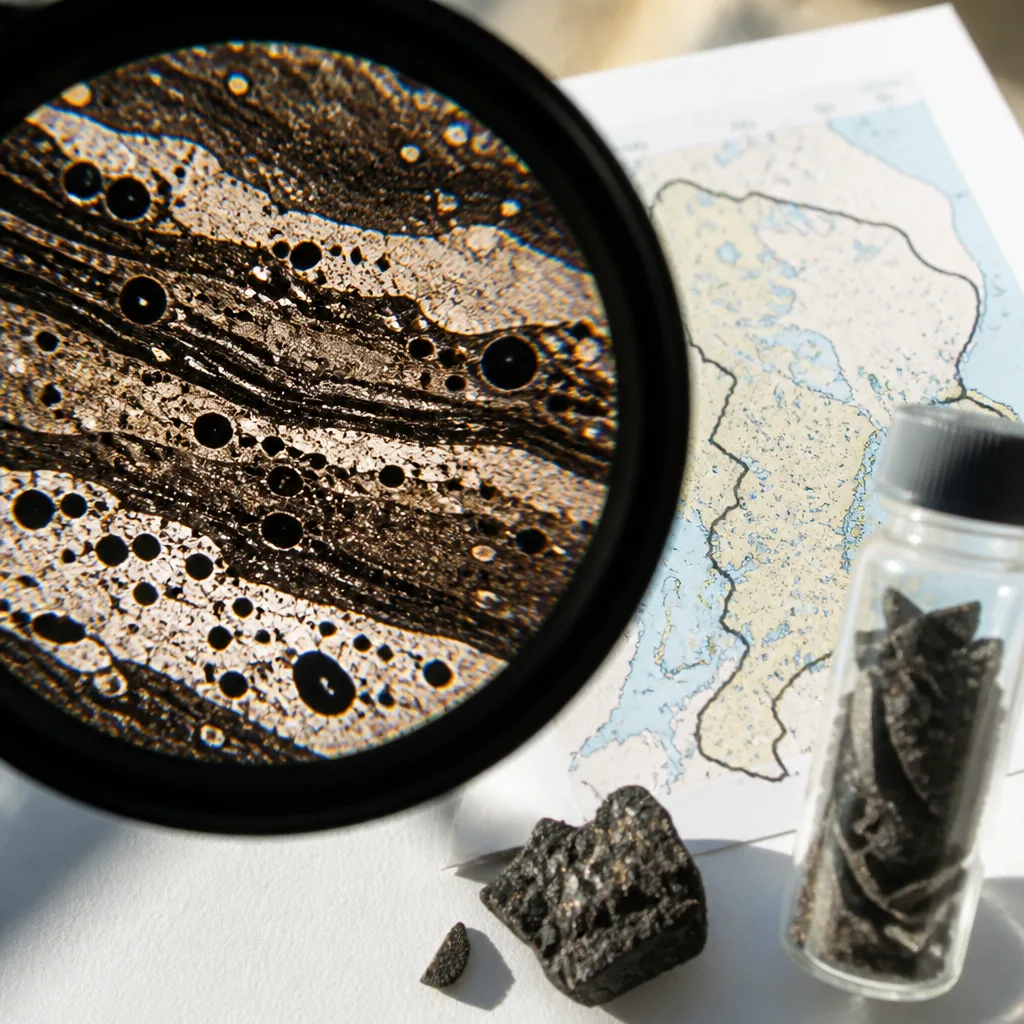
A key carbon-isotope signal long cited as evidence for a global disruption in Earth’s ancient carbon cycle may originate from local processes inside a single sedimentary basin, according to a new study led by researchers at Caltech.
Local processes in Karelia
The researchers examined gases trapped in microscopic pockets within rocks from the Zaonega Formation in Karelia, Russia — one of the oldest known fossil oil fields. Those rocks are rich in pyrobitumen, an altered organic material. The team found that the unusual carbon-isotope signature present in these rocks can be explained by phenomena operating within a basin of a few hundred square kilometres rather than by a worldwide event.
“One major debate centers on an unusual carbon-isotope signal that has often been interpreted as evidence of a worldwide environmental change,” said Nivedita Thiagarajan, a senior scientific researcher at Caltech and lead author of the study.
The period in question lies between roughly 2.5 and 2.0 billion years ago, when Earth experienced what is widely called the Great Oxidation Event: a sustained rise in atmospheric oxygen. During and after this transition, large volumes of microbial organic matter were buried beneath the seafloor and became locked in rocks that record an atypical carbon-isotope ratio. For decades, that isotopic anomaly — observed in drill cores from Karelia and from the Francevillian Basin of Gabon — has been interpreted by many researchers as evidence for a global-scale perturbation of the carbon cycle.
Method and immediate findings
The Caltech-led team focused on gas inclusions preserved in microscopic pockets inside the Zaonega rocks. By analysing the composition and isotopic character of these trapped gases, they reconstructed chemical processes that affected organic matter after burial. The results indicate that the anomalous isotope signature at this key site can be produced by local alteration and fluid-rock interactions within the sedimentary basin that hosted the Zaonega Formation.
- Study site: Zaonega Formation (Karelia, Russia), a pyrobitumen-rich, ancient fossil oil field.
- Analytical focus: gases trapped in microscopic inclusions within the rocks.
- Conclusion: isotope anomaly consistent with basin-scale processes rather than an unquestionably global signal.
The paper appears in the journal Geology and is led by researchers in the laboratory of John Eiler at Caltech. The authors emphasise that the new interpretation modifies how the Karelia record should be used when reconstructing early Earth environments.
Context and consequences
The distinction between a basin-specific signal and a global event matters because many models of Earth’s ancient atmosphere and biosphere rely on the geographic extent and synchronicity of isotopic anomalies. If a record once seen as global instead reflects local basin chemistry, then some inferences about the timing, intensity and drivers of oxygenation and carbon-cycle change may need refinement.
Importantly, the study does not dismiss the broader observation that Earth’s surface chemistry changed dramatically in the early Proterozoic, enabling the eventual rise of complex life. Rather, it asks caution of researchers who extrapolate from single sites. The team’s results underscore the value of sampling multiple, geographically separated records and of applying micro-scale geochemical techniques that can distinguish primary depositional signals from later, local alteration.
| Site | Typical interpretation | New reading (Karelia) |
|---|---|---|
| Zaonega Formation (Karelia) | Part of a global isotopic excursion indicating widespread carbon-cycle disruption | Isotopic anomaly can be produced by basin-scale processes affecting pyrobitumen and trapped gases |
| Francevillian Basin (Gabon) | Another source of the global signal (comparison site) | Study focuses on re-evaluating how records from multiple basins should be compared |
Follow-up work will be required to test whether other classic sections that have been used to define a global carbon-isotope excursion record local overprints or truly synchronous, globe-spanning environmental change. The new study is a reminder that rocks carry a layered history: a primary depositional signature can be modified by later chemical, thermal or fluid-driven processes, and careful microscale analysis is often necessary to untangle those histories.
For South African researchers and students of Earth history, the paper reinforces established best practice: correlate multiple proxies from several basins, and use modern micro-analytical tools to separate primary signals from later alteration. Doing so gives a more robust foundation for models of how our planet’s atmosphere and biosphere co-evolved two billion years ago.









