
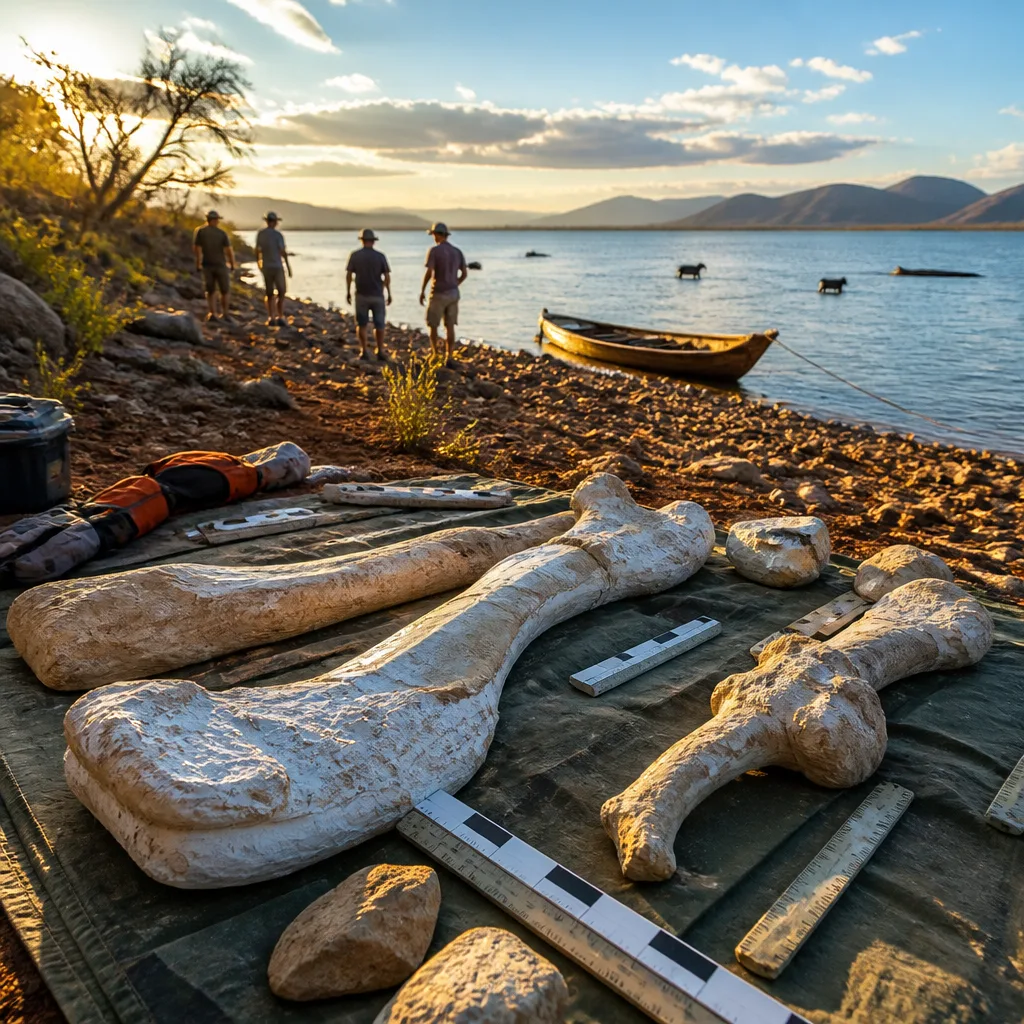
Scientists have described a new species of dinosaur, Musango matusadonaensis, based on fossil material recovered from the shores of Lake Kariba in Zimbabwe. The find, published in July, follows eight years of excavation, preparation and study and involved an international expedition that worked in difficult field conditions.
What was found and where
The fossils were recovered from a remote area around Lake Kariba, where field teams sometimes travelled by boat and faced encounters with large wildlife such as hippos and Nile crocodiles. The specimen was first discovered in 2018; subsequent seasons of work produced the bones that allowed scientists to recognise a distinct species.
Anatomy and age
Musango matusadonaensis is placed among the sauropodomorphs, an early group of dinosaurs that later gave rise to the long-necked sauropods. Unlike the massive quadrupedal sauropods of the Jurassic and Cretaceous, this animal walked on two legs.
| Characteristic | Musango matusadonaensis |
|---|---|
| Age (geological) | Late Triassic (~210 million years ago) |
| Estimated length | ~4.5 m |
| Estimated mass | ~222 kg |
| Ontogenetic stage | Nearly mature (approx. 8 years old at death) |
The skull was not preserved in anatomical position, so precise details of feeding behaviour and sensory anatomy remain uncertain. Based on body proportions and the depositional context, researchers infer that it probably fed on plants near water, although omnivory cannot be ruled out.
Fieldwork challenges and local potential
Field teams navigated hazardous access conditions: boats were required in parts of the shoreline, and crews had to remain vigilant for elephants, lions and crocodiles. The work involved extended field seasons and detailed laboratory preparation over several years before the species description could be completed.
Researchers suggested the discovery may be the first of many important palaeontological finds in the region. The specimen’s preservation — a near-complete skeleton in anatomical position is uncommon — highlights the value of targeted exploration in Africa for filling gaps in our knowledge of early dinosaur evolution.
“Perhaps only one in a hundred specimens that are found has a skeleton preserved in anatomical position. And among those specimens, a skull is present in roughly one out of ten. So a significant part of our work involves drawing conclusions based on hundreds of years of fossil collecting.”
This comment was reported from Jonah Choiniere, professor of comparative biology at the University of the Witwatersrand, who provided context about the rarity of well-preserved skeletons and the interpretive challenges palaeontologists face.
Why the find matters
- Fills an African gap: The specimen adds to the relatively sparse record of Late Triassic dinosaurs from southern Africa.
- Evolutionary insights: As a bipedal sauropodomorph, Musango informs understanding of the anatomy and lifestyle shifts that preceded giant quadrupedal sauropods.
- Fieldwork value: The discovery demonstrates that remote and underexplored regions can yield scientifically significant material.
While much remains to be learned — notably from cranial material that was not preserved — the formal description of Musango matusadonaensis is a reminder that long-term, careful field and laboratory work continues to reshape the picture of early dinosaur history in Africa.
Further publications and comparative studies will be needed to refine its place in sauropodomorph phylogeny and to explore ecological questions about diet and habitat.









