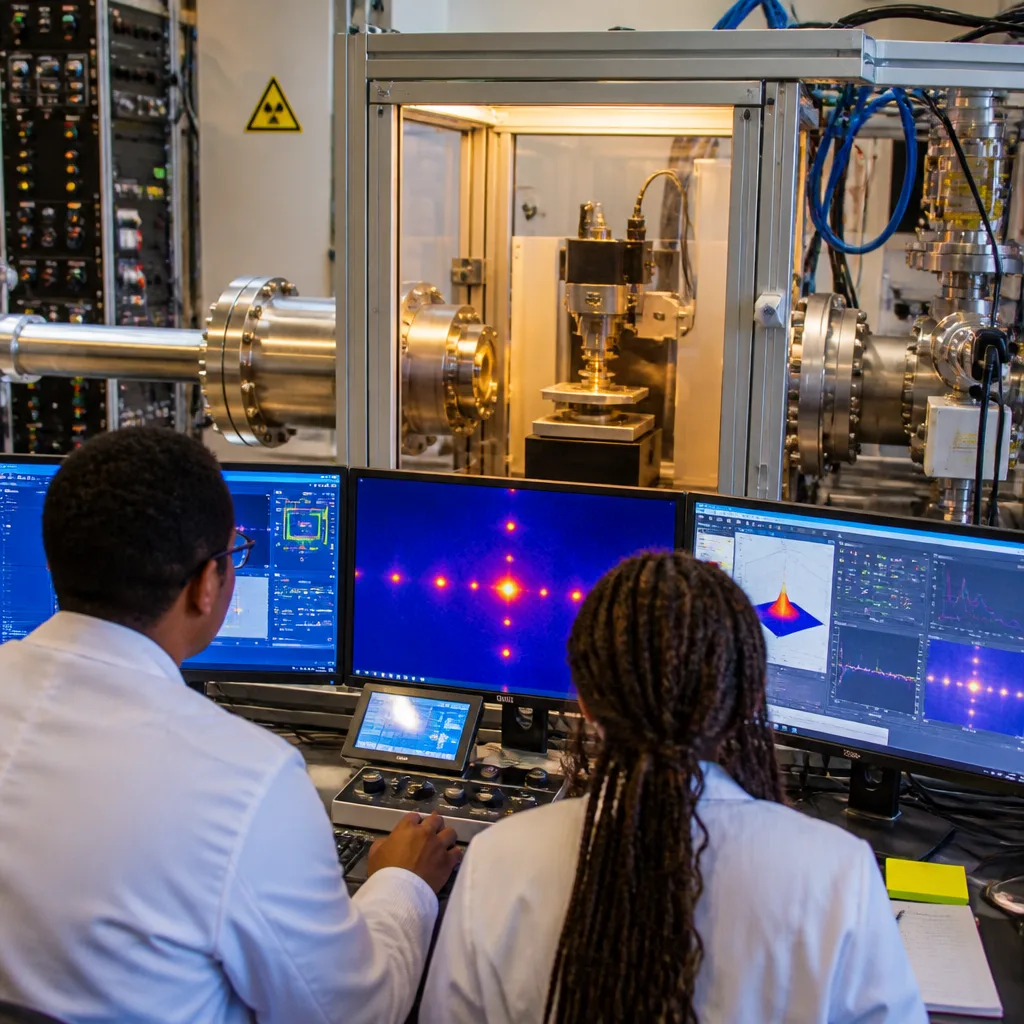
Researchers at the U.S. Department of Energy's Argonne National Laboratory have developed a machine‑learning tool that produces near‑instant interpretation of complex X‑ray images from scanning X‑ray nanodiffraction microscopy (SXDM). Called DONUT (Diffraction with Optics for Nanobeam by Unsupervised Training), the system is described as a physics‑aware neural network that can reveal lattice strain and tilt inside materials while an experiment is still running.
Real‑time results at major user facilities
DONUT was developed and tested on data from the Hard X‑ray Nanoprobe beamline jointly operated by the Advanced Photon Source (APS) and the Centre for Nanoscale Materials (CNM). According to the paper published in npj Computational Materials, the tool can deliver results in real time — in some cases hundreds of times faster than traditional analysis pipelines that can take weeks or months.
"DONUT lets us see what's happening inside materials as the experiment unfolds," said Aileen Luo, assistant computational scientist at Argonne and Cornell University. "Instead of waiting for weeks to find out if an experiment worked, we can now get answers on the spot."
Real‑time analysis gives beamline users the ability to adapt experimental parameters on the fly, change focus areas, or abandon runs that are not producing useful data. The developers say this will increase the productivity of experiments and lower the barrier to entry for new users who are less familiar with SXDM data interpretation.
How DONUT works and what it means
DONUT is described as physics‑aware because its architecture incorporates constraints derived from how focused X‑ray beams interact with crystalline matter. It uses an unsupervised deep‑learning workflow to infer lattice strain and orientation (tilt) from diffraction patterns without needing a labelled training set for every new material.
- Technique used: Scanning X‑ray nanodiffraction microscopy (SXDM).
- Facility: Hard X‑ray Nanoprobe beamline at APS/CNM.
- Publication: Results published in npj Computational Materials.
The capacity to extract structural maps rapidly is particularly useful when investigating advanced materials where nanoscale heterogeneity — variations in strain or orientation across tiny volumes — governs macroscopic properties such as strength, conductivity or catalytic activity.
Benefits, caveats and wider implications
The immediate benefit is operational: scientists can make decisions during beam time, improving throughput and potentially reducing the number of repeat visits to large, expensive facilities. Faster analysis also helps teams iterate experimental designs more quickly, accelerating the pace of materials discovery and optimisation.
However, several caveats are worth noting. The published work demonstrates DONUT on data from a particular beamline and technique; generalisability to other beamlines, different photon energies or substantially different sample types will need further testing. As with any unsupervised method, users should be cautious about overinterpreting outputs without independent checks or physical validation.
For South African researchers and institutions that rely on international synchrotron facilities — or for local efforts to develop advanced materials and devices — tools that reduce analysis bottlenecks could lower time and cost barriers. They may also make it easier for multidisciplinary teams, including chemists and engineers who are not specialist beamline users, to extract useful information from complex diffraction datasets.
In the longer term, embedding physics knowledge into machine‑learning models is a promising strategy for other forms of in‑situ and operando characterisation, from electron microscopy to neutron scattering. The approach taken with DONUT is an example of how combining domain expertise with modern algorithms can produce practically useful tools for large scientific facilities.
| Item | Detail |
|---|---|
| Tool | DONUT (Diffraction with Optics for Nanobeam by Unsupervised Training) |
| Technique | Scanning X‑ray nanodiffraction microscopy (SXDM) |
| Facility | Hard X‑ray Nanoprobe beamline, APS/CNM |
| Publication | npj Computational Materials |
DONUT will not replace careful experimental design or physics‑based validation, but it represents a clear step towards faster, more adaptive science at synchrotron facilities. For researchers constrained by limited beam time and steep data‑analysis curves, that can make the difference between a stalled project and a new discovery.