
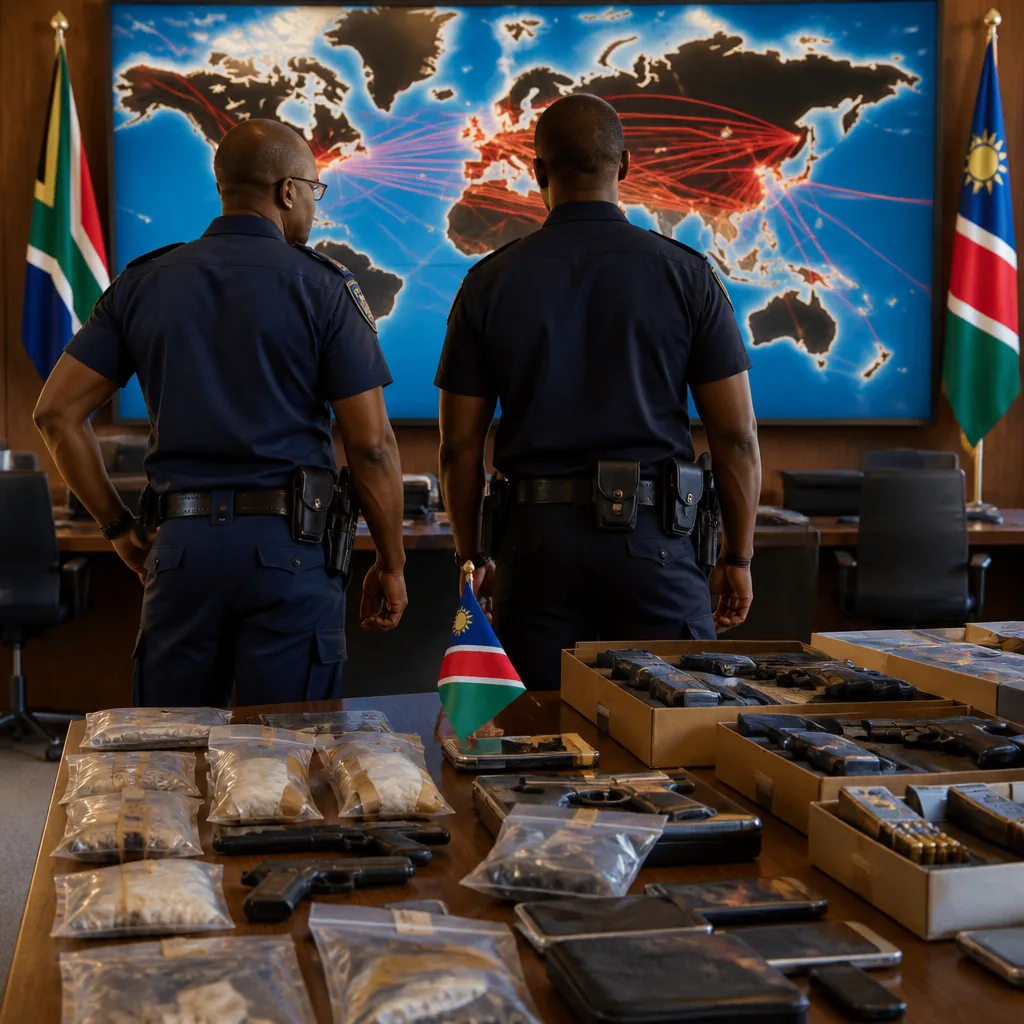
The Namibian Police have highlighted the growing necessity of international cooperation to tackle crime that crosses national boundaries, marking the United Nations’ International Day of Police Cooperation on 7 September, police spokesperson Deputy Commissioner Kauna Shikwambi said on Sunday.
Cross-border threats and practical results
Shikwambi told reporters the observance, this year themed “Global Police Cooperation for Global Security”, was an opportunity to underline how criminals exploit borders to commit a range of offences, from online fraud and human trafficking to drug smuggling and the movement of illicit money and firearms.
“Every day, crime crosses borders,”
She said the National Central Bureau–Interpol in Windhoek (NCB–Interpol Windhoek) would use the day to showcase practical outcomes of international police cooperation, including the arrest and extradition of fugitives, drug seizures and the confiscation of firearms. Officers attached to the NCB–Interpol Windhoek, Shikwambi added, play a central role in facilitating information exchange, coordinating investigations and supporting joint operations with foreign counterparts.
Cooperation as a tool for justice and victim protection
According to Shikwambi, international policing is not merely a technical link between institutions but a mechanism to ensure borders do not become barriers to justice. She said cooperation enables law-enforcement agencies to locate and support victims, reunite missing persons with families, bring fugitives to justice and disrupt dangerous criminal networks.
Shikwambi also stressed that this year’s observance places an emphasis on protecting vulnerable people and on strengthening public trust and legitimacy in policing. The Namibian Police said it remains committed to working with international partners, stakeholders and relevant forums to intensify efforts against transnational crime.
- Key cross-border crimes highlighted: online fraud, human trafficking, drug smuggling, movement of illicit money and firearms.
- Primary mechanism cited: NCB–Interpol Windhoek facilitating exchange of information and coordination of investigations.
- Operational outcomes noted: arrests and extraditions, drug seizures, firearms confiscations.
Regional implications
While Shikwambi’s remarks focussed on Namibia, the issues she identified are common across southern Africa. The use of national Interpol bureaux and mutual legal assistance arrangements forms a routine part of regional crime responses and can support cooperative work with agencies in South Africa and neighbouring countries to address the same cross-border threats.
The Namibian statement did not supply specific figures for arrests, seizures or extraditions. It did, however, underline the qualitative value of sustained international cooperation: shorter investigation times, improved intelligence-sharing and stronger operational coordination.
As countries mark the UN day, policing authorities across the region are likely to reiterate similar priorities: strengthening information exchange, protecting vulnerable victims and ensuring that international borders do not impede accountability for serious crimes.
| Area | Role of international cooperation |
|---|---|
| Fugitives | Arrest and extradition through coordinated operations |
| Illicit drugs | Joint investigations and seizures |
| Firearms | Cross-border tracing and confiscation |
Namibia’s focus on collaborative policing reflects broader global commitments to collective security. For citizens in the region, strengthened cross-border law enforcement can mean swifter justice and better protection for victims of transnational crime—as long as cooperation is accompanied by transparency and respect for legal standards, the police said.









