
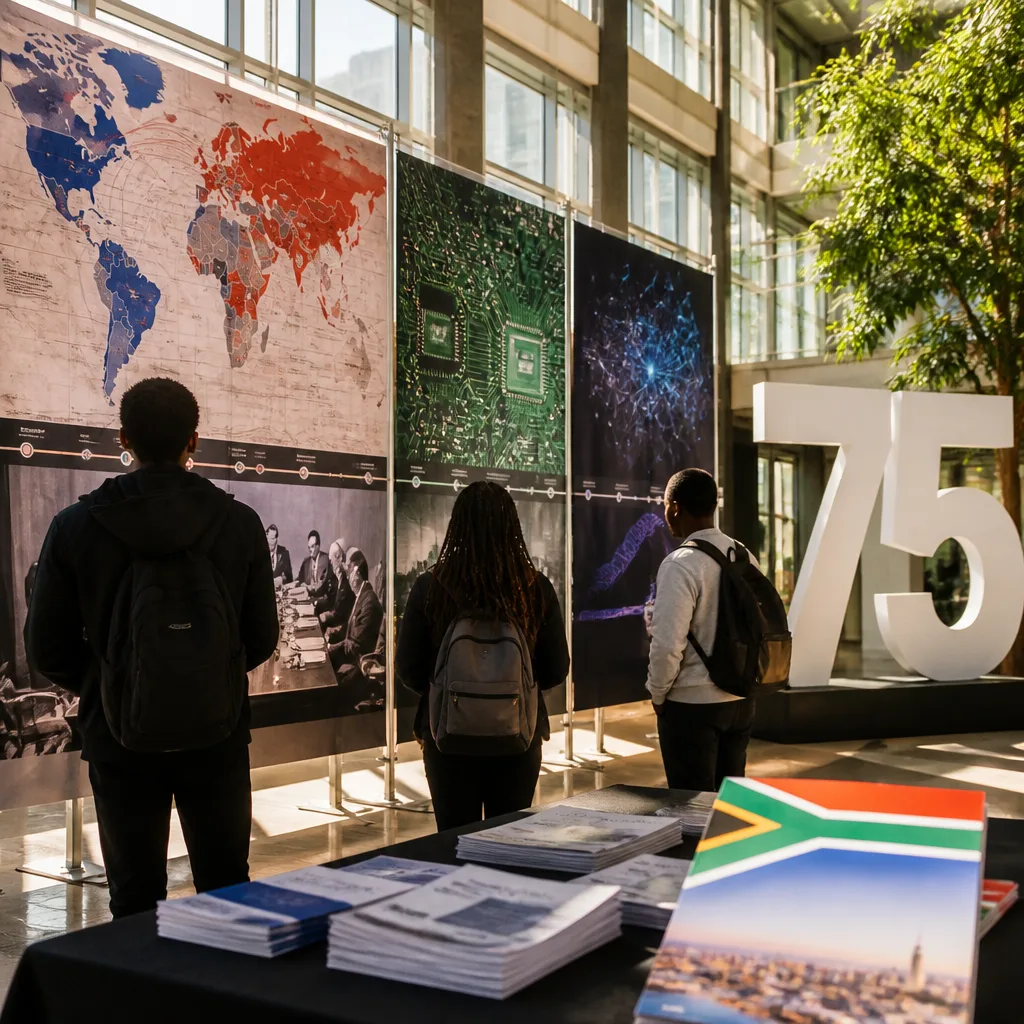
The Massachusetts Institute of Technology’s Center for International Studies (CIS) marks its 75th year with a record of bringing engineers, social scientists and policy practitioners together to study how scientific and technological change alters global politics. The centre’s work — from Cold War security studies to contemporary questions about artificial intelligence and development — highlights a practical model for integrating technical expertise into policy research.
Embedded science and policy
CIS was founded as the Cold War began and quickly embraced the idea that science, technology and geopolitics were becoming inseparable. Rather than treating international studies as a distinct social‑science silo, CIS positioned itself inside a leading technical university so scholars could apply engineering and scientific methods to international problems.
That institutional design has produced concrete policy influence. The centre has combined economists, political scientists and engineers in the same projects, producing research that has been cited in policymaking circles and that has helped shape US engagement overseas.
“Being situated within the world’s leading technical institution enables a lot of exciting possibilities,” said Evan Lieberman, director of CIS and the Total Professor of Political Science and Contemporary Africa.
The proximity to technical disciplines has, according to CIS leadership, enabled research that neither purely technical labs nor conventional international‑relations departments typically produce. It has allowed scholars to assess how innovations change power balances, and how policy should respond to rapid technological diffusion.
From Cold War origins to contemporary challenges
From its earliest years, CIS pursued a dual mission: to understand international security and to channel scholarly work into public debate and policy formation. One noted historical example is a 1961 memorandum by Max Millikan, CIS’s first director, which contributed to the ideas behind the creation of the Peace Corps — a development that redefined a strand of US foreign engagement.
Today, as alliances shift and technological change accelerates, CIS’s remit includes questions about how artificial intelligence, cybersecurity and emerging dual‑use technologies intersect with diplomacy and national security. Its structure — interdisciplinary, policy‑oriented and embedded in a technical environment — is presented by leaders as a template for addressing the generational challenges of rapid technological change.
- 75 years of CIS activity linking technical research and international studies.
- Interdisciplinary approach: economists, political scientists and engineers work together on policy‑relevant problems.
- Policy impact: early CIS work influenced US development policy, including ideas that led to the Peace Corps.
| Milestone | Significance |
|---|---|
| Founding during the Cold War | Established focus on science in international security |
| 1961 memorandum by Max Millikan | Contributed to the conception of the Peace Corps |
| Contemporary work | Examines AI, alliances and the geopolitics of technology |
For South African research institutions, the CIS story is instructive in several ways. First, it demonstrates the value of co‑locating technical and social science expertise to obtain a fuller view of how technologies reshape societies and statecraft. Second, it shows how universities can aim to influence policy not only by producing scholarship but by convening practitioners and policymakers in ways that translate ideas into action.
Such lessons are particularly relevant as South Africa and other middle‑income countries confront questions about the governance of AI, the strategic implications of technological dependence, and the need to design development programmes that are resilient to rapid technological change. Institutions here that are considering closer collaboration between engineering faculties and social‑science departments may find in the CIS model a tested approach to generating research that speaks both to technical detail and to political context.
That said, the CIS experience also underscores limits to any single institutional model. Embedding international studies within a technical university is not a silver bullet: it requires long‑term commitment, funding, and a deliberate effort to bridge different disciplinary languages and incentives. But as the boundaries between science and geopolitics continue to blur, the CIS example offers a practical template for how universities can help societies prepare for and shape technological change.









