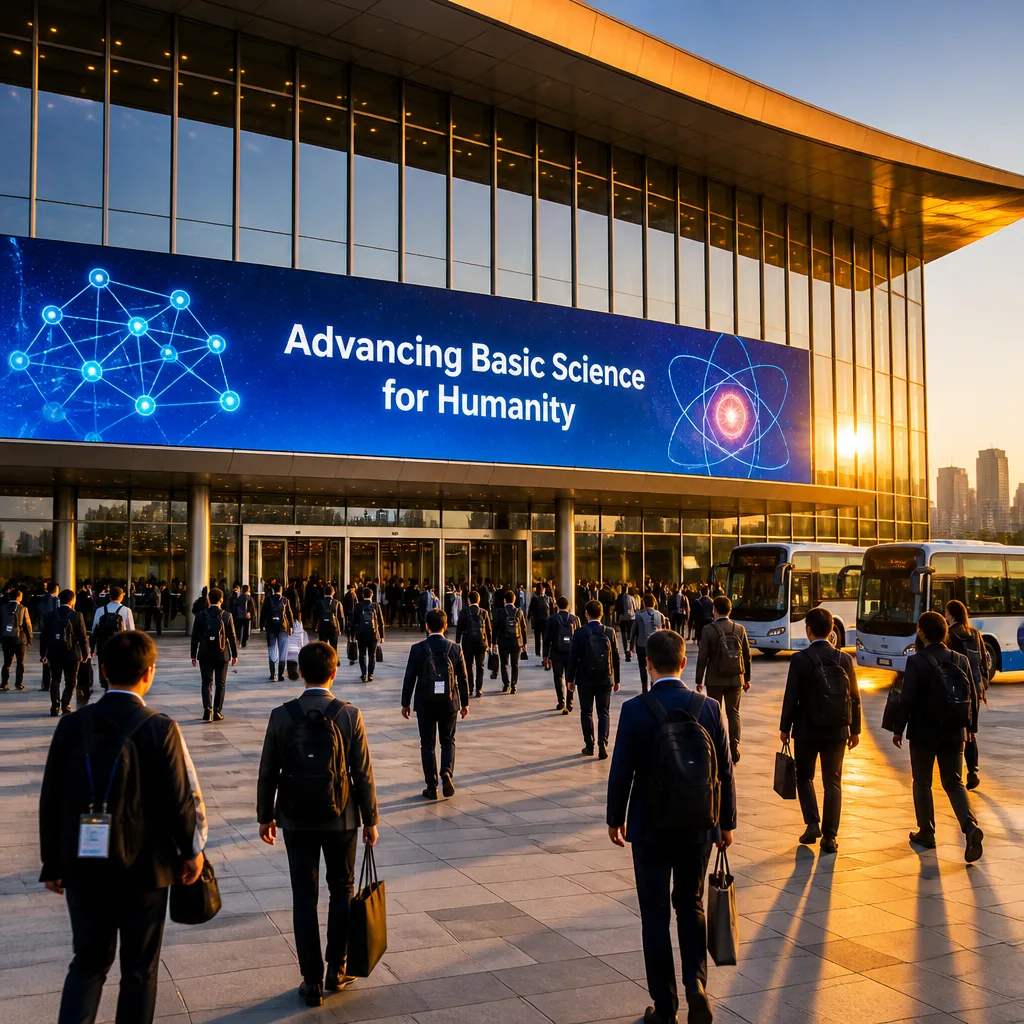
The 2026 International Congress of Basic Science (ICBS) opened in Beijing on Sunday, bringing together in excess of 1,000 participants for a two-week programme of lectures, high-level dialogues and outreach events.
Wide ranging programme aims to reconnect basic science with societal challenges
Organisers say the congress will run more than 500 academic sessions spanning traditional domains such as mathematics, physics and engineering alongside interdisciplinary and frontier subjects, among them generative large-model reasoning, computer vision, human–computer interaction and quantum information. The stated theme is
“Advancing Basic Science for Humanity”.
The meeting is designed to showcase recent breakthroughs and to stimulate collaborations across disciplines. A series of thematic, evening dialogues — billed as Mathematics Night, Physics Night and Engineering Night — will feature high-profile prize winners. The aim is to interpret frontier results for broader scientific communities and to discuss future research directions.
New forums and engagement for young and women scientists
The congress has added targeted activities intended to broaden participation in basic science. A newly launched Women Scientists Forum will host established female researchers to reflect on career pathways and the institutional challenges women face in research. Separate youth-focused events and university dialogues are scheduled to encourage early-career scholars to consider careers in foundational research.
One item on the programme, Tsinghua Day, will bring leading mathematicians and physicists to Tsinghua University to meet students and discuss routes into research. An outreach strand, Explore Huairou, will take international delegates to the Huairou Science City and surrounding facilities, providing a view of the local research ecosystem and innovation infrastructure.
AI and basic science: a forum for theory and application
Alongside subject-specific sessions, the organisers have planned a Basic Science and AI Forum to debate the theoretical bottlenecks and possible breakthrough paths in artificial intelligence, as well as implications for industry. This points to a growing interest among basic-science communities to interrogate the foundations of AI and to situate engineering advances within broader scientific frameworks.
Observers will be watching for whether such discussions clarify the open, theoretical questions underlying contemporary machine-learning systems — for example, why large models generalise, how reasoning emerges at scale, and what new mathematics or physics might be needed to secure future progress.
What it means for South African science
Large international gatherings like ICBS perform several practical functions for national research systems. They:
- Create networks between local researchers and leading international groups, which can lead to collaborations, exchanges and co-supervision of postgraduate students.
- Signal research priorities by spotlighting topics that attract prize winners and funding attention, potentially influencing national science strategies and university hiring.
- Provide inspiration and training for early-career scholars through direct contact with cutting-edge methods and ideas.
South African scientists attending events such as ICBS can return with fresh perspectives on how basic theory might feed applied work in areas important to the country, including computational methods for health, climate modelling and quantum technologies.
| Congress feature | Detail |
|---|---|
| Duration | Two weeks |
| Participants | More than 1,000 international and domestic attendees |
| Sessions | Over 500 academic sessions across disciplines |
| Notable strands | Mathematics Night, Physics Night, Engineering Night, Women Scientists Forum, Basic Science and AI Forum, Tsinghua Day |
As with any large congress, the long-term benefit depends on follow-through — new collaborations must be sustained, funding aligned, and opportunities for students and researchers in lower-resourced countries preserved. The ICBS provides a concentrated forum to discuss those practicalities as much as it does to celebrate achievement in basic science.