
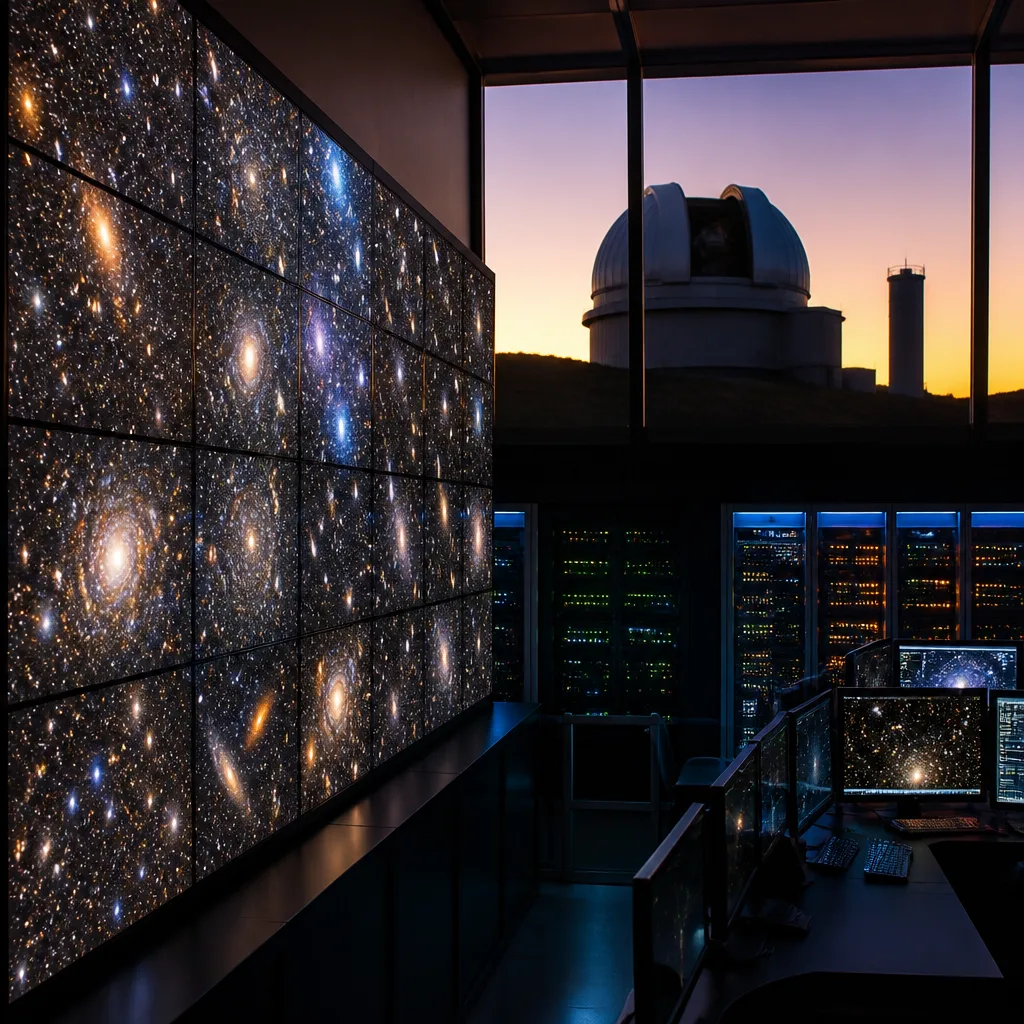
The DESI Legacy Imaging Surveys team has released the largest two‑dimensional map of the sky to date: a 5.6‑trillion‑pixel image that catalogues nearly four billion celestial objects and covers roughly 75% of the sky. Compiled over 13 years, the dataset will serve as the basis for the largest‑ever three‑dimensional map of the Universe used to probe dark energy and the large‑scale distribution of matter.
What the map contains and how it was made
The map brings together visible and near‑infrared imaging to produce a deep view of the extragalactic sky that is not obscured by the dust and stars of the Milky Way. Contributing facilities named in the release include two National Science Foundation (NSF) NOIRLab telescopes: the Mayall telescope and the Blanco telescope, the latter using the Department of Energy’s DECam instrument.
The assembled product is publicly accessible through the Legacy Survey Sky Viewer, enabling astronomers, students and citizen scientists to inspect objects and events across a vast area. The catalogue includes a wide range of sources — stars, galaxies, supernovae, gravitational lenses, black holes and even Solar System objects such as asteroids — and can be combined with other observations for follow‑up studies.
“It’s part of the fabric of astronomy research now,” said David Schlegel, co‑lead of the Legacy Surveys and scientist at Lawrence Berkeley National Laboratory. “When you're working with astronomical objects today, you often start by pulling up the Legacy Imaging Viewer to see what you’re looking at.”
Scientific value and context
The DESI Legacy Imaging Surveys maps have already underpinned a substantial body of research: the release notes that more than 1,800 science papers have referenced earlier Legacy Surveys data. The new, higher‑resolution and more complete 2D map will act as the imaging foundation for spectroscopic campaigns that build three‑dimensional maps — adding distance information to angular positions — which are essential to measure how galaxies cluster and how that clustering changes with cosmic time.
Two of the central uses highlighted are investigations of dark matter — the unseen mass that dominates galactic and cosmic structure — and dark energy, the phenomenon driving the accelerated expansion of the Universe. Researchers will also use the dataset to search for rare or transient phenomena such as gravitational lenses, which magnify distant galaxies, and supernovae, which fade over weeks and require repeated imaging to discover.
- Scope: ~75% of the sky in visible and near‑infrared light
- Size: 5.6‑trillion pixels
- Objects catalogued: nearly 4 billion
- Scientific legacy: >1,800 papers citing earlier survey releases
Access and reuse
The team has emphasised open access: the imagery and catalogues are available to all through the Legacy Survey Sky Viewer, which allows users to pan and zoom across the map and to extract catalogued positions and photometry for individual objects. Open datasets of this kind accelerate discovery because they remove barriers for researchers and for members of the public who want to explore the sky or contribute to citizen‑science projects.
Practically, the new map will be combined with spectroscopic surveys that measure the redshifts of galaxies — the shift of spectral lines to longer wavelengths as the Universe expands — to create the full three‑dimensional view needed to constrain cosmological models. The imaging also helps astronomers identify suitable targets for follow‑up with large telescopes.
Limitations and next steps
While the 2D map is extraordinarily detailed, it does not by itself provide distances to the catalogued sources. Converting the map into a full cosmological tool depends on complementary spectroscopic observations and on careful treatment of observational biases, such as the obscuration by the Milky Way and variations in image depth across the sky.
Nevertheless, the release represents a major community resource. By making a uniform, deep view of most of the sky freely available, the DESI Legacy Imaging Surveys team has strengthened the observational foundation for studies ranging from Solar System science to the largest scales of cosmology.
| Item | Value |
|---|---|
| Sky coverage | ~75% |
| Pixel count | 5.6 trillion |
| Catalogued objects | Nearly 4 billion |
| Referenced papers (prior releases) | >1,800 |
The survey continues to serve as a central reference for the astronomy community: for many projects today, researchers begin by consulting the Legacy Imaging Viewer to understand the appearance and context of objects before planning further observations.









